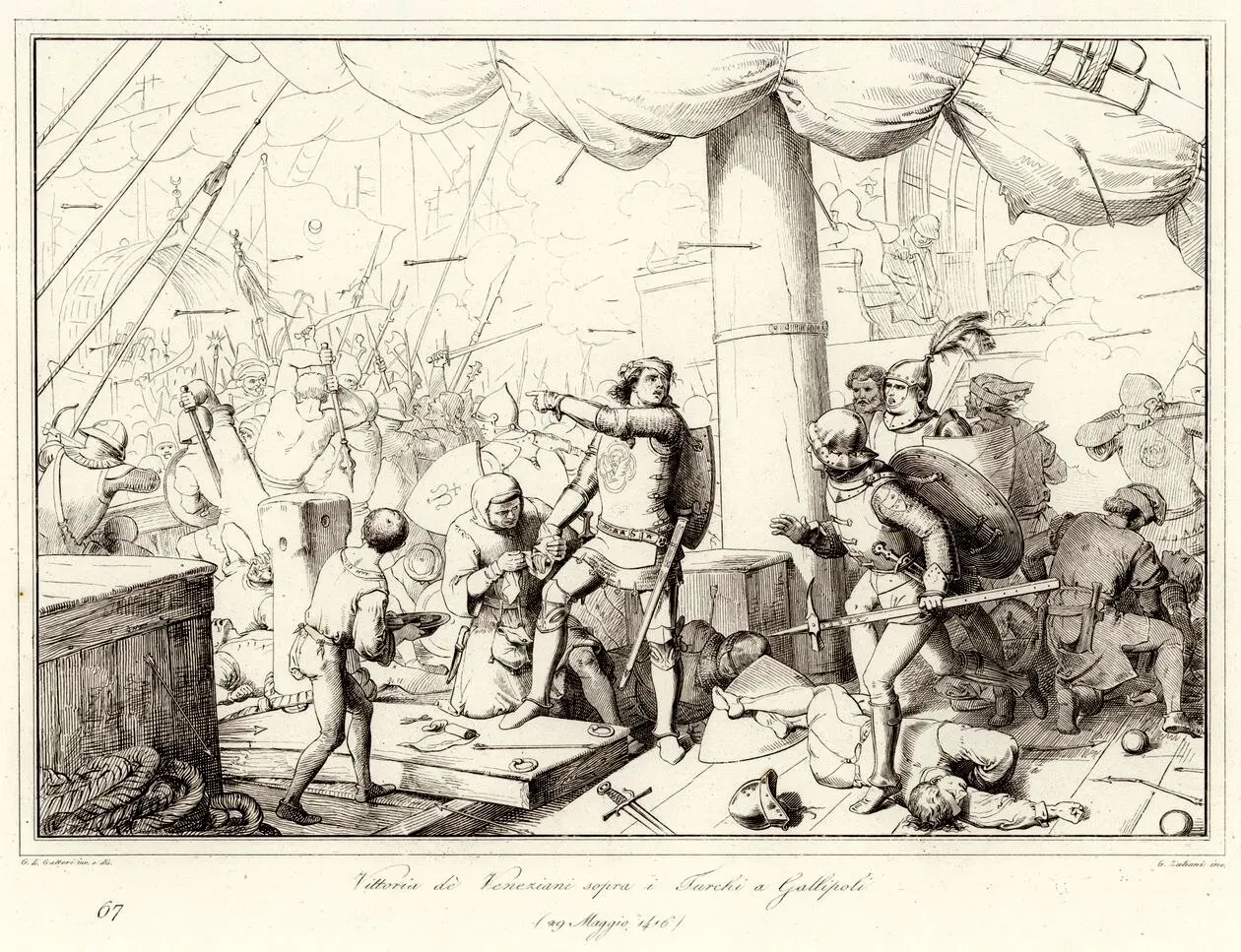
On 29 May 1416, the waters of the Dardanelles off Gallipoli witnessed a clash that was as much a cultural shock as it was a tactical masterpiece. Under the command of Captain-General Pietro Loredan, a Venetian fleet of just fifteen galleys smashed into a far larger Ottoman armada, turning the narrow strait into a floating slaughterhouse. By sunset, the Venetian banner of the Lion of Saint Mark flew undisputed over the Aegean, the Ottoman admiral Çali Bey was dead, and dozens of Turkish vessels were captured or sunk. It was a spectacular exhibition of Republican maritime discipline over raw, continental numbers. But as Loredan’s ships sailed home draped in captured silk and towing prize hulls, they had done far more than protect Venice’s mercantile spreadsheets—they had inadvertently awakened the giant that would eventually devour them.
To understand the necessity of this violent policing action, one must look at the shifting nature of the Eastern Mediterranean in the early fifteenth century. For centuries, Venice had treated the Aegean as its private lake, a profitable web of shipping lanes connecting the lagoons of the Adriatic to the lucrative markets of the Black Sea. But the rapid, terrifying rise of the Ottoman Empire on land was beginning to spill into the water. Though still primarily a land-based power, the young Sultan Mehmed I was beginning to sanction irregular maritime raids on Venetian merchantmen, disrupting the delicate flow of silk, grain, and spices. Frustrated by these irritants, the Venetian Senate dispatched Loredan not to conquer, but to negotiate—with explicit instructions to deliver a sharp, diplomatic ultimatum to the Sultan in Adrianople, and to strike only if those negotiations were met with steel.
I find the tactical confidence—and the profound strategic naivety—of the Venetian leadership in this moment far more telling than the actual exchange of cannon and arrow fire. Venice was operating under the comfortable delusion that naval supremacy was a permanent birthright, a commodity that could be bought, managed, and maintained like a cargo of wool. Pietro Loredan was a seasoned professional, a technocrat of the sea who understood the geometry of a galley clash, the precise timing of boarding actions, and the psychological impact of his heavy shipboard artillery. When the Ottoman fleet refused his diplomatic overtures and attacked, Loredan did not hesitate. He orchestrated a masterpiece of defensive maneuvering, drawing the disorganized Turkish vessels into a narrow space where their superior numbers became a chaotic liability, then crushing them with disciplined, coordinated boarding parties. But while Loredan was a brilliant tactical manager, he failed to see that he was playing a short-term game against an opponent with an infinite horizon.
The immediate aftermath of the battle was a grim testament to the high-stakes cruelty of medieval Mediterranean warfare. Having broken the Ottoman line, Loredan’s men engaged in a systematic slaughter, sparing only the Christian mercenaries who had served the Sultan—though even many of them were executed as traitors to the faith. The Venetian victory was absolute: they captured six great galleys and nine smaller galliots, asserting an immediate monopoly on the regional trade routes. For a brief moment, the Republic of St. Mark had proven that cash, professional crews, and superior ship design could reliably defeat a continental empire’s raw manpower.
This crushing humiliation at sea forced the Ottomans to do something they rarely did on land: compromise. In 1419, after three years of tense negotiations, Mehmed I signed a landmark maritime treaty with Venice. I find this document extraordinarily significant, as it represented one of the very first formal diplomatic treaties between the expanding, fiercely Islamic Ottoman state and a Christian European power. The treaty established mutual trade rules, returned captured prisoners, and formally recognized Venetian sovereignty over the Aegean islands in exchange for a modest tribute. On paper, it looked like a triumph of Venetian diplomacy, a validation of the Republic’s pragmatic, trade-first foreign policy. But in reality, it was merely a strategic pause.
The true historical legacy of Gallipoli was not the peace of 1419, but the violent wake-up call it delivered to the House of Osman. The Ottomans, whose genius lay in their ability to learn from their defeats, realized that they could never achieve their imperial ambitions so long as they were at the mercy of Italian sea captains. They did not retreat from the water; instead, they began a massive, state-sponsored modernization of their shipyards and naval schools. Within decades, the Ottoman navy would transform from a collection of clumsy, irregular raiders into a professional, state-directed juggernaut. The clash of 1416 was the opening salvo of a three-century-long naval arms race that would drain Venice’s treasury, strip her of her Aegean colonies one by one, and culminate in the loss of Constantinople, Rhodes, Cyprus, and Crete.
I look back at that May afternoon off Gallipoli and see the classic tragedy of the status quo power. Venice won the battle because it was more efficient, more professional, and more technologically advanced. But in winning, they taught their future executioner how to fight. We are always tempted to treat our competitive advantages as permanent shields, forgetting that the very act of demonstrating our superiority serves as a blueprint for our rivals. The Venetians sailed home in 1416 believing they had secured their trade routes for a generation. Instead, they had merely fired the starting gun on an arms race they could not possibly win in the long run. The sea, as the merchants of Venice would eventually learn at a terrible cost, belongs not to those who dominate it first, but to those who can afford to lose the most ships and keep coming back.