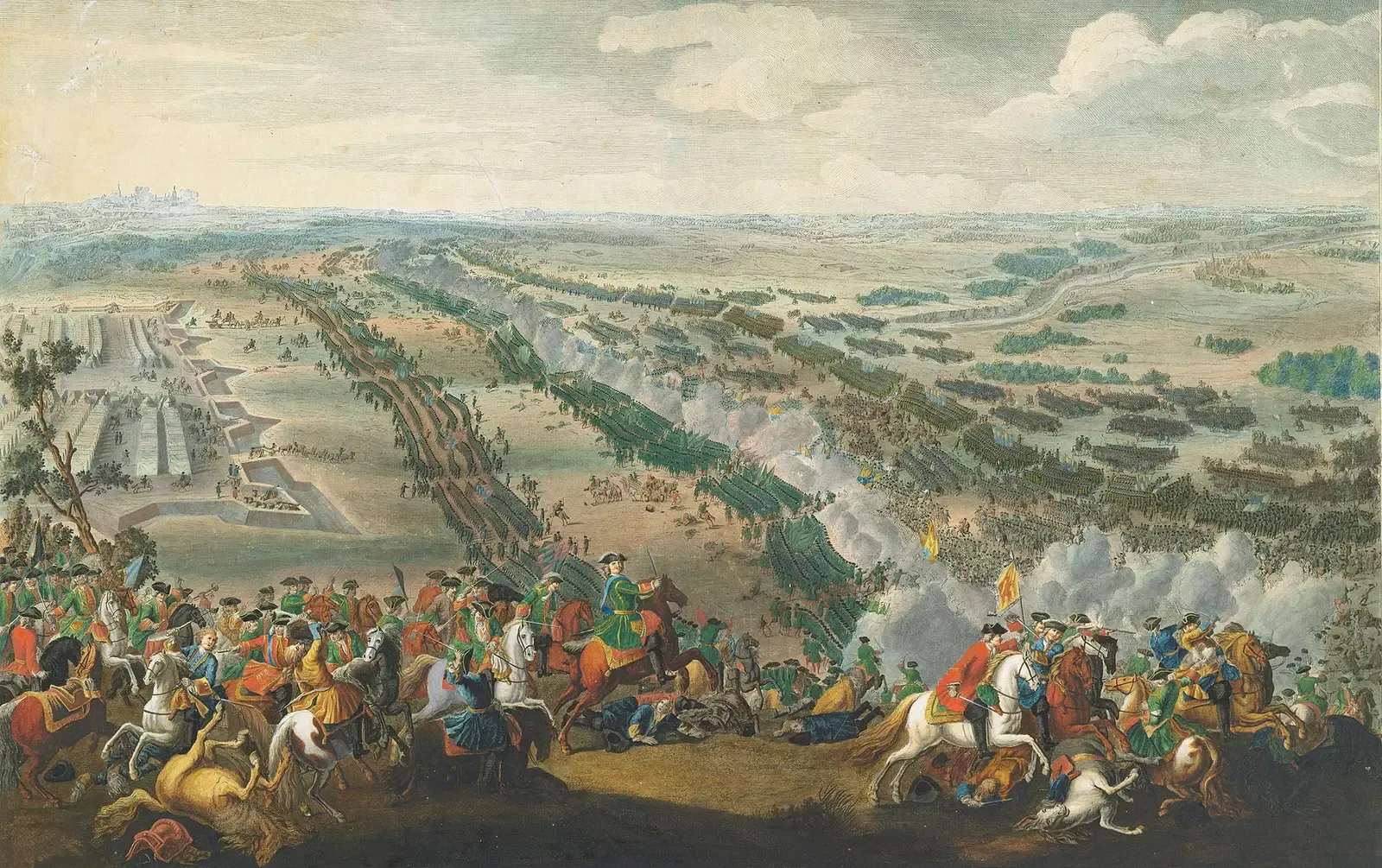
Charles XII of Sweden fought the Battle of Poltava from a litter carried between two horses. Ten days earlier a Russian bullet had shattered his heel, and by the morning of 8 July 1709 he could neither stand nor mount a horse. He had himself lifted onto a stretcher and carried into the line anyway, shouting orders as his bearers dodged fire, until a cannonball smashed the litter to pieces beneath him and his men had to improvise a new one from crossed pikes. It is the kind of detail that sounds invented for effect. It happened, and it tells you almost everything about how Sweden lost an empire in a single morning: a general who would not stop fighting, commanding an army that had already run out of road.
Nine years earlier, at Narva in 1700, Charles had done the opposite of losing. Nineteen years old and newly crowned, he took a force barely a third the size of the Russian army besieging the fortress, attacked in a blinding snowstorm, and routed it completely. Peter I of Russia had not even been present, having left the field days before to hurry reinforcements; the men he left behind surrendered en masse or drowned trying to flee across the river. Narva made Charles the most feared soldier in Europe and confirmed what everyone already suspected about Russia: a large, backward country with an army that dissolved on contact with anything trained and modern. Charles spent the next several years marching around Poland and Saxony, deposing kings and forcing peace treaties on his own terms, while Peter, denied a second shot at glory, did something less dramatic and far more dangerous. He rebuilt.
That rebuilding is the part the Narva story leaves out and Poltava makes impossible to ignore. Peter had lost his artillery train at Narva down to the last gun, so he had church bells melted down and recast as cannon. He restructured the army along Western lines, brought in foreign officers to drill it, and kept fighting smaller, unglamorous campaigns along the Baltic coast while Charles was occupied elsewhere - campaigns that gave Peter’s soldiers something Narva-era Russia had never had: officers who had actually won something. In 1703 he founded Saint Petersburg on marshland he had just taken from Sweden, a fortress-city built as a statement that he intended to keep what he had captured. Charles, fixated on the Polish and Saxon theatres, let him.
By 1708 Charles judged the time right to finish the job and marched on Moscow itself, at the head of an army that had never lost a major battle under his command. Russia refused to give him the battle he wanted. Peter’s forces burned crops and villages ahead of the Swedish advance, harassed the supply columns, and let the distances and the winter do the damage no Russian regiment had managed on its own. The winter of 1708 to 1709 was one of the coldest of the century; Swedish accounts describe birds freezing in mid-air and thousands of men lost to frostbite and starvation before a shot was fired at Poltava. Charles diverted south into Ukraine chasing supplies and the support of the Cossack hetman Ivan Mazepa, who had turned against Peter, but Mazepa arrived with a few thousand men rather than the tens of thousands he had promised. The army that reached Poltava was a fraction of the force that had left Sweden, worn down by a campaign that had never gone the way its commander planned.
The siege of Poltava itself, which Charles had begun in the spring, was almost incidental to what happened next. Peter arrived with a relief army roughly twice the size of the besiegers, fortified his approach with a system of redoubts, and waited for the Swedes to come to him. Charles, wounded and unable to lead from the front, handed operational command to Field Marshal Rehnskiöld, and the coordination that had made Swedish infantry so lethal under Charles’s personal direction did not survive the handoff. The Swedish columns lost contact with each other advancing through the redoubts, took heavy losses from Russian artillery they had no answer for, and by the time the main battle lines met in the open, the Swedish army had already been fought down to a force that Peter’s numbers and guns simply overwhelmed. The rout that followed cost Sweden most of its infantry killed or captured. What remained of the army surrendered days later at Perevolochna, on the banks of the Dnieper, having failed even to secure enough boats to get its own commander across the river in time.
Charles escaped south into Ottoman territory with a few hundred men and spent the next five years there, alternately a guest and a prisoner of a sultan who found him useful for provoking Russia and eventually inconvenient enough to arrest. Mazepa died in exile within months. The Cossack autonomy he had gambled everything on trying to preserve did not survive his betrayal; Peter razed the Cossack capital at Baturyn in retaliation and spent the following decade tightening Russian control over Ukraine in ways the Cossacks never fully reversed. Sweden fought on without its king for years, losing the Baltic provinces piecemeal, until Charles finally returned home in 1714 to a kingdom stripped of most of what had made it an empire.
What Poltava changed cannot be measured only in territory, though the territory mattered: Peter secured Livonia, Estonia, and Ingria, which meant he secured Saint Petersburg, which meant the window to the west he had spent a decade building was no longer a fortress on contested ground but the settled capital of an emerging empire. It can be measured better in how the rest of Europe adjusted its arithmetic. Before 1709, no serious European calculation ran through Moscow. After it, none of the major settlements of the following century - the partitions of Poland, the alliances against Napoleon, the entire architecture of nineteenth-century diplomacy - could be made without asking what Russia wanted. Peter declared Russia an empire in 1721, once the war was formally over, but the declaration was paperwork. The fact of it had been settled twelve years earlier, on a battlefield outside a Ukrainian fortress, by an army built from melted-down church bells against a general who had to be carried into his last real fight on a broken litter.
Sweden never got its empire back. It kept its independence, its institutions, and eventually built one of the more durable neutral states in Europe, but the stormaktstid - the age of Swedish great-power status that Gustavus Adolphus had built and Charles XII inherited - ended at Poltava and stayed ended. Charles spent his remaining years trying to reverse the arithmetic through sheer persistence, invading Norway in 1718 in search of some new leverage, and died there in the trenches outside Fredriksten, shot through the head under circumstances still disputed three centuries later. He never accepted that the war was over. History accepted it for him, on the morning a Russian tsar who had once fled a defeat at Narva finally got the battle he had spent nine years preparing to win.