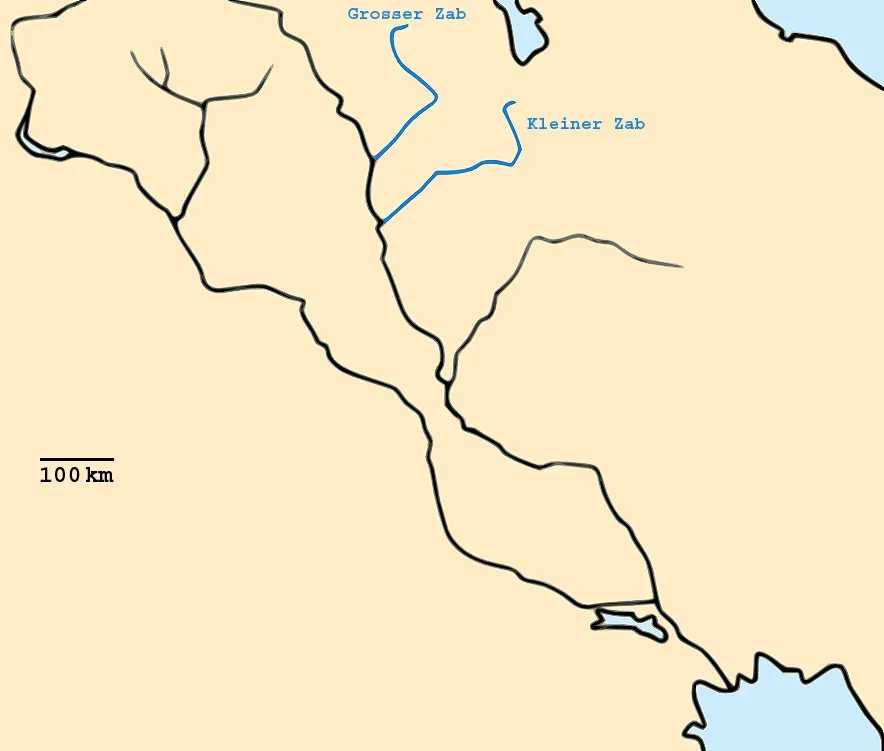
The dynasty that had ruled the Islamic world for nearly ninety years ended on the banks of the Great Zab river on 25 January 750. The Umayyad Caliphate’s last real army, commanded by Caliph Marwan II himself, broke against an Abbasid spear-wall and dissolved in a rout from which its soldiers never recovered. What followed was not merely a change of dynasty. The Abbasids had campaigned under black banners and they intended to be thorough.
Within months of the battle, nearly every male member of the Umayyad family was dead. The new caliph’s uncle, Abdullah ibn Ali, organised the killings systematically: family members rounded up across Syria and Palestine, executed in batches, their bodies thrown into mass graves. One account - consistent enough across the sources to be taken seriously, dramatic enough to have been embellished in the telling - describes a banquet held for surviving Umayyad princes under the pretence of reconciliation, at which soldiers entered before the meal was finished. The guests did not leave. Leather mats were reportedly spread over the dying so the feast could continue undisturbed.
One young man was not at the banquet. Abd al-Rahman, grandson of a caliph and twenty years old in the year of the battle, had been north of Damascus when the Abbasid forces arrived. He and his younger brother fled east. At the bank of the Euphrates, Abbasid horsemen caught up with them. The soldiers called across the water. They called out guarantees of safe conduct. The brother, who had only swum partway across, turned back. Abd al-Rahman, who had made it further and was not willing to believe in Abbasid promises, kept going. His brother was killed on the bank. Abd al-Rahman reached the other side and disappeared into the desert.
What had brought the Abbasids to this moment had been building for decades. The Umayyad Caliphate, established in 661 after the killing of Ali ibn Abi Talib, had governed the Islamic world from Damascus as a predominantly Arab enterprise. Non-Arab Muslims - Persians, Berbers, converts across the conquered territories - had been accepted into the faith while being largely excluded from political and military power, often still expected to pay the jizya tax historically levied on non-Muslims even after conversion. This resentment was fertile ground, and the Abbasids, claiming descent from Muhammad’s uncle al-Abbas, cultivated it expertly. Their revolt began in Khorasan - the eastern province covering modern Iran and Central Asia - in 747, under a general known as Abu Muslim whose origins are still debated by historians and whose ruthlessness is not. Within three years, he had swept west across Persia and into Iraq.
The Abbasids marched under black banners. The colour was deliberate. Islamic tradition had preserved prophecies of an army coming from the east under dark standards that would usher in a new age; the Abbasids invoked this consciously. Black robes, black flags, black everything: the imagery of religious transformation, not merely a political coup. It was excellent propaganda, and it worked well enough that Arab tribal loyalties that should have held for the Umayyads did not hold. The caliph’s army collapsed in the east before it could be properly assembled.
At the Zab, Marwan II faced Abdullah ibn Ali across a river in what is now northern Iraq. The Umayyad cavalry attempted to break the Abbasid lines the way Arab cavalry had been breaking lines since the conquests of the seventh century. The Abbasid infantry held a spear-wall and did not move. The charges failed. When the Umayyad cohesion fractured, the retreat became a rout and the rout became a disaster from which no rally was possible. Marwan II fled north to Mosul, then to Syria, then to Egypt, where Abbasid pursuers caught him in August 750 at a village in the Fayyum. He died fighting. His head was sent to the new caliph in Iraq.
The new caliph was Abu al-Abbas al-Saffah. Al-Saffah means, in Arabic, “the blood-shedder.” He had taken the name himself.
Abd al-Rahman spent five years as a fugitive. He crossed North Africa from east to west, sheltering among his mother’s Berber tribe in the Maghreb, keeping distance from anyone with Abbasid connections. When he crossed the Strait of Gibraltar in 755 or 756, he was entering a land that was Muslim but politically fragmented, its Arab governors at each other’s throats. He spent a year building alliances among Syrian Arab families who had settled in Iberia and who had no great love for the Abbasid east. In 756, he defeated the sitting governor at the Battle of Musara and entered Córdoba. He was twenty-six years old and had been a fugitive since twenty. He declared himself emir, independent of Baghdad, and ruled for thirty-two years. The dynasty he founded would govern Al-Andalus for two and a half centuries.
The Abbasids, for their part, built Baghdad. Founded in 762, twelve years after the Zab, the new capital sat on the Tigris at the intersection of the Persian and Arab worlds rather than in the Syrian desert where the Umayyads had been comfortable. Persian administrators - the Barmakid family most prominently - ran the bureaucracy. Persian and Greek scholars translated ancient texts into Arabic. The House of Wisdom that Hulegu Khan would one day destroy was an Abbasid institution, built on the premise that the caliphate’s intellectual resources should draw on everyone within it. The change of dynasty had been violent beyond ordinary measure. What it produced, across the following century, was the Islamic Golden Age.
The Umayyads have their defenders. By the standards of eighth-century empire, their administration was not notably worse than its contemporaries, and the Arab empire they assembled - stretching from Iberia to Central Asia in under a century - was an extraordinary military and organisational achievement. But their political model, Arab supremacy dressed in Islamic legitimacy, could not survive the reality of an empire with tens of millions of non-Arab subjects who had accepted the faith and expected something in return. The Abbasids understood this and replaced the ideology, not just the caliph.
The twenty-year-old who swam the Euphrates in 750 understood it differently. He had no interest in ideological change - he wanted his dynasty back and he never got it. What he built instead, in Spain, was something the Abbasids could not quite reach: a Córdoba that would eventually house half a million people, a court where Christian and Jewish scholars worked alongside Muslim ones, a library that rivalled anything Baghdad could offer. He called himself “the Immigrant” and “the Falcon of the Quraysh.” The argument he had lost on the banks of the Zab - about who should rule the Islamic world - he lost definitively and permanently. The argument about what Islamic civilisation could become when it was not under siege, he won in the one place the black banners never flew.