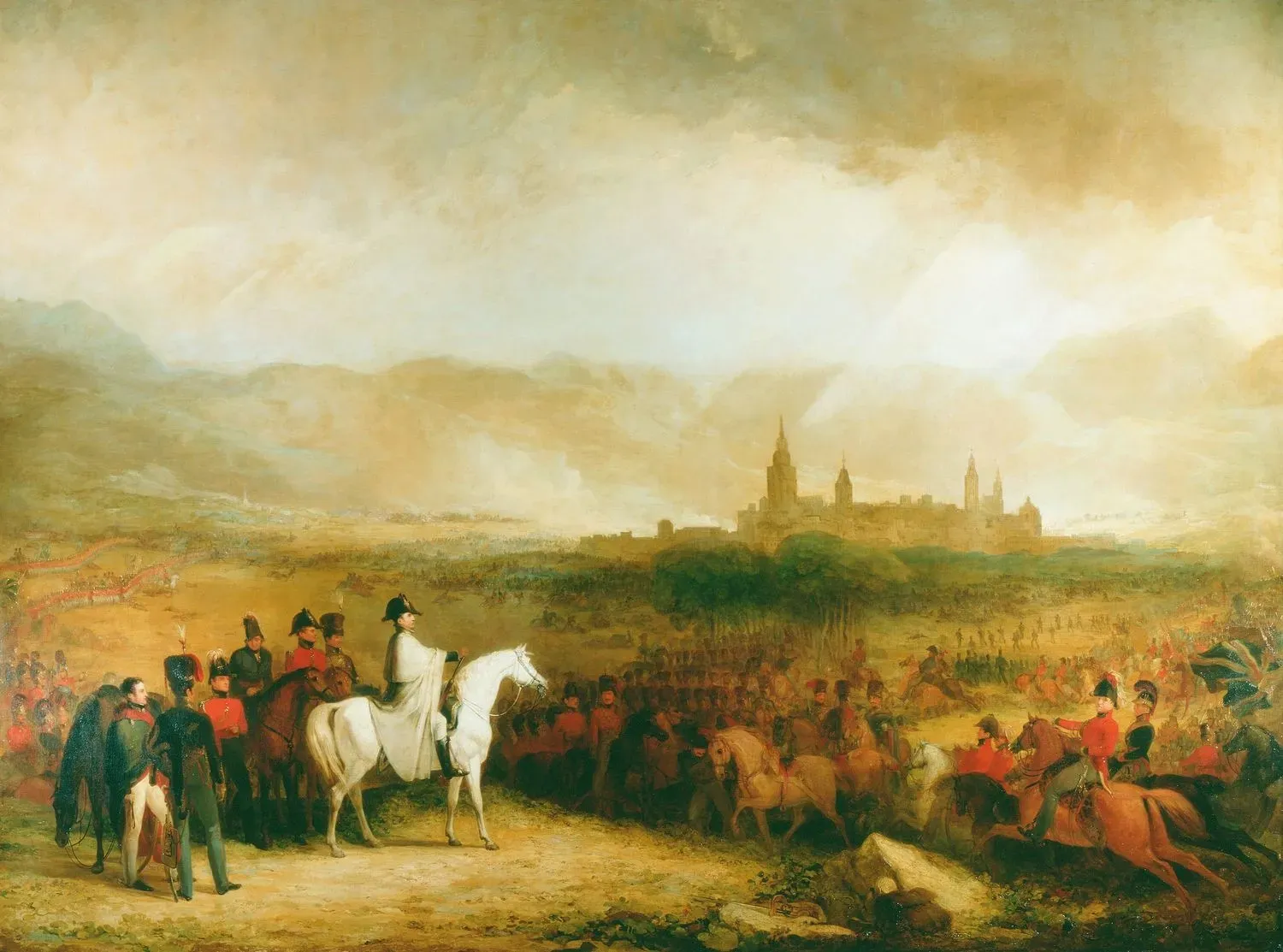
The road north from Vitoria to Pamplona on the evening of 21 June 1813 was covered in treasure. Boxes of gold coins split open in the mud. Diplomatic correspondence fluttered from overturned wagons. Paintings by Velázquez, Rubens, and Correggio lay propped against wheels or abandoned face-down in the dirt. Among the wreckage was the personal property of King Joseph Napoleon of Spain: his carriage, his silver plate, his brother’s correspondence, a good portion of the Spanish royal collection. The 14th Light Dragoons stopped his coach on the road; Joseph himself escaped on horseback by a narrow margin, but his dignity did not make it out. The King of Spain - the king Napoleon had invented for the occasion - fled into France with what he could carry and never came back.
That pile of abandoned property on the Pamplona road is the clearest summary of what Wellington accomplished at Vitoria: not merely a battlefield victory, but the physical demonstration that the French empire in Spain had collapsed. The battle took roughly seven hours. The occupation it ended had lasted six years.
The Peninsular War had begun in 1808 when Napoleon, impatient with the dysfunction of the Spanish Bourbon monarchy, engineered the abdication of Charles IV and his son Ferdinand, installed Joseph on the throne, and expected the Spanish to accept it. They did not. The uprising that followed - the Dos de Mayo in Madrid, the guerrilla campaign that gave the word “guerrilla” to European languages, the regular armies that kept reconstituting no matter how many times they were beaten - tied down French forces on a scale Napoleon consistently underestimated. At its peak, France had over 350,000 soldiers in the peninsula. They were fed into the ground by a country that refused to conclude the conflict on French terms.
Wellington’s British and Portuguese army was the spine of organised resistance. He had landed in Portugal in 1808, fought cautiously through years of campaign, and by 1813 had ground the French back from the Atlantic coast to the Ebro. His forces had grown from roughly 30,000 to something closer to 80,000 - British, Portuguese, and Spanish - whose logistics he had spent five years building into something capable of sustained offensive operations in difficult country. He had learned to fight a war that could not afford a decisive defeat, which is a harder discipline than it sounds.
The design of the battle at Vitoria was not that Wellington attacked. It was how he attacked. Joseph and his field commander Marshal Jourdan had positioned the French army along the River Zadorra west of the city, anchoring a defensive line with the road to France running north through the mountains behind them. Wellington did not push straight at this. He sent his columns in multiple arcs: the main body along the central road, a northern column under General Graham to cut the escape route before the battle was decided, other divisions ordered to cross the Zadorra at fords the French had left unguarded out of miscalculation or insufficient numbers. The plan required coordination across broken ground with limited communication. It worked because French intelligence was poor and because Wellington had spent years drilling his subordinates to act on initiative rather than wait for instructions that might arrive too late.
The French position came apart in the early afternoon. Graham’s column cut the main road north before Joseph realised it was under threat. The centre broke under pressure from multiple crossing points simultaneously. By mid-afternoon the French were not retreating in order - they were dissolving. Roughly 57,000 soldiers trying to use a single secondary track through the mountains, while British cavalry pursued and infantry closed from three directions. The treasure wagons, the court carriages, the artillery train: none of it could move fast enough. The French abandoned 151 of their 153 guns on the field. An army that arrived at Vitoria as a functioning force left it as a crowd.
Wellington’s men did not distinguish themselves in the pursuit. The quantity of abandoned loot was so large that significant portions of the infantry broke off to plunder rather than press the retreating French. Soldiers found cases of gold coin, trunks of Spanish royal plate, casks of wine. Wellington, who needed to chase a broken army and instead watched his men turn into a foraging party, was furious. His letter home described them as “the scum of the earth” who had “enlisted for drink” - an assessment that may have been harsh given that they had just destroyed a French army in a single afternoon, but which reflected genuine frustration at watching annihilation settle for rout.
Among the things that did not escape: Jourdan’s marshal’s baton. Wellington sent it to the Prince Regent in London. The Prince Regent responded by making Wellington a Field Marshal and sending him a British baton in return. It remains the most formally reciprocated piece of war loot in the correspondence of that period.
The political consequences ran fast. Joseph’s departure removed the operational rationale for continued French presence in Spain. The argument that the army would eventually restore order had died on the Pamplona road along with most of the artillery. Ferdinand VII remained in French captivity until April 1814, when Napoleon’s abdication made further leverage pointless, but the Spanish regency at Cadiz had been governing in his name since 1810 and continued to do so without French permission or interference.
In Vienna, Beethoven received the news and composed Wellington’s Victory - Opus 91 - for mechanical orchestra. It is one of the noisiest things he wrote, structured around cannon fire and the contrasting national anthems of the opposing armies. The musical press loved it. Beethoven later described it with some embarrassment as a piece written “below his dignity.” He was correct, but it raised considerable money for soldiers wounded at Hanau, and the first performance - conducted by Beethoven himself - featured Salieri among the players.
What mattered for the war was that Wellington could now cross the Pyrenees into France. By October 1813 he was fighting on French soil. By November he was outside Bayonne. The Sixth Coalition was pressing from the east simultaneously, having beaten Napoleon at Leipzig in October - the Battle of Nations that cost him 60,000 men in three days and the loyalty of most of his German clients. Wellington’s southern army was a second front the French had no mechanism to close.
Napoleon abdicated in April 1814. The proximate cause was the Coalition armies entering Paris. But the logic that made Paris indefensible had been assembling since Vitoria, since the afternoon a British infantry column crossed an unguarded ford on the Zadorra and Joseph’s court fled north and left their treasure in the road.
The road from Vitoria ran all the way to Fontainebleau.