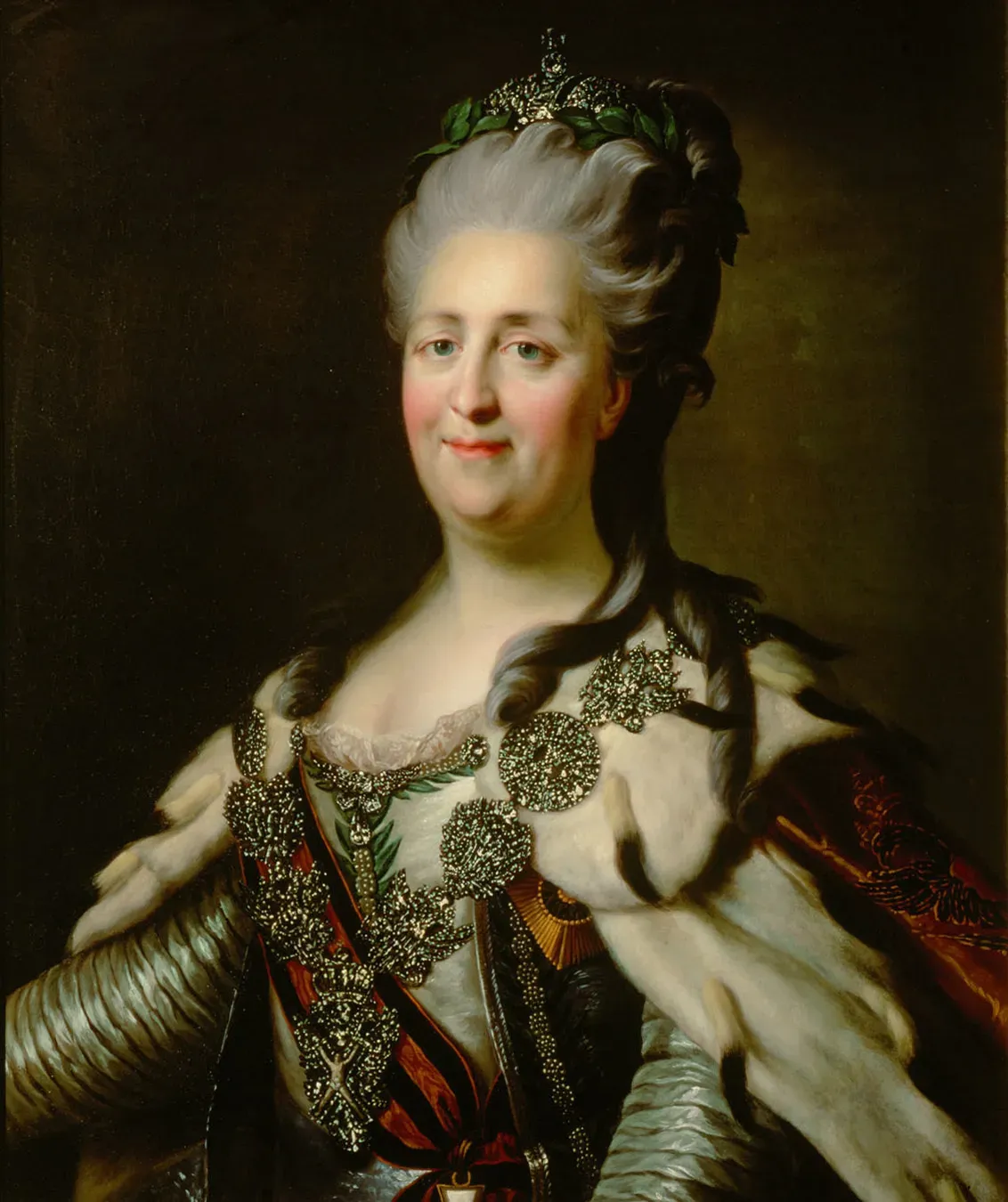
On the afternoon of 9 July 1762, Catherine, Grand Duchess of Russia, pulled on a green uniform borrowed from a captain of the Semyonovsky Life Guards and mounted a horse at the head of some fourteen thousand soldiers. She had no sword knot and no plume for her hat; a young Guards officer galloped up alongside and supplied both. She was riding for Peterhof, to find her husband, Emperor Peter III, and take from him the only throne he would ever hold. By nightfall he had signed the document that gave it up, without a shot fired on either side, and the German princess who had arrived in Russia seventeen years earlier to marry a man she once called “detestable” began a reign that would run for thirty-four years and be remembered as Russia’s golden age.
She had been born Sophie Augusta Frederica of Anhalt-Zerbst, and she met her second cousin, the future Peter III, in 1739, when she was ten. She wrote later that she found him instantly repellent - his fondness for drink, his pale complexion - and that she kept to one end of the castle while he stayed at the other. Six years on, aged sixteen, she travelled to Russia anyway, converted to Orthodoxy, took the name Catherine, and married him at the Empress Elizabeth’s insistence, because Elizabeth needed an heir for her nephew and cared little what either of the young people thought about it. The marriage went unconsummated for years, which Catherine put down to Peter’s own immaturity: he preferred drilling toy soldiers and reading accounts of criminals broken on the wheel to spending time with his wife. Elizabeth eventually got her heir, Paul, born in 1754, though the paternity was disputed even then. Whatever regard had once existed between the couple had curdled long before Elizabeth died.
Elizabeth died on 5 January 1762, and Peter inherited a throne he had no talent for holding. Russia had spent the previous six years fighting Prussia in the Seven Years’ War, at a cost that included the Russian occupation of Berlin in 1761. Peter, who idolised Frederick the Great, ended the war within weeks of his accession and handed back every Prussian territory Russian soldiers had bled for, without asking for anything in return. He then began preparing a new war against Denmark, to recover Schleswig for his home duchy of Holstein - a fight that mattered to Peter personally and to nobody else in Russia. He ordered the Guards regiments that had just finished fighting Frederick to prepare to march and die for a Danish campaign fought in the interests of a German duchy most of them had never heard of. Officers who had spent six years in Frederick’s crosshairs were now expected to die for Peter’s, and they noticed the difference.
Catherine had spent those same years building the alliances Peter was busy discarding. She had been the lover of Grigory Orlov, a Guards officer wounded three times at the Battle of Zorndorf in 1758, since 1760, and by April 1762 the two had a son together, kept quiet from the court. Orlov and his four brothers spent months working the Guards barracks, using Grigory’s post as an army paymaster to grease the argument with cash where charm alone did not do the job. Princess Ekaterina Dashkova recruited among the nobility. The former chancellor Alexei Bestuzhev-Ryumin and the diplomat Nikita Panin lent their names and their connections. None of it needed to stay especially secret, because the grievance behind it - Peter’s contempt for the Guards, for the church, for the war he had just abandoned - was already common knowledge in every barracks in the capital.
The conspirators had not fixed a date, and might have waited longer, if Peter had not forced their hand. On 27 June, a lieutenant named Passek, one of Catherine’s co-conspirators, was arrested after a loose word about the emperor. Fearing that torture would produce every name in the plot within hours, Alexei Orlov - Grigory’s brother, built like a soldier and nicknamed “Scarface” for a duelling wound - rode through the night to Peterhof, woke Catherine, and told her the time had come for her to reign. She dressed and rode back to St Petersburg with him before dawn. At the barracks of the Izmailovsky Regiment she made a short speech asking the soldiers to protect her from her husband; they swore allegiance on the spot and, by her own account, rushed to kiss her hands and the hem of her dress. The Semyonovsky Regiment followed within the hour. The Preobrazhensky Regiment hesitated under its commander, a brother of Peter’s own mistress, then came over anyway, begging forgiveness for being last. By mid-morning the clergy at Kazan Cathedral had proclaimed her sovereign, and officials at the Winter Palace were queuing to swear an oath to an empress who, twelve hours earlier, had been a grand duchess with no formal power at all.
That was the moment she called for the borrowed uniform. Hers came from Captain Talyzin of the Semyonovsky Guards; Princess Dashkova, riding beside her, wore one lent by a Lieutenant Pushkin, the two officers chosen chiefly for being roughly the right height. Word of the coup reached Peter at Oranienbaum before Catherine’s column did. An elderly field marshal advising him, Burkhard von Münnich, urged him to make for the naval fortress at Kronstadt and rally loyal forces there. Peter took a boat to the island, arrived after dark, and was warned that if he tried to land, the garrison’s guns would open fire - the fortress had already declared for Catherine. He turned back to Oranienbaum, reportedly in tears, and had nothing left to do but wait for the wife he had spent seventeen years disregarding to arrive and decide what became of him.
She dictated the abdication terms herself once she reached Peterhof: a short statement of his own incapacity to rule, in exchange for a peaceful retirement. Orlov carried it to Oranienbaum, and Peter signed without argument. He was stripped of his sword and his uniform, told he would be confined at the country estate of Ropsha rather than granted any exile abroad, and placed in Alexei Orlov’s custody for the journey there. Six years of imagining himself Frederick the Great’s Russian counterpart ended with a man in his shirtsleeves, signing away an empire in someone else’s handwriting.
Peter lasted eight days at Ropsha. The official account, issued after an autopsy, blamed a haemorrhoidal colic complicated by a stroke - an explanation that convinced almost nobody at the time and fewer historians since. Alexei Orlov’s own letter to Catherine reporting the death pointed instead to a drunken brawl that got out of hand. Whether Catherine ordered the killing, tolerated it, or simply asked no questions once it was reported to her, she punished no one for it. Peter III was buried without the ceremony due an emperor, in a monastery rather than beside his Romanov predecessors, and Catherine did not attend.
She was crowned properly in Moscow that September, in a ceremony that produced the Great Imperial Crown still kept in the Kremlin Armoury, and she went on ruling for thirty-four years - pushing the empire to the Black Sea, partitioning Poland, founding cities, and building the reputation as an enlightened sovereign that her husband, given the same six months anyone else got, could not manage in half a year. Historians still argue over whether to call her a usurper or a regent standing in for her infant son; she settled the argument herself two years later, having a rival claimant to the throne, the long-imprisoned Ivan VI, killed the moment anyone tried to free him. The girl who once found her betrothed detestable at the age of ten spent one afternoon in a soldier’s borrowed coat and wore an empress’s crown for the rest of her life.