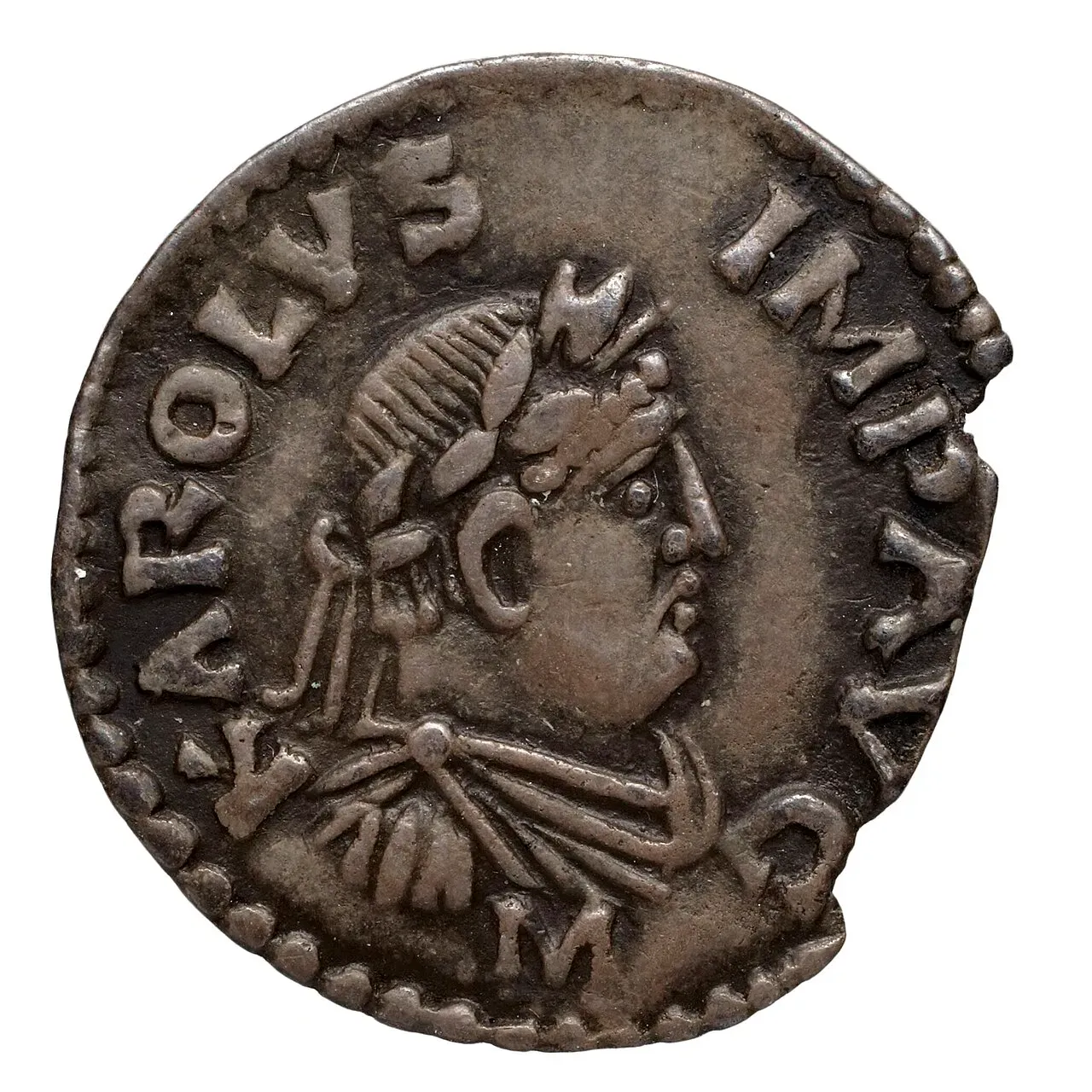
Born on 2nd April 747 - or thereabouts; the year may actually have been 748, and Frankish record-keepers did not treat birth dates as a priority - Charlemagne is one of those figures whose actual biography disappears quickly beneath the legend. He is called the Father of Europe, the architect of Western medieval civilisation, the man who stitched together the frayed remnants of the Roman West into something coherent. That reputation is substantially earned. It is also, in some ways, the wrong lesson to draw from his life.
He inherited the Frankish kingdom from his father Pepin III in 768 and spent the next three decades making it unrecognisable. Through more than fifty military campaigns he extended Frankish control from the Atlantic coast to the Elbe, from the North Sea to central Italy. The Lombards of northern Italy he defeated in a single campaign in 773-774, took their crown, and never went back. The Saxons he fought for thirty-two consecutive years.
The Christmas Day coronation in 800 is where most accounts become reverent. Pope Leo III placed the imperial crown on Charlemagne’s head in St Peter’s Basilica, reviving the title of Emperor of the Romans in the West for the first time since the fifth century. His biographer Einhard claimed the emperor was surprised and displeased by the ceremony. This is almost certainly diplomatic theatre; the preparations had been months in the making. What the coronation actually did was stake a symbolic claim that would define European politics for a millennium: that secular rulers needed papal validation, and that the Pope had the authority to dispense or withhold it. That arrangement would eventually produce the Investiture Controversy, the Crusades, and Henry IV standing barefoot in the snow at Canossa. It was not a small ceremony.
His administrative system was serious work. He divided the empire into roughly 300 counties and then - recognising that local administrators with local loyalties are never entirely reliable - created the missi dominici: pairs of royal representatives who travelled the empire in circuits, auditing counts’ governance, hearing appeals, and reporting back to court. The system was imperfect and did not outlast him, but it was a genuine attempt to govern five million square kilometres from a single centre.
The cultural programme known as the Carolingian Renaissance is sometimes presented as an intellectual golden age. That is too generous. What Charlemagne built was infrastructure. He imported scholars - Alcuin of York, Paul the Deacon, Theodulf of Orléans - and set them to work standardising Latin literacy, establishing cathedral and monastic schools, and developing the clear consistent script known as Carolingian minuscule, the direct ancestor of the typeface you are reading now. Charlemagne himself, according to Einhard, could read but never learned to write properly despite practising throughout his adult life, keeping tablets under his pillow to work on the letters in the dark. He built a school without ever being a scholar. The intellectual tradition that eventually flowered in the High Middle Ages was built partly on the infrastructure he laid.
The Saxon Wars require honest accounting. The conflict ran from 772 to 804 and involved repeated campaigns against Germanic tribes who were pagan, fiercely independent, and persistently rebellious. In 782, after a Saxon uprising killed a Frankish force at the Süntel Hills, Charlemagne had approximately 4,500 Saxon prisoners executed in a single day at Verden. He then issued the Capitulatio de partibus Saxoniae, making apostasy, refusal of baptism, and the practice of pagan rites capital offences. The conversion that followed was real, in the sense that Saxony was Christian and Frankish by 804. The Father of Europe was not gentle about the paternity.
He died in January 814 at his palace in Aachen, from pleurisy. He left the empire to his son Louis the Pious. Louis left it to his three sons, who spent the next decade fighting each other for it. The Treaty of Verdun in 843 divided the Carolingian Empire into three: West Francia, East Francia, and a central strip that neither side ever stopped disputing. West Francia became France. East Francia became Germany. The strip between them - Lorraine, later Alsace-Lorraine - became a recurring fracture point in European history, contested in 1870, 1914, and 1940. The unity Charlemagne built lasted one generation past his death.
What survived was the institutional skeleton: the ecclesiastical structures, the educational network, the administrative vocabulary, and the imperial title itself, which would persist as the Holy Roman Empire until Napoleon dissolved it in 1806. The Carolingian script became the basis of every Western typeface. And the map he drew - in its broad division between a western Romance-language zone and an eastern Germanic one - is still legible in Europe today.
“Father of Europe” was coined by a ninth-century chronicler, not by Charlemagne himself. It is accurate and misleading in equal measure. He created the conditions in which something called Europe could eventually form, and he created the specific fault lines along which it would fracture for the next twelve centuries. The children of difficult fathers understand the feeling.