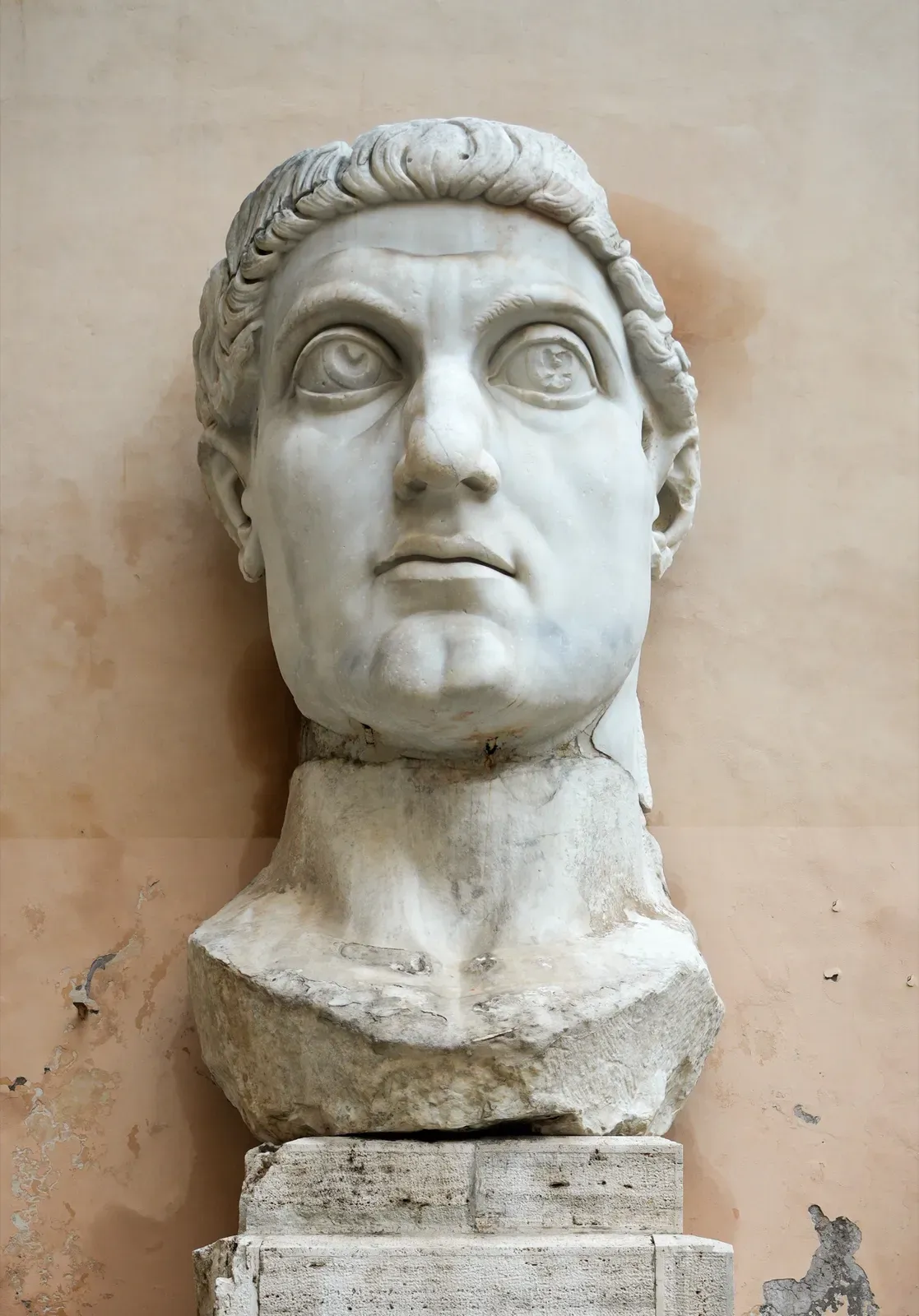
The man who presided over the meeting that defined Christian orthodoxy was not a baptised Christian. Constantine had been emperor since 306, had extended legal toleration to Christians across the empire with the Edict of Milan in 313, had written to bishops urging them to resolve their theological disputes peacefully, and had personally summoned the council at Nicaea to impose that resolution. He was baptised - by an Arian bishop, as it happens - on his deathbed in 337. The man who decided what Christians should believe about the nature of Christ spent his life keeping the question open.
This tells you something important about what the First Council of Nicaea actually was. It was not primarily a theological exercise. It was an exercise in imperial management.
The dispute Constantine needed to resolve was, on the surface, narrow to the point of absurdity. An Alexandrian priest named Arius had been teaching that Jesus Christ was the greatest of all created beings - powerful, divine in a secondary sense, but ultimately not co-equal with God the Father. The Son came after the Father. The phrase Arius used was there was a time when he was not. His bishop Alexander, and Alexander’s combative young deacon Athanasius, argued the opposite: that the Son was eternally generated from the Father, of the same substance, not merely similar substance. In Greek, the difference between homoousios - same substance - and homoiousios - similar substance - is a single letter. One iota. Edward Gibbon later observed, with characteristic precision, that this iota divided an empire.
Constantine had written to both sides before the council, telling them that wise men did not bicker over such fine distinctions, that the dispute was trivial, and that they should stop. When they did not stop, he transported roughly 318 bishops to Nicaea - a prosperous city in northwest Asia Minor, now the Turkish town of İznik - funded their travel and accommodation, sat in their middle in a gold-embroidered robe, and made clear that he expected an agreement. He did not want a winner. He wanted the argument to end.
He got a winner anyway.
The council lasted approximately two months. The overwhelming majority of bishops - somewhere between 250 and 300 of the 318 present - voted to condemn Arianism. The original Nicene Creed declared the Son “begotten, not made, consubstantial with the Father.” Arius was exiled to Illyria and his writings ordered burned. Constantine, whose own theological position remained strategically vague throughout, signed the condemnation and enforced it with all the authority the Roman state could bring to bear.
The Easter ruling, worked out alongside the doctrinal deliberations, was in practical terms the more immediately useful decision. Different Christian communities across the empire had been celebrating the resurrection on different dates - some following the Jewish Passover calendar, some working from independent calculations. For an institution claiming universal authority, the incoherence was embarrassing. The council fixed Easter as the first Sunday after the first full moon on or after the spring equinox. It was a clean, calculable formula that every community in the empire could apply uniformly, and that removed the festival from any dependence on the Jewish calendar - a separation the bishops appear to have considered desirable in itself.
The twenty canons the council produced covered more mundane ground: clerical discipline, the hierarchy of bishops, how to readmit Christians who had abandoned the faith under earlier Roman persecutions, and the prohibition on clergy lending money at interest. Nothing in this list looks like world history. It looks like the housekeeping of any organisation that has grown large enough to need written rules. What made it consequential was the precedent: that a general council could produce binding law for the whole church, that the assembled bishops collectively outranked any individual bishop, and that the emperor would enforce their decisions. The Catholic Church is still governed by canons. The word diocese, which Diocletian had coined for his administrative provinces in 293, was borrowed by the church for its own territorial units, and it is still in use.
What Constantine could not have anticipated - what none of the 318 bishops apparently anticipated - was that the question they had voted to settle was not settled. Arianism survived its condemnation with remarkable ease. Constantine himself was baptised by an Arian bishop. His son Constantius II, who succeeded him in the east, was an Arian who used imperial authority to reverse Nicaea’s rulings and exile its defenders. Athanasius, who had argued harder than anyone for the homoousios formula and had the creed named partly after his efforts, was sent into exile five separate times by emperors who found the Arian version more politically convenient. He reportedly described his position as Athanasius contra mundum - Athanasius against the world. He was not wrong about the arithmetic.
Nicene Christianity ultimately prevailed, but it took the Council of Constantinople in 381 to definitively reaffirm it. The creed most Christians recite today is not quite the Nicene Creed of 325 but the revised text produced in 381, fifty-six years later. Arianism survived longer among the Gothic peoples, who had converted to the Arian variant in the fourth century and carried it into the western Roman provinces when they moved in the fifth. It disappeared from Europe by the end of the sixth century, absorbed by Nicene orthodoxy or expelled by it, but its final disappearance took a century and a half after Nicaea had declared it condemned.
The relationship between church and empire established at Nicaea outlasted all of this. For 250 years the Roman state had persecuted Christians with varying intensity. Nicaea did not merely end the persecution - it made the emperor an active participant in theological governance. Constantine called the council, paid for it, enforced its rulings. The arrangement suited both parties initially and generated complications for both almost immediately: the church gained political power and imperial resources, along with an emperor who believed he had standing to adjudicate doctrinal disputes; the emperors gained an institution that could reinforce social cohesion across the empire, along with an institution that increasingly argued about whether the church or the state held final authority over Christian life.
That argument did not end in 325. It did not end in 381. Medieval popes and Holy Roman Emperors spent centuries fighting over it. The Protestant reformations of the sixteenth century were partly a reaction to how far the institutional church had extended its civil claims. The question of where religious authority ends and civil authority begins is, depending on where you are reading this, either a settled matter or very much alive.
Constantine opened the council at Nicaea wearing a gold-embroidered robe because he wanted the fighting to stop. He got a creed, a calendar, and the institutional framework that would shape Christianity for the next seventeen centuries. He also got, rather than an end to the argument, a formalised version of it that proved considerably more durable than the empire that had convened it.