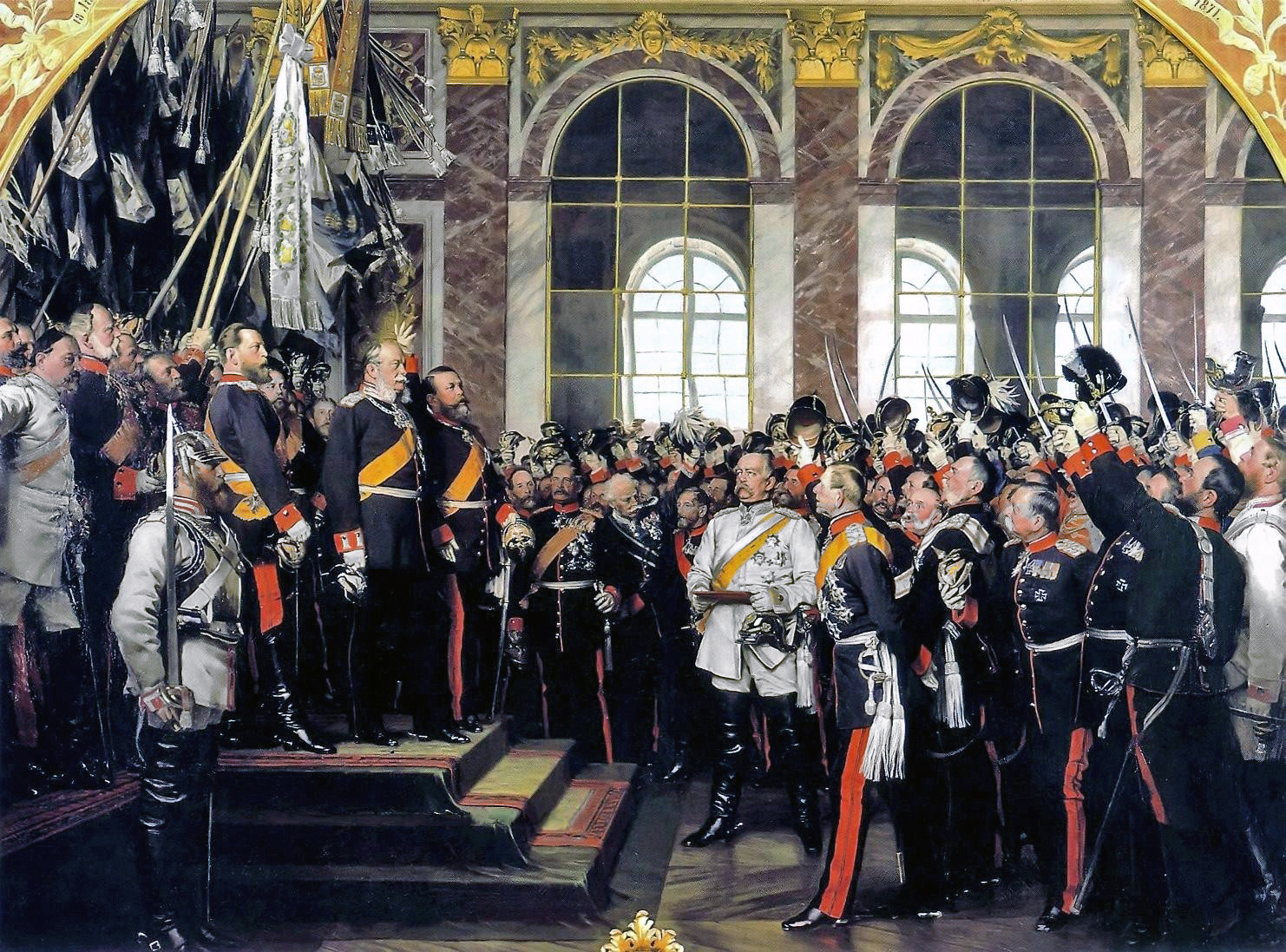
On 18 January 1871, in the Hall of Mirrors at the Palace of Versailles, Otto von Bismarck proclaimed the German Empire. The hall had been built by Louis XIV as a monument to French grandeur — 357 windows, 357 mirrors, eighteen-metre ceilings painted with allegories of royal conquest. The French had not been consulted about its use that day. Paris was besieged outside. The Prussian army had surrounded the city three months earlier, and the French government had fled south — the siege and its aftermath would convulse the city for months yet. Bismarck chose Versailles deliberately, and he chose the Hall of Mirrors for the same reason a man plants his flag on a hill he has just taken: to make the point impossible to miss.
King Wilhelm I of Prussia was proclaimed German Emperor before a hall packed with princes, generals, and the ambassadors of the newly united German states. Wilhelm was not enthusiastic about the title — he wanted to be Emperor of Germany rather than German Emperor, a distinction of precedence over the other monarchies that mattered enormously to him. Bismarck had to negotiate even that detail. But the ceremony happened, the proclamation was read, and a new great power stepped onto the European stage in someone else’s throne room, with the smell of French defeat still in the air.
What had produced that moment was three wars in seven years. In 1864, Prussia and Austria defeated Denmark and took Schleswig-Holstein. In 1866, Prussia defeated Austria itself at Königgrätz in seven weeks and removed the Habsburgs from German affairs for good. In 1870, Napoleon III declared war on Prussia in a fit of miscalculated prestige, and within six weeks the French army had been shattered at Sedan, the emperor himself captured, and the siege of Paris begun. Three wars, three victories, and the accumulated result was a state of sixty million people with the most formidable army in Europe, sitting in the middle of the continent, holding Alsace and most of Lorraine as war trophies, and owing its existence in large part to the sustained conviction of one man — Bismarck — that German unification was achievable but had to be engineered from the top rather than born from revolution.
The Germany that came out of Versailles in 1871 was extraordinary by almost any measure. Within twenty years it had the largest industrial economy in Europe. Its steel production exceeded Britain’s. Its universities and scientific institutions were the envy of the world — the periodic table, germ theory, the foundations of quantum mechanics: German scholarship dominated European science for half a century. Its population was growing faster than France’s, its railway network expanding faster than anyone’s. The British watched it with mounting unease and drew the obvious conclusion: this was competition, and competition of the kind that eventually becomes something else.
Bismarck understood the danger. He spent the 1870s and 1880s constructing a system of alliances designed to keep Germany’s neighbours from combining against it — the Three Emperors’ League, the Dual Alliance with Austria-Hungary, the Reinsurance Treaty with Russia. The logic was simple: Germany was a status quo power now. It had got what it wanted. Its job was to prevent anyone from wanting revenge enough to do something about it. He kept Russia and France from coordinating. He kept Austria from overreaching in the Balkans. He kept the peace for nineteen years.
Then, in 1890, Kaiser Wilhelm II fired him.
What followed was the dismantling of Bismarck’s careful structure by a man who combined genuine intelligence with a spectacular inability to use it. Wilhelm II cancelled the Reinsurance Treaty with Russia — the provision that had kept St Petersburg from tilting towards Paris — and France and Russia concluded an alliance two years later, which was precisely what Bismarck had spent his career preventing. Wilhelm built a battle fleet designed to challenge British naval supremacy, which had the predictable effect of pushing Britain towards France. The Triple Entente — France, Russia, Britain — that faced the Triple Alliance in 1914 was not inevitable. It was the foreign policy legacy of a man who thought personal diplomacy, bluster, and the threat of force were substitutes for actual strategy.
The forty-eight years between Versailles in 1871 and Versailles in 1919 are not a single story. They are two: the Bismarckian story of a great power carefully managing the world it had made, and the Wilhelmine story of a great power squandering what it had been given. The first story ended in 1890. The second ended in November 1918, when the Kaiser abdicated and boarded a train to the Netherlands — the United States had entered the war nineteen months earlier, and the arithmetic had changed beyond recovery.
On 18 January 1919, exactly forty-eight years after Bismarck had proclaimed the Empire in the Hall of Mirrors, the Paris Peace Conference opened. It did not meet in the Hall of Mirrors — that came later, on 28 June, when the treaty was signed in the same room where the Empire had begun. But the date was not accidental. Georges Clemenceau, who was running the conference with the determination of a man who had personally lived through two German invasions of his country — 1870 and 1914 — and who had no intention of allowing a third, chose 18 January with full awareness of what it meant. The anniversary was the point.
The Treaty of Versailles imposed on Germany the war guilt clause — Article 231, a formal legal declaration that Germany and its allies bore sole responsibility for causing the war. It stripped Germany of Alsace-Lorraine, which it had taken in 1871. It dismantled the German army to 100,000 men, eliminated the air force, and reduced the navy to a coastal defence force. It detached territory in the east to reconstitute Poland, leaving millions of ethnic Germans in the new Polish state. And it imposed reparations — eventually fixed at 132 billion gold marks — that Germany could not pay and would refuse to accept as legitimate. The war guilt clause was not just a legal formula. It was designed to provide the moral justification for the reparations bill. You cannot demand compensation from a country for a war it did not cause. So the cause had to be settled first, by treaty, by signature.
John Maynard Keynes walked out of the negotiations and wrote The Economic Consequences of the Peace that same year. His argument was that Versailles was not a peace but a deferred war — that the terms were punitive enough to guarantee economic collapse and political catastrophe without being comprehensive enough to actually prevent German recovery. He was right on both counts, and he was right on the timeline. The Weimar Republic spent thirteen years trying to govern a country that blamed it for the treaty it had been handed. The stab-in-the-back myth — that Germany had gone undefeated in the field and been betrayed by civilians — was nonsense, but it was emotionally satisfying nonsense, and it spread accordingly.
Germany would recover its military strength under very different circumstances, and under very different management. The German Empire that stood in the Hall of Mirrors in 1871 had been built on diplomatic patience and surgical violence — three short, decisive wars, then a long conservative peace. What came after 1933 was something altogether different: the same national energy, the same industrial capacity, the same military tradition, stripped of every restraint and given over to an ideology that Bismarck would not have recognised and would not have survived. The Reich that invaded Poland in 1939 was not a continuation of the one proclaimed in 1871. It was what the 1919 settlement, clumsily engineered, had made possible.
Forty-eight years from the Hall of Mirrors to the Hall of Mirrors. From the proclamation that announced Germany’s arrival to the treaty that tried to ensure it could not arrive again. The same room, the same city, two entirely different meanings — and a third act neither side was prepared for, already written in the terms of what they thought was the ending.