Fort St. Elmo was not supposed to take a week. Mustafa Pasha, the Ottoman land commander, had 40,000 men, artillery that had reduced larger fortifications to rubble, and decades of unbroken victories behind him. The fort at the tip of the Sciberras peninsula was small - a star-shaped redoubt, undermanned, pounded into pieces - and his engineers told him it would fall in four or five days. It held for thirty-one. When it finally fell on 23 June 1565, roughly 6,000 Ottomans lay dead, including Dragut Reis, the greatest corsair commander of the age, killed by cannon debris while directing operations from a trench. Standing in front of Fort St. Angelo across the Grand Harbour - the main fortification, the real objective - Mustafa reportedly said: “If so small a son has cost us so dear, what price shall we have to pay for so great a father?”
That question more or less answered itself over the following two months. The Ottomans never took Fort St. Angelo.
To understand why the siege of Malta mattered, you have to understand what Malta was. The island sits in the narrowest part of the central Mediterranean, roughly ninety miles south of Sicily, in waters where anyone controlling the crossing controls movement between the eastern and western halves of the sea. The Knights of St. John - the Knights Hospitaller - had been given the island by Holy Roman Emperor Charles V in 1530, after they lost Rhodes to the Ottomans in 1522. Charles’s logic was not generosity: he wanted a garrison in that gap, manned by soldiers who had already demonstrated, at Rhodes, that they would fight to the point of extinction rather than surrender.
Suleiman the Magnificent had been expanding the Ottoman Empire relentlessly for forty years. He had taken Rhodes, Belgrade, and large swathes of Hungary. His navy had dominated the eastern Mediterranean for decades. By 1565, the only serious gap in Ottoman naval supremacy was the western Mediterranean, and that gap existed largely because the Knights sat in it. He had, in 1551, tried to take Malta and given up. He sent the 1565 expedition, under Mustafa Pasha and the naval commander Piyale Pasha, in May, with clear instructions: take the island.
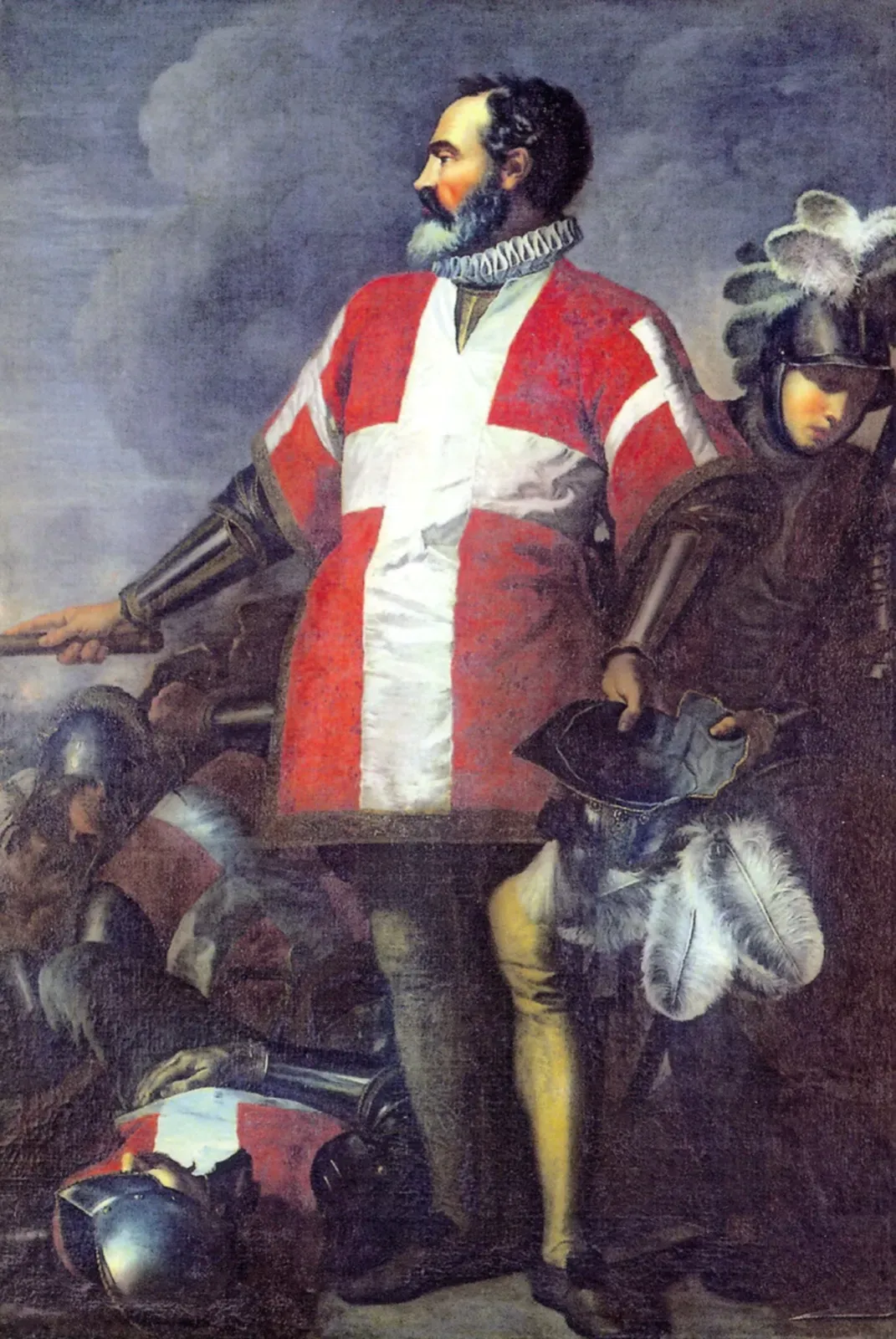
The Grand Master of the Knights was Jean Parisot de la Valette, seventy years old, who had survived the fall of Rhodes as a young man and had since spent four decades fighting. Against the Ottoman force, he had roughly 700 Knights, supplemented by perhaps 8,000 Maltese militia, mercenaries, and soldiers of various origins. He distributed his men across Fort St. Elmo, Fort St. Angelo, and Fort St. Michael. He did not attempt to hold everything. He chose his ground and dug in.
St. Elmo was the sacrifice. La Valette knew the fort could not hold indefinitely against the full weight of the Ottoman assault, but every day it held was a day the Ottomans were not attacking the main positions, and a day that the relief force he was waiting for from Sicily might arrive. He rotated fresh soldiers into St. Elmo by boat across the Grand Harbour, keeping the garrison supplied enough to keep fighting without reinforcing it to the point where it could survive. The men inside understood what they were being asked to do. Several of the senior Knights wrote to La Valette in mid-June asking why he was sending reinforcements into a position that was already lost - a fort, they said, which was no longer a fort but a cemetery. La Valette wrote back that if the fort was indeed a cemetery, it would need more dead to defend it properly. He sent more men.
Dragut arrived in late May and recognised immediately what the Ottomans had done wrong. Mustafa Pasha had placed his batteries without fully accounting for the crossfire from St. Angelo. Dragut repositioned the guns. He was directing operations from a forward trench on 18 June when a cannon ball struck the ground nearby and a fragment of stone or metal hit him in the head. He lingered for five days and died on 23 June, the same day St. Elmo fell. The Ottomans had spent a month and 6,000 men - among them one of the most capable naval commanders in the Mediterranean - on a fort their own commander had expected to take in a week.
When the fort fell, nine Knights were found alive, too wounded to fight. Mustafa Pasha had them killed immediately. The bodies of the Knights who had died in the siege were found floating in the harbour, tied to wooden crosses, a deliberate insult to Christian symbols. La Valette’s response was immediate and unambiguous. He had all Ottoman prisoners in his custody executed, and their severed heads loaded into the fort’s cannons and fired across the harbour into the Ottoman lines. The siege of Malta was not a chivalric affair.
Over July and August the Ottomans pressed the attack on St. Angelo and St. Michael with everything they had. The defenders were running out of men, ammunition, and food. Several assaults came close enough that Knights fought in the breaches with whatever was available. The summer heat was killing both sides. Disease was spreading through the Ottoman camp. Piyale and Mustafa were barely on speaking terms, disagreeing about tactics and about who bore responsibility for the increasingly obvious failure. By late August, the Ottomans had taken the fortified town of Birgu in a surprise attack, only to find they were fighting house to house against the entire population, men and women, and pulled back.
The relief force - the Gran Soccorso, roughly 8,000 Spanish and Sicilian troops under García Álvarez de Toledo - landed on the north of the island on 7 September. Mustafa attempted to engage it and was driven off. Two days later, with perhaps a third of his original force dead and most of the rest sick or exhausted, he ordered the fleet to withdraw. The Ottoman armada sailed from Malta on 11 and 12 September 1565.
Suleiman was seventy-one and had been campaigning for four decades. He understood the difference between a setback and a decision. He ordered a second, larger expedition to be prepared for 1566. It never left. He died in September 1566, during a separate campaign in Hungary, of natural causes. His son Selim II, who inherited the empire, looked at the central Mediterranean and concluded that his father’s determination to anchor there had cost too much already. He turned his naval ambitions eastward instead, to Cyprus, which the Venetians held and which fell to an Ottoman force in 1570 - 1571.
That campaign ended at Lepanto.
On 7 October 1571, a combined Christian fleet under Don John of Austria met the Ottoman navy in the Gulf of Patras and destroyed it. Over 200 Ottoman galleys were sunk or captured. It was the largest naval engagement in the Mediterranean since ancient times. The Holy League that assembled the Christian fleet - Venice, Spain, the Papacy, Genoa - had been forming since Malta; the siege had demonstrated, more clearly than anything before it, that the Ottomans could be stopped if European powers pooled their resources long enough to stop them. Lepanto ended Ottoman naval supremacy in the Mediterranean. It was not the end of the Ottoman Empire - which would last another three and a half centuries - but it ended the particular fear, shared across Christian Europe for decades, that the Ottomans were simply unstoppable.
Malta had a great deal to do with that. When La Valette’s men held St. Angelo through the summer of 1565, they were not just holding a fort. They were disproving an argument. The Ottomans had built their strategic reputation on a long chain of successes: Rhodes, Belgrade, Mohács, Tripoli, Djerba. Every new campaign recruited from that reputation; enemies flinched before the fight began. Malta broke the chain. The Ottomans had committed the largest amphibious force they had ever deployed in the western Mediterranean, under their best commanders, including the man who had been their finest naval mind, and they had sailed home with a third of their men dead and nothing to show for it. That fact circulated across Europe, was noted, and eventually was acted on.
The hill on which the city of Valletta now stands - the Sciberras peninsula, where St. Elmo was built - was bare rock before 1565. La Valette started building a fortified city there in 1566, the year he died. He named it after himself, which was by any measure earned. The city has been continuously inhabited since. The fort at its tip still stands, used as a government building, looking across the Grand Harbour at Fort St. Angelo. What the father cost was the entire expedition.