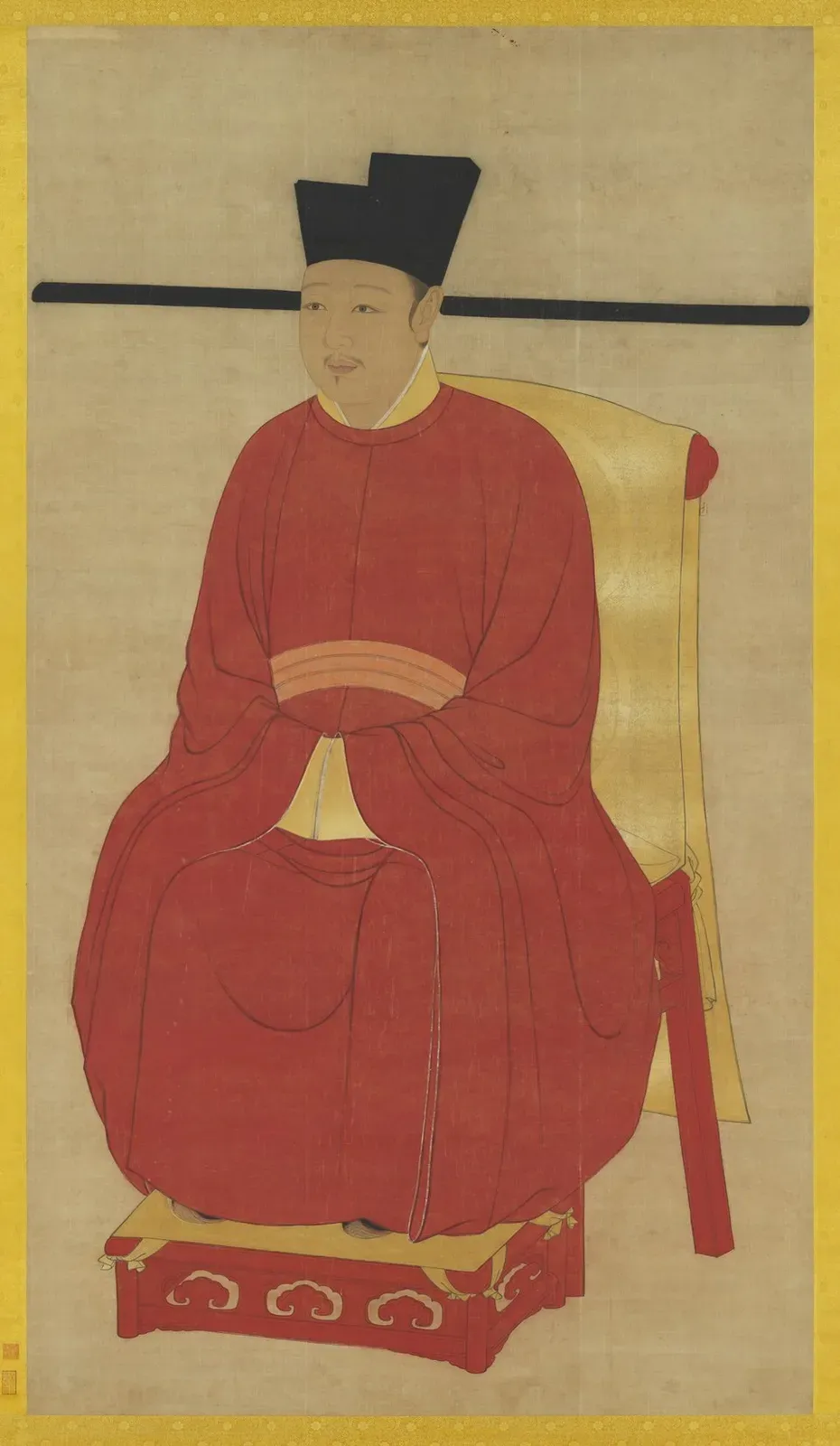
Emperor Huizong was, by any measure, one of the finest painters in Chinese history. His bird-and-flower studies show a precision and delicacy that later emperors tried to imitate and mostly couldn’t. He invented a style of calligraphy - “slender gold” - elegant and spidery, still taught today. He composed music, redesigned the imperial gardens, and assembled one of the greatest art collections the country had ever seen. What he was not doing, during any of this, was running his empire.
In 1120, Huizong struck what seemed like a shrewd bargain. The Liao dynasty - the Khitan state that had squeezed annual tribute out of Song for well over a century - was being torn apart from the north by a new and violent power, the Jurchen Jin dynasty. Huizong’s plan was to ally with Jin, help finish off Liao, and finally recover the Sixteen Prefectures, the northern territories Song had lost to the Khitans in 938. The arrangement went by the name of the Alliance Conducted at Sea.
It collapsed almost immediately. When Song armies marched north to take their share of Liao, they couldn’t even breach its defences - a dying empire still too strong for them. Jin watched, finished the job Song couldn’t do, and took all the former Liao territory for itself. Song’s promised portion of the Sixteen Prefectures was eventually handed over in exchange for 300,000 bolts of silk and 200,000 ounces of silver - the same amount Song had been paying as annual tribute to Liao. The relationship going forward was already clear: Jin took, Song paid.
What the campaign had also exposed was the state of the Song military. City after city had surrendered without a fight. Generals who had been expected to hold the border had simply opened their gates. Jin had needed no particular encouragement to conclude that Song territory was worth taking.
By the autumn of 1125, they decided to take it. Jin launched two armies south into Song territory. Huizong panicked. He abdicated in favour of his eldest son, who became Emperor Qinzong, and fled south to the countryside. The northern Jin army swept through city after city, encountering almost no resistance, and by February 1126 stood outside the walls of Bianjing - Kaifeng, the Song capital, a city of perhaps a million people.
The first siege ended with Song buying time. Qinzong agreed to pay a ransom, surrendered the strategic city of Taiyuan as a goodwill gesture, and the Jin army withdrew. Huizong came back from the countryside. Lavish parties resumed at the palace. The generals who had actually defended Bianjing were transferred out of the capital. Army divisions were disbanded and sent home. Then, three months after Jin left, Qinzong made a decision so spectacular in its foolishness that it is difficult to explain even in hindsight.
Jin had sent two envoys to Bianjing - men who happened to be former Liao nobles. Qinzong believed he could turn them. He wrote them a coded letter, sealed in candle wax, inviting them to defect and form an anti-Jin alliance. They took the letter directly to the Jin emperor. The response was swift. In September 1126, Jin launched a second campaign with a force twice the size of the first, having fixed the tactical problem that had slowed them down previously: that time, the western army had been bogged down at Datong and couldn’t reinforce the siege. This time, Datong fell in a month. By December, both armies had reunited under the walls of Bianjing.
On 9 January 1127, the city fell.
Qinzong, who had signed over Taiyuan and written the letter, was captured inside the walls. Huizong, who had abdicated and fled and come back and spent the intervening months at court banquets, was captured with him. Jin stripped both men of their imperial titles and demoted them to commoners. The looting of the palace followed: jade, silk, musical instruments, books from the imperial library, printing blocks, astronomical maps, gold and silver, and over 14,000 people - the entire Song imperial family and court, their servants, their musicians, their physicians and astronomers and painters and wine makers - were ordered north on foot to the Jin capital at Shangjing, near present-day Harbin. Many died on the march from exhaustion, dehydration, and exposure. Upon arrival, each prisoner was required to wear only sheepskins in a reception ceremony. Empress Zhu killed herself rather than submit to it.
The fate of the women was considerably worse than the men’s. Imperial princesses were distributed as concubines to Jin princes; others were sold into slavery. A prince’s granddaughter sold for less than ten ounces of gold. Emperor Huizong protested when his daughter was taken. “Above there is Heaven,” he told the Jin commander, “and below emperors and the people have their daughters and daughters-in-law.” The Jin commander was unmoved.
Qinzong spent the rest of his life in captivity. In 1156, nearly thirty years after the fall of Bianjing, the Jin emperor arranged a polo match between the two conquered rulers he held: Qinzong of Song and the former Liao emperor, Tianzuo, both elderly men. Tianzuo, lifelong horseman, tried to use the opportunity to escape and was shot by archers. Qinzong fell off his horse. He died that year. Huizong had predeceased him by twenty years, composing poetry in captivity until his death in 1135.
The one member of the Song imperial family who escaped was Zhao Gou, a son of Huizong who had been sent as a hostage to Jin during the first siege and was later released. When Bianjing fell, he fled south, and in June 1127 had himself crowned Emperor Gaozong, founding what historians call the Southern Song, with its capital eventually at Lin’an - present-day Hangzhou. The dynasty continued for another 152 years, but it never recovered north China. It tried constantly. The general Yue Fei came closer than anyone, driving into Jin territory in the 1140s before being recalled and executed on Gaozong’s orders, on trumped-up charges, almost certainly because a military success would have meant the return of Qinzong, whose continued existence in Jin custody was a standing inconvenience for an emperor who preferred to hold power himself.
The Chinese term for what happened in 1127 is Jingkang zhī chǐ - the Humiliation of Jingkang. It became, over the following centuries, the reference point for national disgrace, cited in poems, novels, and political speeches across dynasties that had no direct connection to the Song. The name of Yue Fei, who had fought to reverse it, became nearly sacred. A poem attributed to him - probably written by someone else, during the Ming dynasty - is still memorised in schools.
The long-term consequence the user’s note describes as the “fragmentation allowing the Mongols in” is not quite how it worked, but the direction is right. Jin and Southern Song spent the next century grinding at each other across the Huai River, neither able to decisively defeat the other. When Genghis Khan’s armies began pressing into Jin territory from the north in 1211, Song and Jin briefly became unlikely potential allies - and Song, seeing an opportunity for revenge, instead allied with the Mongols to finish off Jin, repeating almost exactly the mistake Huizong had made with Jin against Liao a century earlier. Jin collapsed in 1234. The Mongols then turned south. The Southern Song held out until 1279 - longer than Jin had - before the last Song claimant drowned off the coast of Guangdong, an infant, held in an official’s arms as they leaped together into the sea.
The event that began all of this was decided, in large part, by a letter sealed in candle wax that two men handed to their emperor the moment they received it. Qinzong had survived one siege by paying gold and silk. He could have used the following three months to reinforce defences, keep experienced generals, position troops along the Yellow River. Instead he plotted in secret against an adversary who had demonstrated, twice, that it had informants everywhere. Song’s military weakness was real - but it was Qinzong’s diplomatic incompetence, not Jin’s military strength, that made the second siege inevitable.
Huizong, who had created the conditions for catastrophe by befriending Jin in the first place and built an army incapable of defending his borders, spent his last years as a captive in the far north, painting, apparently, to the end. The “slender gold” calligraphy survived him. The dynasty he spent twenty-five years leading survived him too, though in reduced form, further south, and without the cities he had been born to rule. History has occasionally managed to produce rulers of genuine artistic talent who were also competent statesmen. Huizong was not one of them.