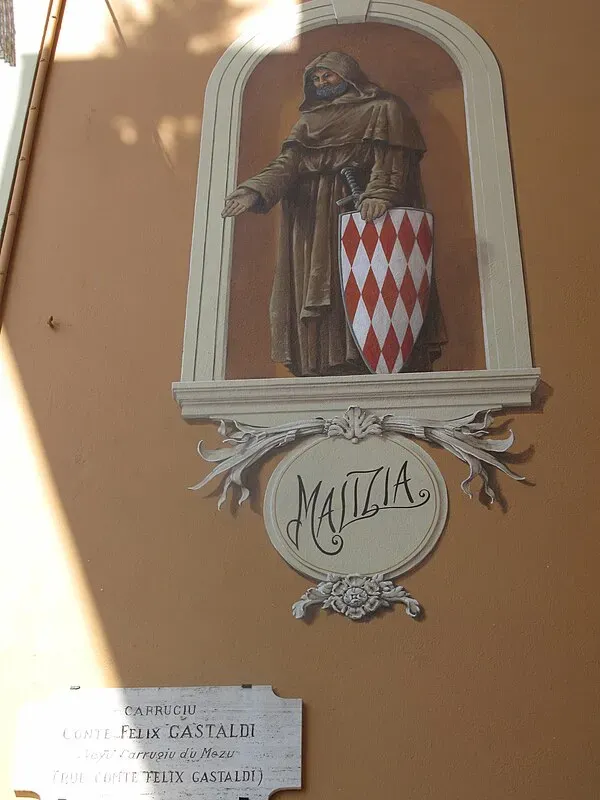
The man who founded Monaco’s ruling dynasty was known, in his own lifetime, as “il Malizia” - the malicious one. This is not a label his descendants have tried to obscure. It is on the coat of arms.
On the night of 8 January 1297, François Grimaldi approached the fortress on the Rock of Monaco dressed as a Franciscan friar. The Rock is a 62-metre limestone monolith jutting into the Mediterranean between Nice and the Italian border, and it had been garrisoned by the Genoese Ghibellines since 1215, when they built the fortress to control the coastal road. Grimaldi knocked on the gates. The garrison opened them. He and his men, who had been waiting nearby, seized the castle. His cousin Rainier helped. The garrison, presumably, did not see the funny side.
The broader context is the Guelph-Ghibelline civil war that had been shredding northern Italian politics for generations - the Guelphs backing papal authority, the Ghibellines backing the Holy Roman Emperor. The Grimaldis were a Guelph family from Genoa, powerful and well-connected, which meant they were intermittently exiled every time the Ghibellines gained the upper hand in the city. By 1295, François had been routed by a Ghibelline army in Liguria and was effectively a Guelph commander in search of a defensible position. The Rock of Monaco was an obvious target: it sat at a strategic point on the coastal route between Italy and France, and it was lightly held.
The capture itself lasted four years. The Ghibellines eventually took the fortress back by siege, and Grimaldi lost it. He did not give up. The family returned and seized the Rock again in 1331, this time under his cousin Rainier I and his son. They were expelled again. The pattern repeated itself for another century, with the Grimaldis periodically holding the Rock, periodically losing it to Genoese attack, periodically making alliances with whichever regional power could help them stay. In 1419, they resolved the tenure question permanently by purchasing Monaco outright from the Crown of Aragon, through the Queen of Aragon, Yolande. After that, the family ruled as a matter of law rather than opportunistic occupation. The purchase was handled by three of Rainier I’s grandsons - Ambroise, Antoine, and Jean. There was no disguise required.
François himself died in 1309 without children. His marriage to Aurelia del Carretto produced no heirs, which means the entire subsequent dynasty - the House of Grimaldi that still rules today - descends not from the man who staged the original coup, but from his cousin. The famous name was inherited, not the bloodline. The Grimaldis who purchased Monaco in 1419, who navigated Spanish sovereignty and French pressure for the next two centuries, who are currently represented by Prince Albert II - none of them are directly descended from the man in the monk’s habit who knocked on the gate that January night. History gave François the founding myth and gave Rainier I the dynasty.
What no one tried to sanitise was the act. Monaco’s coat of arms has carried two monks brandishing swords since the medieval period, a direct visual reference to the disguise. The motto is “Deo Juvante” - “With the Help of God” - which, given the founding story, carries a certain dry wit. The principality’s official history treats January 1297 as its origin point. There is no version of the founding that omits the costume or softens the deception into something more respectable. The malicious monk is the founder.
Monaco today covers 2.02 square kilometres, making it the world’s second smallest sovereign state. It has a Grand Prix circuit laid out through its streets, a casino that opened in 1863 and helped keep the principality solvent after it lost 95 per cent of its territory to France in 1861, and a royal family whose faces appear regularly in tabloids across three continents. Its independence, technically, has rested on French military protection since the 19th century. None of this was visible in 1297, and almost none of it was the result of long-term planning. The fortress on the Rock was seized because a Guelph exile needed somewhere to put his soldiers, and the garrison believed a man wearing a habit.
The gateway François knocked on that January night is long gone, replaced by the fortifications of a later century, but the rock it sat atop still carries a palace. Seven hundred and twenty-nine years of a dynasty that began with a lie about the habit.