Bram Stoker’s Dracula is an immortal Transylvanian count who sleeps in a coffin, fears garlic, and requires an invitation to enter a room. The man who inspired him killed 23,884 Turks in a single two-week campaign, counted them meticulously, and reported the figure to the King of Hungary in a letter. The real Dracula did not sleep in coffins. He impaled people on stakes — enemy soldiers, Ottoman ambassadors who refused to remove their hats, envoys who came bearing demands he found offensive. On 17 June 1462, he led his cavalry through the darkness into the sleeping camp of Mehmed II — the conqueror of Constantinople, the most feared commander in Europe — and very nearly cut him down.
Vlad III, Prince of Wallachia, inherited the title Dracula from his father, Vlad II Dracul, a member of the Order of the Dragon. “Dracul” means either “the Dragon” or “the Devil” in Romanian; “Dracula” means son of whichever one you prefer. He had been sent to the Ottoman court as a child hostage in 1442, alongside his younger brother Radu, when their father traded his sons for Ottoman military backing and kept his throne. Radu adapted to court life in Constantinople. Vlad did not. When Vlad eventually returned to Wallachia and seized power, he turned with concentrated ferocity on the empire that had held him captive. In the winter of 1461 - 62, he crossed the frozen Danube into Ottoman Bulgaria with his army split into several raiding columns and covered eight hundred kilometres in two weeks, killing over 23,000 Turks. The Christian Bulgarians he spared. Everyone else he counted.
The Ottoman response was an army that dwarfed anything Wallachia could field. Mehmed brought, depending on which source you believe, between 60,000 and 150,000 men, 120 cannon, a fleet of 175 vessels, bridge-building engineers, and astrologers. Against this, Vlad had perhaps 30,000, the majority of them peasants and shepherds with improvised weapons. He did not attempt to meet the Ottomans in open field. He poisoned the wells, diverted rivers to create marshes, dug pits and covered them with timber and leaves, evacuated the population and animals into the mountains, and sent people infected with bubonic plague into the Ottoman camp to intermix with the soldiers. For seven days Mehmed’s army marched through a stripped, empty country and found nothing to eat or drink. The Ottoman force was powerful, enormous, and losing men to starvation and disease before it had fought a single pitched battle.
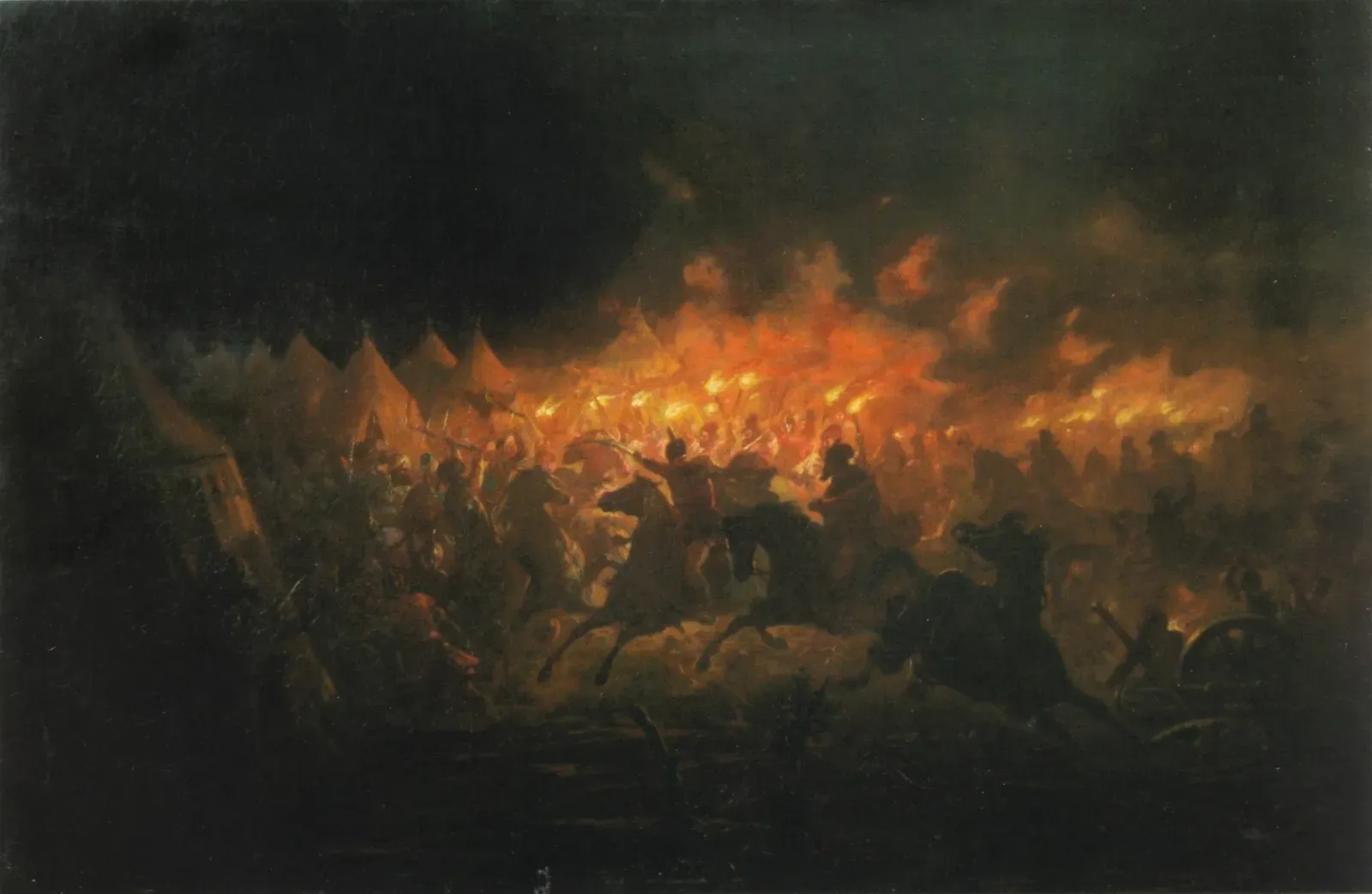
On the night of 17 June, when the Turks camped south of Târgovişte, Vlad launched the attack his whole campaign had been building toward. Somewhere between 7,000 and 24,000 horsemen went in. The papal legate Niccolò Modrussa recorded the account of a Wallachian veteran who had been there: before the assault, Vlad disguised himself as a Turk, slipped alone into the Ottoman camp, located the sultan’s tent, and returned to his men. The attack started three hours after sunset and ran until four in the morning — torches blazing, bugles screaming, cavalry cutting through the camp “like lightning in every direction.” His target was Mehmed. He found the tents of the two grand viziers, Ishak Pasha and Mahmud Pasha, instead. A boyar named Galeș, commanding the second arm of the assault, lost his nerve and failed to press from the other side as planned. The sultan, according to Modrussa’s account, “abandoned the camp and fled in a shameful manner. And he would have continued this way, had he not been reprimanded by his friends and brought back, almost against his will.”
The man who had ended the millenia-old Roman Empire ran from a Wallachian cavalry raid. Mehmed pressed on to Târgovişte the following day and found the capital deserted — gates wide open, no garrison, nothing to fight. What he found outside the city was something else. For half an hour, the Ottoman army marched down a road bordered by impaled corpses: 20,000 Turks captured during Vlad’s Bulgarian campaign, displayed on stakes in a forest of the dead. At the centre stood the rotting remains of Hamza Pasha, impaled on the tallest stake to honour his rank. Chalkokondyles, the Greek historian who accompanied the expedition, recorded Mehmed’s reaction: “The sultan was seized with amazement and said that it was not possible to deprive of his country a man who had done such great deeds, who had such a diabolical understanding of how to govern his realm and its people.” Then Mehmed retreated. He burned Brăila on the way out, sailed to Adrianople, arriving on 11 July. His court declared a great victory.
Wallachia did not ultimately save itself through military brilliance, remarkable as it was. Mehmed had a more efficient weapon: Vlad’s younger brother. Radu had stayed at the Ottoman court after their shared captivity, converted to Islam, and fought alongside Mehmed at the fall of Constantinople. He commanded 4,000 Ottoman horsemen in the campaign against Vlad. History records him as Radu cel Frumos — Radu the Beautiful — and a number of sources suggest that his relationship with the sultan extended well beyond military command, though the particulars are disputed. What is not disputed is that Radu understood Wallachia in ways no Ottoman general could. After the Night Attack, he campaigned for support among the boyars with patience and precision: promising restored privileges, no reprisals, lasting peace. After years of Vlad’s pitiless methods, this was not a difficult sale. The boyars defected. Vlad fled to Hungary to ask his ally Matthias Corvinus for help, and was promptly arrested on fabricated treason charges. He spent the next twelve years in a Hungarian dungeon while his handsome younger brother ruled Wallachia as an Ottoman vassal.
The larger problem was arithmetic. Wallachia had perhaps half a million people. The Ottoman Empire had twelve million subjects and could absorb Vlad’s atrocities and send another army the following season. His strategy was about as good as strategy gets under those constraints: scorched earth, guerrilla warfare, psychological terror at scale. But Mehmed did not need to defeat him in battle. He just needed Radu to offer a better deal. Vlad returned briefly to the throne in 1476 and was killed in battle the same year, aged around 45. The Ottoman advance into the Balkans and Hungary continued for another two centuries.
What Stoker borrowed from this history was not the man but the atmosphere: Transylvania, the impaled bodies, the castle in the mountains, a prince who seemed neither quite natural nor quite mortal. The fictional Dracula is immortal, patient, and parasitic. The historical one was mortal, outnumbered, and fighting an empire with a principality. He killed more people in a fortnight than his fictional counterpart managed in three hundred years. He was not undead. He was desperately, violently alive — and on the night of 17 June 1462, he came close enough to killing Mehmed II that the sultan had to be dragged back to his own camp by his friends to stop him from abandoning the whole campaign on the spot. The vampire never managed anything half as impressive.