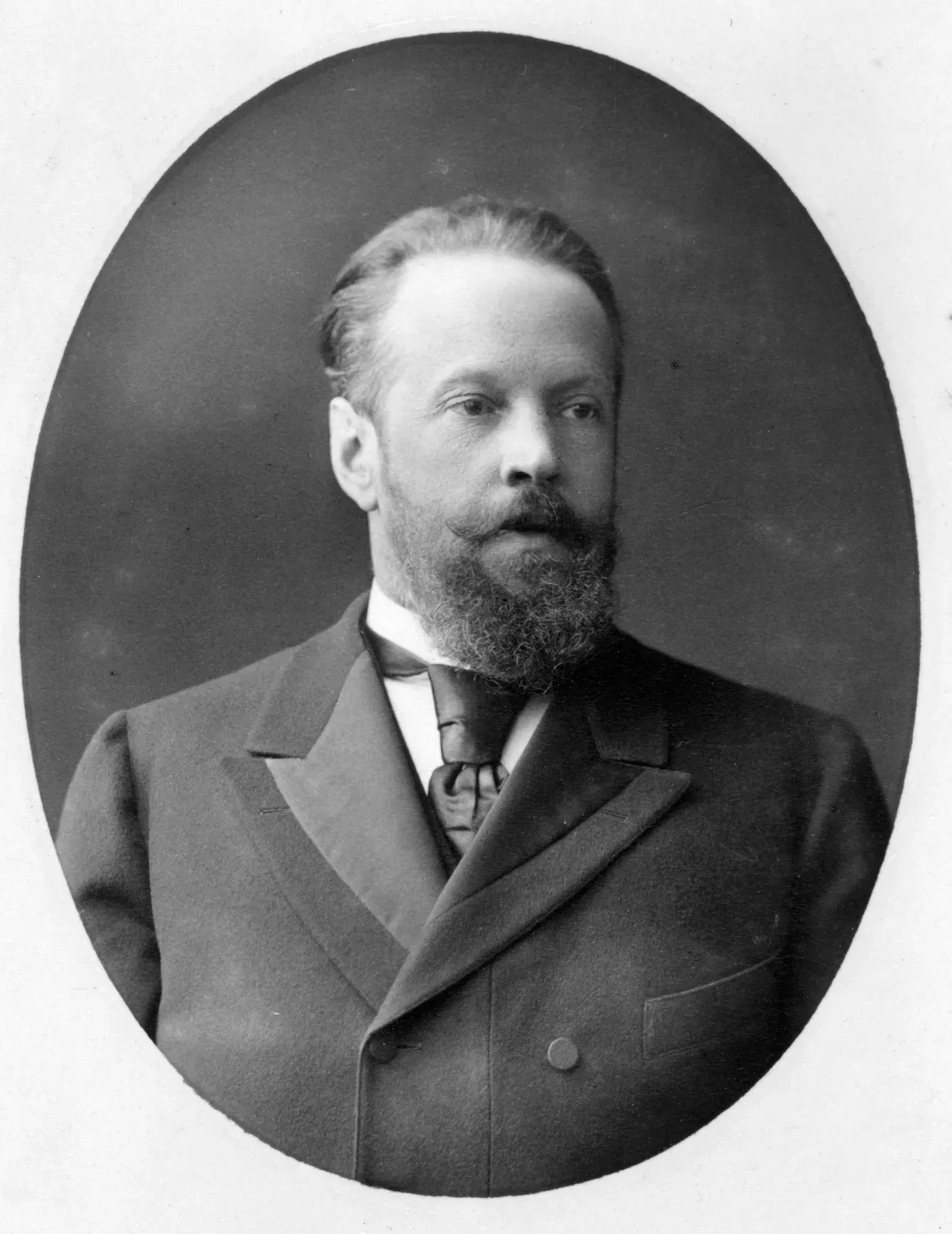
Sergei Witte spent eleven years as Russia’s Minister of Finance building the most aggressive industrialisation programme the country had ever attempted. When he left the job in 1903 - pushed out by court rivals who considered him too ambitious and too indispensable - Russia had added tens of thousands of miles of railway, placed the ruble on the gold standard, and grown its manufacturing sector at roughly 8 per cent annually for a decade. Two years later he negotiated the peace treaty that ended the Russo-Japanese War, returning home with terms far better than Russia’s military position deserved. The tsar appointed him the empire’s first Prime Minister. Then spent the following six months ensuring he had no real power before accepting his resignation. Witte lived another nine years, long enough to watch what he had predicted come true.
He was born on 29 June 1849 in Tiflis, the capital of the Russian Caucasus, the son of a civil servant of Dutch descent. His early career was built on railway administration in Odessa, and his reputation came from competence in a profession that rewarded it - running trains on time, managing costs, getting difficult things through obstructive bureaucracies. Alexander III took notice partly through the aftermath of the Borki train disaster of 1888, in which the imperial train derailed at speed and the tsar’s family crawled from the wreckage. Witte had previously warned the railway authorities that the express services were running too fast for the track conditions. The warning had been ignored. He was made Minister of Finance in 1892.
His diagnosis of Russia’s problem was blunt: the country was a peasant economy in an era when industrial capacity determined whether empires survived. Britain was producing 8 million tons of steel annually. Germany had electrified factories and a navy being built to challenge Britain’s. Russia was exporting wheat. His response was state-directed industrialisation on the model Bismarck had used in Germany - protective tariffs to shelter domestic industry, aggressive pursuit of foreign capital, and state construction of infrastructure no private investor would fund. In 1897 he placed the ruble on the gold standard, which stabilised the currency and made Russian government bonds attractive in Paris and Berlin. By 1900, Russia’s pig iron production had overtaken France’s. The manufacturing base was real and it was growing fast.
The cost fell almost entirely on the peasantry. Witte taxed the villages heavily and promoted grain exports as the primary way to earn the foreign exchange his programme required. In years of poor harvest, grain continued to leave the country. The countryside fed the cities and the bond payments while it went without. Witte was not indifferent to this - he understood it was politically unstable and economically self-defeating in the long run - but he believed that a Russia with factories and railways would eventually produce enough to feed everyone, while a Russia without them would not survive long enough to try. The argument had a logic. It did not make him friends in the villages, or among the reformers beginning to argue that a country cannot tax its way to modernity without also giving its subjects some say in how they are governed.
Nicholas II dismissed him from the Finance Ministry in 1903. The proximate cause was bureaucratic rivalry - Interior Minister Vyacheslav von Plehve had the tsar’s ear and considered Witte’s influence excessive. Von Plehve’s prescription for Russia’s mounting social unrest was, famously, a short victorious war to restore morale and patriotism. Japan attacked the Russian fleet at Port Arthur in February 1904 without a declaration of war. The war was not short and it was not victorious. Russia lost two fleets; Port Arthur fell after a 154-day siege; at Tsushima in May 1905, the Japanese navy destroyed the Baltic Fleet that had sailed 18,000 miles to reinforce the Pacific. Von Plehve was assassinated by a revolutionary’s bomb in July 1904, which was the closest thing to a personal vindication Witte received in those years.
By the summer of 1905, Nicholas had no choice but to send for him again. He dispatched Witte to Portsmouth, New Hampshire, to negotiate with the Japanese. The cards were weak: Russia had lost comprehensively and everyone at the table knew it. What Witte extracted from the Treaty of Portsmouth was a settlement in which Russia ceded the southern half of Sakhalin Island and surrendered its leases in Manchuria, but paid no war indemnities and preserved its presence in the Far East. Japan had demanded financial reparations; Witte refused them. The Russian public called the result a humiliation anyway - the loss of Sakhalin was real - but a settlement requiring no indemnities after a defeat of that scale was a diplomatic achievement most governments would have been grateful for. Theodore Roosevelt, who had helped broker the talks, received the Nobel Peace Prize for his efforts. Nicholas granted Witte the title of Count, which was the appropriate reward for a man the tsar considered useful in emergencies and inconvenient the rest of the time.
He returned to a country in revolution. The events of 1905 were not a single uprising but a sequence: Bloody Sunday in January, when troops fired on a peaceful march in St Petersburg and killed at least 130 people; the mutiny on the battleship Potemkin in June; strikes through the summer; a general strike in October that shut down the railways, the post offices, and most of the factories. The tsar had no reliable way to move troops because the workers had stopped the trains.
Witte laid the choice in front of Nicholas with characteristic directness: military dictatorship and full suppression, or constitutional reform and a legislature. The Grand Duke Nikolai Nikolaevich, asked to command the dictatorship, said he would shoot himself in the head before he accepted the role. Nicholas signed the manifesto. Witte had drafted it. The October Manifesto of 17 October 1905 promised freedom of speech, assembly, and conscience, and established a State Duma with genuine legislative authority. It transformed Russia, at least on paper, from an absolute to a constitutional monarchy - the first time in three centuries of Romanov rule that subjects had a legal right to participate in their own governance. Nicholas appointed Witte Chairman of the Council of Ministers, the empire’s first Prime Minister, the same day. His diary entry for that date records that he had been in tears.
The job lasted six months. Nicholas disliked Witte personally and resented him for the manifesto; the tsar’s mother later told Witte directly that her son hated him. Court conservatives blamed him for surrendering autocracy; liberals thought the reforms had not gone far enough. He secured a foreign loan of 2.25 billion French francs in April 1906 - the largest international government loan to that date - which gave the treasury enough room to stabilise without depending on the new Duma for emergency funds. Then he resigned. The sequence was deliberate: he wanted the finances secured before he left, knowing that Nicholas would find it easier to dismantle the reforms once the immediate pressure was off.
He was right. The first Duma was dissolved after 73 days. The electoral law was revised in June 1907 to reduce the representation of peasants and non-Russian minorities, in a move Nicholas carried out by decree in violation of the constitution he had just agreed to. The Duma continued to meet, but the tsar retained the ability to dissolve it, override it by emergency decree, and rewrite the rules whenever the results displeased him. The constitutional monarchy Witte had created survived as an institutional form while losing most of its constitutional content.
He died on 13 March 1915, a year into a war that was already going worse than the Japanese one. The February Revolution came in 1917; Nicholas abdicated in March. The Bolsheviks took power in October. The empire Witte had spent his career trying to modernise collapsed within two years of his death, along the exact fault lines he had identified: a regime that modernised its economy without reforming its politics, a peasantry taxed beyond endurance, a tsar constitutionally incapable of accepting that the world he had inherited was gone.
The railway is still running. The Trans-Siberian has carried passengers between Moscow and Vladivostok every year since 1904, across 5,772 miles of territory that would otherwise be economically disconnected from the rest of the country. The industrial base Witte built contributed to Russia’s capacity to fight, if not to win, the First World War. The Duma he created gave Russia twelve years of practice at legislative politics before the tsar fell and there needed to be somewhere for a government to assemble. None of it was enough. The lesson is not that Witte failed but that no administrator, however capable, can substitute for a ruler willing to govern. Nicholas II could modernise a railway network and was incapable of modernising himself. Witte knew this by 1906. Russia found out in 1917.