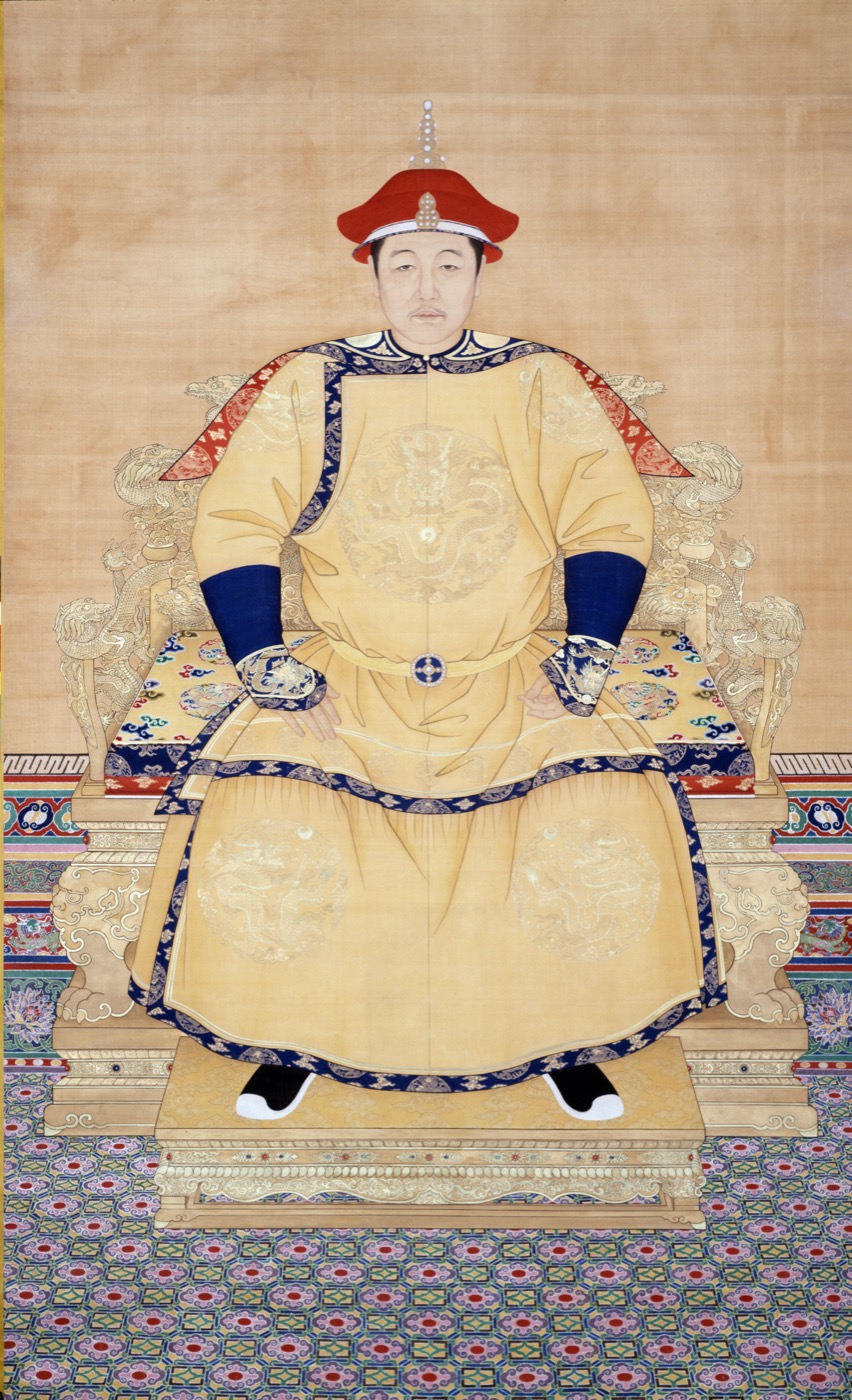
On 21 September 1643, Hong Taiji — ruler of the Qing dynasty, conqueror of most of Manchuria, and the man who had spent a decade building a state capable of swallowing China whole — died suddenly, without naming a successor. The fledgling Qing state faced the kind of power vacuum that ends dynasties before they properly begin. Several contenders moved immediately: Dorgon, the fourteenth son of the founder Nurhaci, controlled two Banners and had the military record; Hooge, Hong Taiji’s eldest son, had the loyalty of his father’s Yellow Banners and a reasonable claim by primogeniture. Both were capable men. Both were dangerous.
The Deliberative Council of Princes and Ministers reached the only solution that could prevent civil war: neither of them. Instead they picked the ninth son, a five-year-old named Fulin, who posed no threat to anyone and whose youth made the question of regents not only acceptable but necessary. Dorgon became regent. The child was crowned emperor of the Qing dynasty on 8 October 1643, and given the reign name Shunzhi. He was told what to do, where to stand, and when to bow. For the next seven years, the real ruler of his dynasty was the man standing beside him.
Dorgon was, by most measures, a military genius. Under his regency the Qing did in eight months what the Ming had spent years dreading: when rebel leader Li Zicheng breached the walls of Beijing on 24 April 1644, pushing the last Ming emperor to hang himself on a hill behind the Forbidden City, Dorgon moved immediately. He allied with Ming general Wu Sangui, crushed Li’s forces at the Battle of Shanhai Pass on 27 May, and entered Beijing with the six-year-old Shunzhi Emperor in October. The imperial proclamation was careful to present the Manchus not as conquerors but as avengers of the fallen Ming — liberators who had come to restore order. It was a useful fiction, and Dorgon deployed it with the same precision he brought to logistics.
The conquest that followed was brutal and breathtakingly fast. Qing armies swept south, took Nanjing and the Jiangnan cities by mid-1645, and pushed Southern Ming resistance deep into the southwestern provinces. On 21 July 1645, having pacified Jiangnan on paper, Dorgon issued an edict that immediately reversed much of what he had accomplished: he ordered every Chinese man to shave his forehead, braid the rest of his hair into a queue identical to those of the Manchus, and comply within ten days. The punishment for non-compliance was death. The justification was loyalty: those who wore the queue were Qing subjects; those who refused were enemies. The logic was clean. The consequences were catastrophic. The cities of Jiading, Songjiang, and Jiangyin rose in rebellion. Jiangyin held out for eighty-three days against ten thousand Qing troops before the walls were breached, after which the army killed between 74,000 and 100,000 people. Dorgon’s insistence on a hairstyle, in the assessment of one historian, “united Chinese of all social backgrounds in resistance against Qing rule” and broke the momentum of a conquest that had until then proceeded almost without check. He was a great general and a mediocre politician. It is a common combination.
Dorgon died on 31 December 1650, unexpectedly, during a hunting trip in the north. He was thirty-eight. Within weeks, the factions he had suppressed erupted. His brother was arrested. His supporters were purged from court. His posthumous titles were stripped. His name was used as a warning. The thirteen-year-old Shunzhi Emperor, who had spent his reign to that point as a ceremonial object, became an actual ruler almost overnight.
He moved fast. Within months he had dismissed the northern Chinese officials Dorgon had favoured and replaced them with men of his own choosing. He issued an edict against corruption. He reopened the Hanlin Academy and the Grand Secretariat — Chinese-style institutions Dorgon had marginalised because their power flowed to literati rather than Manchu nobles. He invited Han officials into government, not as tokens but as ministers who drafted imperial edicts. He discussed the Confucian classics with his advisors and took the conversations seriously. He also, somewhat provocatively, established a system of thirteen eunuch bureaus to handle key financial and administrative matters, staffed by Chinese eunuchs and supervised by Manchus. The Manchu nobility, who had spent decades ensuring that eunuch power — the plague of the late Ming — could never return, found this alarming. He did it anyway, partly to balance the influence of his mother, the Empress Dowager, and partly because the eunuchs depended on his good will absolutely. The Bannermen would never entirely relinquish some of their independence.
The portrait of the Shunzhi Emperor that emerges from contemporary accounts is of a man who did not fit his role in any of the directions people expected. He was too interested in Chinese culture to satisfy Manchu traditionalists, too willing to upset institutional arrangements to reassure the bureaucracy, and too personally intense to be the steady, detached emperor the dynasty needed. He called Johann Adam Schall von Bell — a Jesuit astronomer from Cologne who had been put in charge of the Qing calendar because his eclipse predictions were more reliable than the official astronomer’s — “mafa,” grandfather in Manchu. According to Schall’s own account, at the height of their friendship in 1656 and 1657, the emperor visited his house regularly and stayed talking late into the night. He was excused from prostrating before the throne. He was given land to build a church in Beijing. The Jesuits’ hope that this would lead to a royal conversion did not survive the year: in 1657, Shunzhi became a devout follower of Chan Buddhism, invited monks to live in the Forbidden City, and took to quoting sutras rather than Confucius. The Manchu elite found the monks as alarming as the eunuchs.
Then, in September 1660, his favourite consort, a woman known as Consort Donggo, died suddenly. The emperor fell into a grief that his officials found embarrassing in its visibility. He could not eat. He could not govern. He issued edicts lamenting her death in terms reserved for empresses, and posthumously elevated her to imperial status. For months he was absent in all but title. Then, on 2 February 1661, he contracted smallpox.
The Manchus had no immunity to smallpox — it killed them at rates that terrified the court — and during Shunzhi’s reign there had been at least nine outbreaks in Beijing, each time forcing the emperor to evacuate to a protected compound outside the city. He had spent years being careful. It was not enough. On 4 February, officials were summoned to his bedside to record his last will. On the same day, his seven-year-old third son, Xuanye, was chosen as successor — selected partly because he had already survived smallpox and could not be killed by it again. The emperor died the following morning, 5 February 1661, in the Forbidden City. He was twenty-two years old.
The will, as promulgated, it expressed regret for Shunzhi’s reliance on eunuchs, his favouritism toward Han officials, and his neglect of Manchu customs — all of which happened to be the policies his named regents found most objectionable, and which they began dismantling within weeks of his death. Historians broadly agree the document was tampered with. The regents, who had Shunzhi’s signature and his corpse, could write whatever they needed.
The rumours started almost immediately. Court statements had not clearly announced the cause of death. The emperor had been visibly devoted to Buddhism, had let monks move into the palace, had spoken of withdrawal from the world. One of those monks recorded in a diary that the emperor’s health had deteriorated severely in early February because of smallpox. A concubine and an Imperial Bodyguard killed themselves to accompany him in burial — not the act of people performing a fiction. But the idea that he had not died at all, that he had simply retired to a monastery somewhere in the mountains, persisted for centuries. It became one of the three great “mysteries” of the early Qing, enumerated and debated by Chinese historians into the twentieth century. The story suited him, somehow. A man that complicated, that emotionally raw, that interested in the life of the mind — it seemed more like him to have walked away than to have died in his bed.
His successor, Xuanye, became the Kangxi Emperor and reigned for sixty-one years: one of the longest reigns in Chinese history, and one of the most prosperous. He defeated the Rebellion of the Three Feudatories, took Taiwan from the last Koxinga descendants, signed the Treaty of Nerchinsk with Russia, and produced the conditions in which Qing China became, by most measures, the wealthiest and most powerful state on earth. The Qing dynasty lasted until 1912 — 251 years after Shunzhi died.
Shunzhi is not usually credited for any of this. He is the emperor between two more famous ones: Hong Taiji, who built the state, and Kangxi, who consolidated it. His seventeen years of actual rule — from the purge of Dorgon’s faction in 1651 to his death in 1661 — tend to be described as a transitional period, which is accurate but slightly condescending. What he actually did during those years was absorb a conquest regime and turn it, grudgingly and incompletely but unmistakably, into a government. He built institutions that Kangxi inherited and improved. He established the precedent that Qing emperors would rule through Confucian bureaucracy, not through Manchu military commanders answering to nobody in particular. He demonstrated that the dynasty could survive a regent, replace that regent, and continue.
He was also five years old when they crowned him, which was not his decision, and twenty-two when he died, which was not anyone’s decision. The compromise candidate who was supposed to be unimportant — chosen precisely because he was too young to threaten the men who needed to fight their way into position — turned out to matter considerably. The Qing princes in that council room in 1643, looking for a child small enough to manage, picked the one who would eventually make all their futures possible. It is the kind of irony that history produces with some regularity, and that nobody in the room could have seen coming.