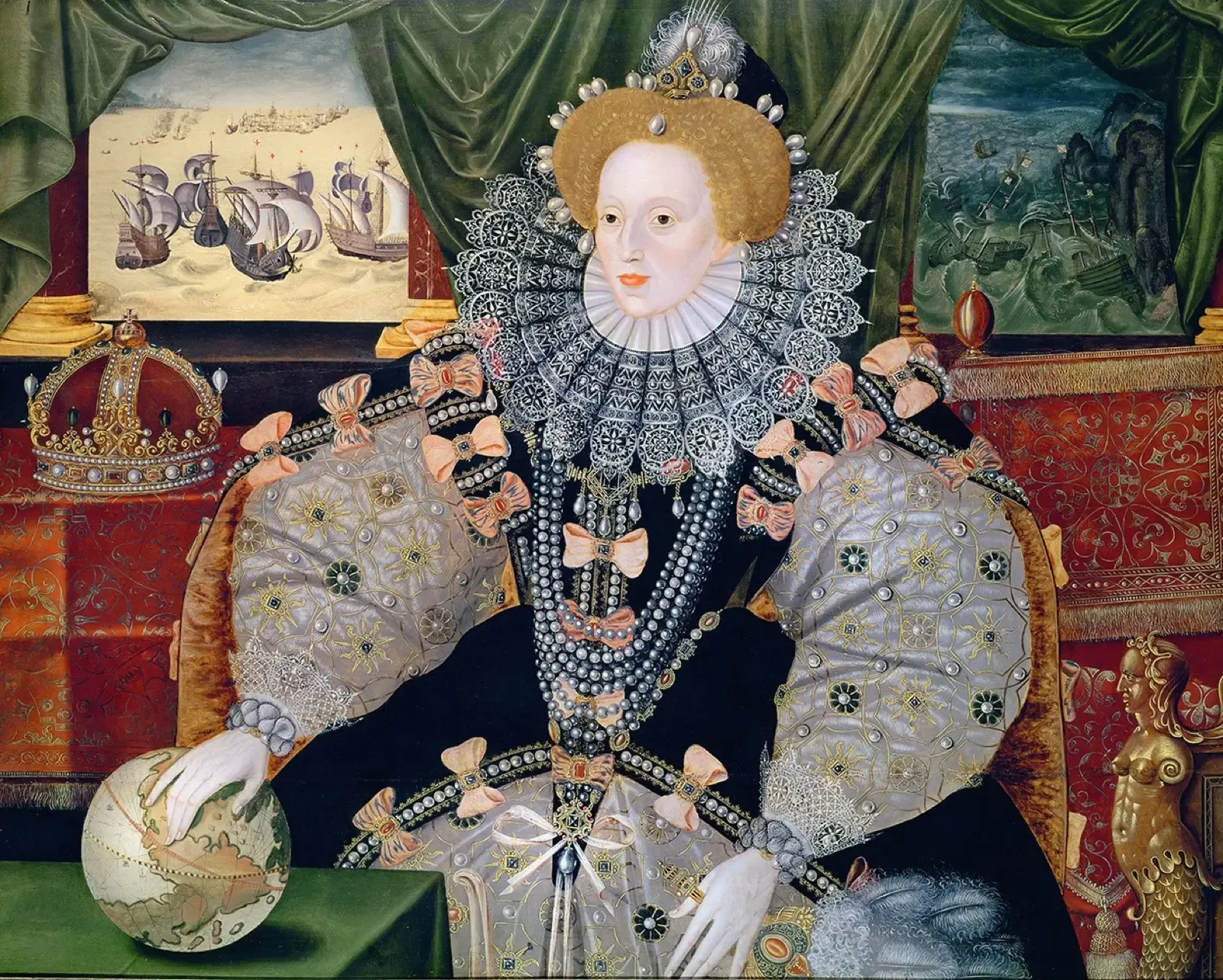
On 28 May 1588, the grandest amphibious campaign in the history of Western Europe began not with a roar of cannon fire, but with a slow, agonisingly bureaucratic creep. It took three full days for the 130 ships of the Spanish Armada - carrying nearly thirty thousand men, two thousand brass guns, and a forest of towering masts - to work their way out of the Tagus estuary. Lisbon harbour had become a choked bottleneck of maritime ambition. Every soldier, sailor, and officer on board had confessed his sins, received the sacrament, and been warned under pain of severe punishment against swearing, gambling, or harbouring women. This was not merely a fleet; it was a floating monastery with cannons, sent by King Philip II to crush the Protestant heresy of Elizabeth’s England. But as the sails unfurled under the banner of the Virgin Mary, the entire enterprise was already carrying the seeds of its own quiet, watery undoing.
To understand the madness of the Enterprise of England, one must look not at the English Channel, but at the writing desks of Madrid. Philip II was a ruler who believed that the world could be governed by ink. From his sparse, cell-like office in the Escorial, he micromanaged an empire that spanned the globe, writing thousands of letters, marginalia, and instructions. He believed, with the quiet certainty of a religious fanatic, that because Spain’s cause was holy, God would handle the logistics. When Álvaro de Bazán, the Marquess of Santa Cruz - Spain’s only legendary, battle-hardened admiral - died of typhus in February, Philip did not replace him with a seaman. Instead, he chose Alonso Pérez de Guzmán, the seventh Duke of Medina Sidonia. The Duke was the richest grandee in Spain, a brilliant administrator, and a man who possessed absolutely no naval experience. He wrote back to the King, desperately begging to be spared the appointment. He pointed out that he knew nothing of marine warfare, had no experience in the Channel, and, most damningly of all, was prone to severe seasickness. Philip ignored the protests. He did not need a brilliant tactical genius; he needed an obedient nobleman who would execute his elaborate, rigid plan to the letter.
I find the strategic delusion of the Enterprise far more telling than the tactical clashes in the Channel. The plan was a masterpiece of strategic fragility. The Armada was not sent to fight its way ashore. It was designed as a massive, armoured escort. Medina Sidonia was ordered to sail the fleet up the Channel to the coast of Flanders, where he would rendezvous with Alexander Farnese, the Duke of Parma, and Spain’s elite Army of Flanders. Parma’s thirty thousand veterans were to be ferried across the Channel in flat-bottomed barges, protected by the Armada’s heavy guns. It was a plan that required two massive forces, separated by hundreds of miles of hostile water, to coordinate their movements with split-second precision in an era when the fastest message travelled by horse or sailing boat. Worse, Parma held no deep-water ports in the Low Countries. His barges were trapped in shallow canals, easily blockaded by Dutch rebel flyboats. The Armada, composed of deep-draft galleons, could not enter these shallow waters to protect him, and there was no secure, deep-water anchorage on the French or Flemish coast where Medina Sidonia could safely wait. The Spanish were sailing toward a rendezvous that was geographically impossible.
Even before they saw an English sail, the Spaniards were fighting their own supplies. When Francis Drake raided Cadiz the previous year - “singeing the King of Spain’s beard” - he did more than sink a few ships. He burned thousands of tons of seasoned barrel staves. As a result, the Armada’s water, wine, and salt provisions had to be packed into casks made of green, unseasoned wood. Within days of leaving Lisbon, the wood warped, the water leaked and spoiled, the meat rotted, and scurvy began its quiet work. To make matters worse, the Atlantic immediately showed its indifference to Philip’s holy crusade. A series of summer gales battered the clumsy, top-heavy Spanish vessels. The fleet was scattered across the Bay of Biscay, its hulls leaking and its crews sick. By mid-June, Medina Sidonia had to put in to A Coruña to refit, dry his sails, and gather his lost ships. He wrote to Philip from the northern Spanish port, pleading with him to abandon the voyage while they still had a fleet. “We are very weak,” he warned, noting that the English ships were faster and better armed. Philip’s response was an exercise in theological hubris: since they were on God’s business, a miracle would surely be provided.
No miracle came. When the Armada finally entered the Channel in late July, they encountered an enemy that refused to fight on Spanish terms. The Spanish navy was built for the classical style of Mediterranean warfare - the tradition of Lepanto, where ships closed, rammed, and boarded, turning naval battles into land engagements fought on wooden decks. For this, they carried thousands of infantrymen and heavy, short-range guns. The English, led by Charles Howard and Francis Drake, had spent decades developing a different kind of fleet. Their “race-built” galleons were lower, faster, and could sail closer to the wind. More importantly, they were armed with long-range culverins and demicannons. The English refused to board. Instead, they hovered on the windward side of the Spanish crescent, dancing out of reach and pounding the lumbering galleons with a relentless, long-range bombardment. It was the birth of modern naval warfare - an engagement decided by gunnery and seamanship rather than hand-to-hand combat. The towering, ornate castles of the Spanish ships, designed to intimidate, became nothing more than massive, target-rich bullseyes for English gunners.
The climax of the campaign was not a grand battle, but a panic. On 28 July, as the Armada lay at anchor off Calais, desperate and still waiting for a sign from Parma, the English launched eight fireships into the crowded harbour. The sight of these blazing vessels, loaded with pitch and gunpowder, broke the Spanish discipline. Fearing “hellburners” - floating mines that had devastated Spanish sieges in Flanders - Medina Sidonia’s captains cut their anchor cables and scattered into the night. The next morning, at the Battle of Gravelines, the English closed in on the disorganised fleet, raking the Spanish hulls at close range. Only a sudden shift in the wind saved the remaining ships from running aground on the Flemish sands. With his fleet battered, his ammunition exhausted, and the wind blowing relentlessly from the south, Medina Sidonia had only one choice. He could not turn back against the wind. He had to lead his remaining ships north, around the wild, rocky coasts of Scotland and Ireland, in a desperate bid to reach home.
It was on this retreat that the “Invincible” Armada was truly destroyed. Clumsy vessels, stripped of their anchors and crewed by starving, fever-ridden men, were flung by autumn Atlantic storms against the jagged cliffs of western Ireland. Dozens of ships broke apart on the rocks. Thousands of Spanish soldiers and sailors drowned in the surf, and those who scrambled ashore were hunted down and executed by English garrisons. Of the 130 ships that had proudly sailed from Lisbon, barely sixty returned to Spain, carrying a remnant of broken, dying men. Medina Sidonia, surviving the voyage, retired in disgrace to his orange groves, forever haunted by the disaster. The myth of Spanish hegemony had been shattered in the northern seas. Philip II had spent the wealth of the Americas to build a crusade, only to watch it wash up as driftwood on the beaches of Connacht.
I look back at that May morning in Lisbon and see the eternal danger of believing that righteousness is a substitute for reality. Philip’s Armada was a masterpiece of faith and administration, designed to conquer a kingdom through pure obedience and religious zeal. But the sea has no theology, and the wind does not bow to royal decrees. The English did not defeat Spain because they were holier, but because their ships were faster, their guns had longer reach, and their captains understood that the ocean is a place of fluid tactics, not rigid scripts. The Spanish Armada sailed from Portugal to install a Catholic king and secure an empire; instead, they left their bones in the Irish sand, leaving England to work out its own maritime destiny. We are still tempted, in our own ideological crusades, to believe that our good intentions can bend the laws of gravity, geography, and economics to our will. But as the Duke of Medina Sidonia could have told us, if we had only bothered to listen, the water always wins.