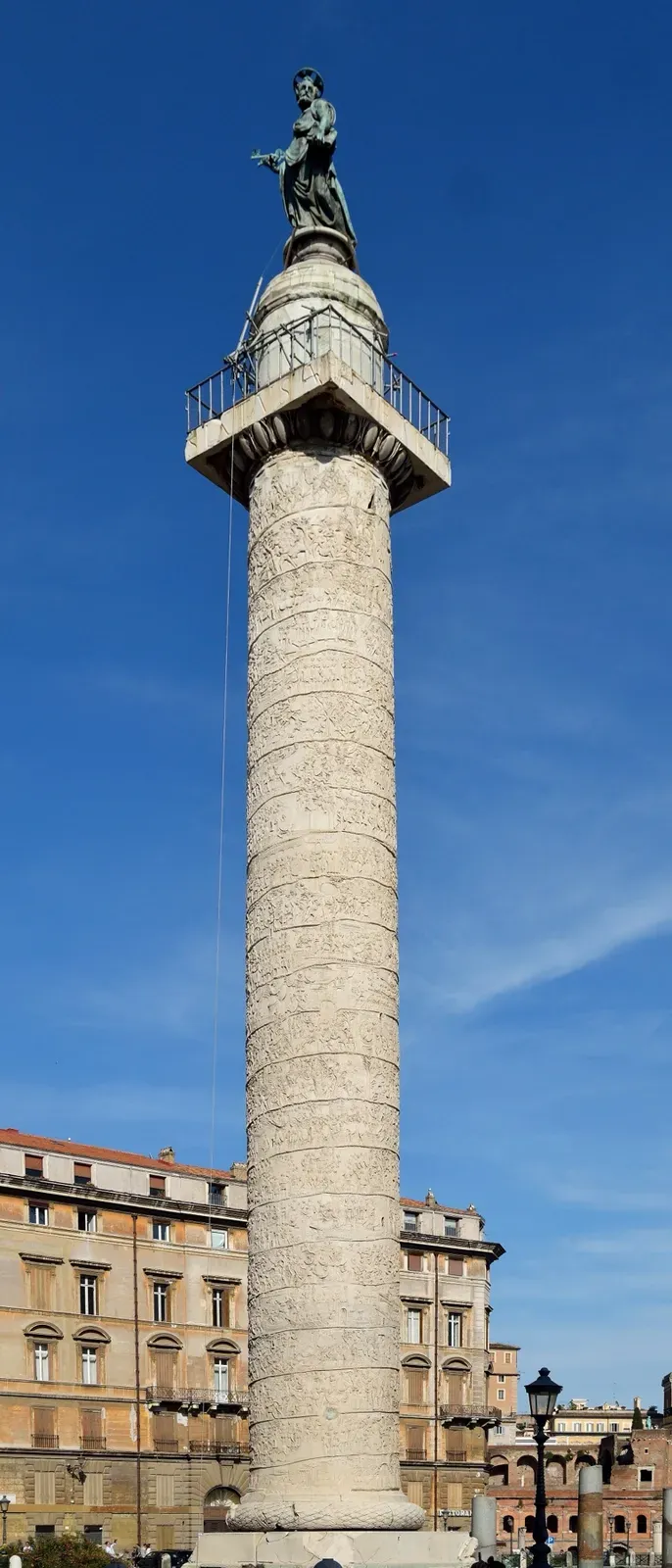
On 12 May 113 AD, Rome unveiled a column. Thirty metres of carved marble, spiralling upward through 155 scenes and roughly 2,500 individual figures, depicting in continuous narrative the Roman conquest of Dacia: river crossings, siege works, pitched battles, diplomacy, and finally the moment when Decebalus, king of Dacia, pressed his own sword to his throat rather than be paraded through the streets of Rome. The column still stands in what is now the centre of that city. Nineteen centuries of rain have softened the detail, but the structure is intact. This makes it one of the most durable pieces of political messaging ever produced, and by some distance the most detailed visual record we have of the Roman army at work.
The wars it commemorates were fought in two rounds. Trajan crossed the Danube in May 101 using a pontoon bridge designed by his engineer Apollodorus of Damascus - the same man who later designed the column - and won a hard battle at Tapae, near modern Caransebeş in Romania. Decebalus sued for peace. The terms required him to return Roman engineers, surrender captured equipment, hand over deserters, and keep his hands off the neighbouring tribes. He complied for a few years, then resumed arming himself and raiding across the river. Trajan launched the second campaign in 105, this time over a permanent stone bridge at Drobeta that stretched more than a kilometre across the Danube. Roman legions worked north, reducing Dacian mountain fortresses one by one. When Sarmizegetusa - the Dacian capital - fell in 106, its water pipes had been cut by a Dacian traitor working for the Romans. Decebalus fled. The cavalry caught up with him. He chose the sword.
What followed the victory was less military campaign than audited robbery. A confidant of Decebalus named Bicilis led Roman forces to the place where the king had diverted the river Sargetia and hidden his treasury in the riverbed. Modern estimates put the haul at around 165,000 kilograms of gold and 330,000 kilograms of silver. The new province of Dacia, with its rich gold and silver mines now under Roman administration, was later calculated to contribute something in the order of 700 million denarii annually to the imperial economy. Trajan announced 123 days of public celebrations in Rome. The games that followed involved 10,000 gladiators and 11,000 animals. He could afford it.
The column itself was dedicated before the Parthian campaign of 113-117, which would push the empire to its furthest territorial extent. But the Dacian wars were the financial engine of everything that came after: the Forum of Trajan, the largest ever built in Rome; the Via Traiana running south to Brindisi; a welfare programme - the alimenta - providing food support for poor children across Italy, funded through mortgage agreements on agricultural land. All of this flows, directly or indirectly, from the Dacian mines. The column stands inside the forum it helped pay for.
What makes it genuinely irreplaceable as a historical document is the specificity. Earlier Roman monuments tell you Rome won; Trajan’s Column tells you how. You can read off the structure of a Roman marching camp from the carved panels. You can see legionaries building fortifications, setting fires to Dacian villages, operating artillery, swimming rivers, negotiating with allies, and preparing field surgery. Dacian warriors are shown with their distinctive curved swords, the falx, a weapon that Roman armourers apparently took seriously enough to redesign their helmets in response. The column is not a stylised allegory - it is a record, biased toward Roman competence as any official account would be, but a record.
Apollodorus designed it to function as a funerary monument as well as a triumph. Trajan’s ashes were placed in a golden urn at the base of the column after his death in 117 - the only emperor ever granted burial inside the city walls. The height of the column, at roughly thirty metres, is thought to be a direct reference to the depth of the hill that was excavated to create the forum. It marks, literally, how much rock the building programme displaced.
The column also arrives at the high-water mark of Roman territorial reach - a moment that would not be revisited. Trajan’s successor Hadrian inherited Mesopotamia and handed most of it back within a year, concluding what Trajan’s own generals had begun to suspect: that the final eastern campaigns had taken more than could be held. Dacia, at least, held. The province survived for a century and a half, developing a Latin-influenced culture robust enough that its descendants still speak a Romance language today. Romania - the name itself carries the lineage.
Standing on the column in the middle of what is now a busy roundabout in central Rome, the carvings are mostly illegible from ground level without binoculars. The Renaissance popes had a bronze statue of St Peter placed on top. The forum around it is mostly excavated ruin. None of that changes what the structure is: a thirty-metre stone newspaper, published in 113 AD, covering the war that paid for Rome’s last great generation of building. You could do worse for a primary source.