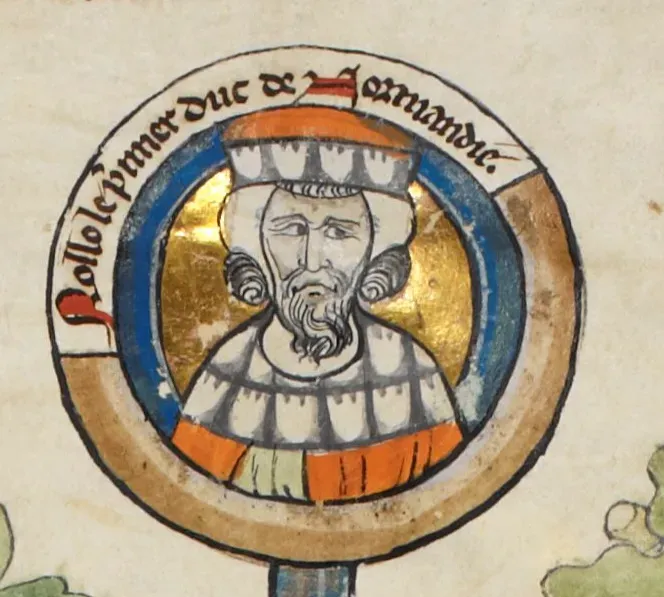
Charles III of West Francia carried the nickname “the Simple” for most of his reign and all of his afterlife. It is a bad translation. The Latin was simplex, closer to “straightforward” than “simpleton,” but historians write in the language they inherit, and English speakers heard “simple” and reached for the obvious joke. The joke is unearned. In the autumn of 911, this supposedly dim king made one of the shrewdest bets in medieval history, and it worked so well that a great-great-great-grandson of the man he cut the deal with ended up ruling England.
By 911, West Francia had been bleeding from Viking raids for three generations. Paris had been besieged in 845 and again in 885, the second time for a full year. Charlemagne’s heirs had tried every available response - pitched battle, bribery, more bribery - and none of it worked for long, because a kingdom that pays Vikings to leave just teaches them where to come back. One of the men who had fought at that second siege of Paris was a Norse warlord named Rollo, who by 900 had stopped raiding the Seine valley and started living in it, settling his followers around Rouen with the kind of permanence that raiders don’t usually go in for.
That settlement held for a decade, more or less peacefully, until 911, when Rollo took his men south and laid siege to Chartres. It went badly. On 20 July, a relief force under Robert of Neustria and Richard of Burgundy broke the siege and mauled the Viking army badly enough that Rollo could no longer contemplate more of the same. Charles was not at the battle, but he understood exactly what it meant: Rollo’s men were containable by force, at a cost, indefinitely, or they could be made to stop for free. He rode to negotiate a peace, and by that autumn the two men had reached the arrangement historians would come to call the Treaty of Saint-Clair-sur-Epte.
Here is the inconvenient part. No copy of that treaty exists, and none may ever have existed. It was very possibly a spoken agreement, sealed by oath rather than parchment. The only detailed account of what was said and done comes from Dudo of Saint-Quentin, a cleric who wrote his History of the Normans around a century later, commissioned by Rollo’s own great-great-grandson, Duke Richard II, specifically to glorify the dynasty paying his wages. A royal charter from 918 does confirm that Charles had granted land “to the Normans of the Seine, that is, to Rollo and his companions, for the protection of the kingdom” - so the deal certainly happened. Whether it happened the way Dudo says, in the place Dudo says, on the terms Dudo says, is a different question, and one that has kept several generations of medievalists gainfully employed.
What the sources agree on is the shape of it. Charles gave Rollo formal title to the land around Rouen and the Pays de Caux, the territory his men had already been squatting on for a decade, stretching from the river Epte to the sea. In exchange, Rollo agreed to be baptised, to swear fealty to the Frankish crown, and to defend the Seine estuary against the raiders he had recently been one of. Dudo adds a wedding, to Charles’s daughter Gisela, though Gisela does not appear anywhere else in the historical record and may not have existed at all. He also adds a scene almost too good to be reliably true: bishops instructing Rollo to kiss the king’s foot as a gesture of submission, Rollo refusing, and delegating the job to one of his warriors, who grabbed Charles’s foot and lifted it to his own mouth without warning, tipping the king over backwards in front of his own court. Dudo was writing propaganda, and a founding king literally knocked on his back by a Viking’s idea of etiquette is exactly the kind of detail propaganda invents. It may also be exactly true. Medieval sources have a way of being both.
Whatever actually happened on that riverbank, the deal itself was real, and it was the right call. Charles was not conceding defeat. He was outsourcing a problem he could not solve by force to the one group of people with an incentive to solve it: give the raiders a stake in the land, and they stop being raiders and start being border guards. It worked immediately - the Seine stopped being a Viking corridor - and it kept working for centuries, which is a return on investment that very few medieval treaties can claim.
What followed was faster and stranger than the deal itself. Rollo took the baptismal name Robert and, in the phrase of one chronicler, spent his later years beheading captives in the name of Odin and endowing churches in the name of Christ, apparently without noticing the contradiction. His son, William Longsword, was raised speaking French. By the 930s, Old Norse had all but disappeared from Rouen, and William had to send his own son, Richard, to be fostered in Bayeux specifically so the boy would grow up able to speak the ancestral language at all - a Viking dynasty, three decades into its own kingdom, importing its founders’ tongue like a foreign elective. The men who had sailed up the Seine to plunder it had, within a single generation, become its French-speaking, church-endowing landlords. Nobody planned that speed of assimilation. It just happened, because it turned out that Rollo’s men wanted what everyone eventually wants: land, security, and a story that lets their grandchildren belong to the place they conquered.
The result was the Duchy of Normandy: Frankish law and Latin Christianity running on Norse discipline and Norse appetite for risk, a combination nothing in ninth-century Europe had quite produced before. A hundred and fifty-five years after Saint-Clair-sur-Epte, Rollo’s descendant Duke William crossed the Channel, beat Harold Godwinson at Hastings, and installed a French-speaking aristocracy over Anglo-Saxon England that reshaped English law, land tenure, and half its vocabulary. Norman ambition did not stop at the Channel. Adventurers from the same duchy pushed south into Italy through the eleventh century, carved out the Kingdom of Sicily from Byzantines and Muslim emirs, and built a court in Palermo that ran in Greek, Arabic, and Latin at once. From one Viking’s failed siege of a French cathedral town came two kingdoms and a Mediterranean dynasty, all traceable back to a land grant nobody bothered to write down.
Charles got less credit for this than the man who signed away nothing and gained everything by force usually does. He was deposed by his own nobles in 923 and died in captivity six years later, a footnote to the dynasty he had spent his reign trying to hold together. Rollo’s line, by contrast, is still being counted: every British monarch since 1066 descends from him, an unbroken line running back nearly a thousand years to a Norse pirate who agreed to stop raiding a river in exchange for the right to own its banks. Call Charles simple if the word still amuses you. The bargain he struck outlasted his crown, his kingdom, and the joke.