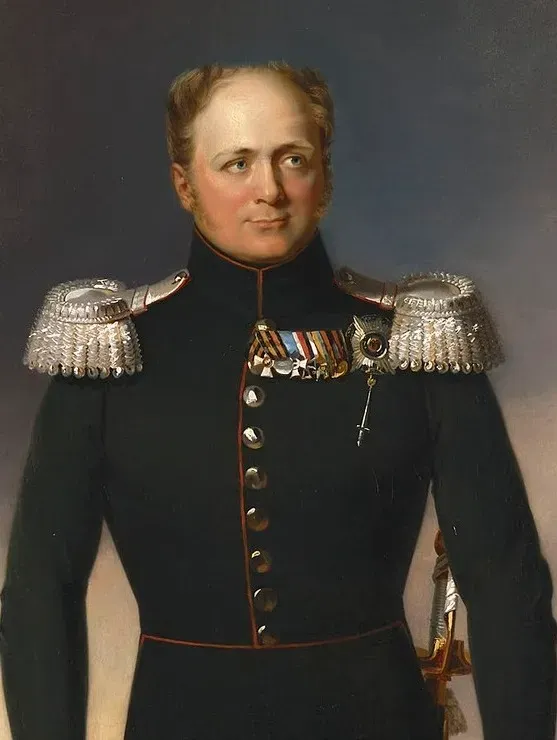
On 25 June 1807, carpenters on the Neman River finished building a raft with two matching pavilions, one marked with a large gilt “N”, the other with an “A”. Onto this raft stepped Napoleon Bonaparte and Tsar Alexander I of Russia, two men who had spent the previous two years trying to destroy each other’s armies, to meet as equals for the first time in their lives. Waiting on the riverbank, not invited aboard, was King Frederick William III of Prussia. He sat on his horse in the rain and watched two other emperors decide his country’s future without him. It was a fitting preview. Everything that mattered about the peace of Tilsit - who got a seat at the table and who got left holding the bill - was visible before either treaty was signed.
The meeting happened because Napoleon had just finished proving, for the second time in eighteen months, that neither Russia nor Prussia could beat him in the field. Austerlitz in 1805 had knocked Austria out of the war and shattered the Third Coalition. The Fourth Coalition, built around Prussia and Russia, fared no better: Napoleon crushed the Prussian army at Jena and Auerstedt in October 1806 and occupied Berlin within weeks. Russia fought on alone through a brutal winter campaign, and at Friedland on 14 June 1807, Napoleon caught the Russian army with its back against a river bend and inflicted around 20,000 casualties in a single day. Alexander had no army left worth the name and no coalition partner left standing. He asked for an armistice four days later.
What followed on the raft was theatre, and both sides knew it. Napoleon set out to charm a man he needed as a client rather than a corpse, and by every account he succeeded: Alexander found him fascinating, the two spent hours in private conversation, and Napoleon reportedly told him “I hate the English as much as you do,” which was exactly the sentence a flattered Russian autocrat wanted to hear from the most successful general in Europe. The performance was aimed at least as much at the watching courts of Europe as at Alexander himself. Two emperors, standing as equals, dividing a continent between them, was precisely the image Napoleon wanted the rest of the world to absorb.
The treaty they produced on 7 July gave that image legal form. Russia agreed to ally with France, sever relations with Britain, and join the Continental System, Napoleon’s attempt to strangle the British economy by closing every port in Europe to its trade. In exchange, Napoleon gave Alexander a free hand against Sweden, which cost Sweden Finland within two years, and tacit encouragement to expand at Ottoman expense in the Balkans. Napoleon also carved a new state out of the Prussian and Austrian partitions of Poland: the Duchy of Warsaw, technically ruled by the King of Saxony but functionally a French client and a permanent reminder to both Russia and Prussia of what French power could rearrange on a map.
Prussia found out exactly where it stood two days later. Frederick William III had refused to meet Napoleon directly, and Napoleon made him pay for the insult. Queen Louise of Prussia travelled to Tilsit herself and pleaded personally with Napoleon for gentler terms, a meeting Napoleon later described with some satisfaction and which produced, for all her effort, a single rose and no meaningful concession. The treaty signed on 9 July stripped Prussia of roughly half its pre-war territory and population, handed its Polish provinces to the new Duchy of Warsaw, imposed indemnities that would take years to pay off, and required Prussia to house French occupation troops until the debt was settled. The charm Napoleon spent so freely on Alexander, he withheld entirely from Prussia. There was no equal on that side of the ledger, only a defeated power being made an example of.
For a moment, the arrangement looked like the definitive settlement of the continent. Austria had been humbled twice, Prussia had been gutted, and Russia - the one power large enough to have kept fighting - was now formally allied with France and cut off from Britain. Only Britain remained in open opposition, an island Napoleon could not reach and could only try to starve through the blockade he had just persuaded Alexander to join. This was the summit of Napoleon’s continental power, and he knew it: for the next several years, no coalition would seriously threaten him.
The alliance was built on convenience, and convenience did not last. The Continental System that Alexander had signed onto was an economic disaster for Russia specifically, since the Russian nobility’s wealth depended heavily on grain and timber exports that had gone almost entirely to Britain. Landowners who found their income cut off did not stay quiet, and Alexander could not indefinitely enforce a blockade that was bankrupting his own aristocracy. By December 1810 he had issued a decree opening Russian ports to neutral shipping, which in practice meant British goods flowed back in under other flags. Portugal had refused outright to join the same system in 1807 and paid for it with a French invasion that sent its royal family fleeing to Brazil - a preview, on a smaller scale, of how badly Napoleon reacted to anyone breaking ranks on this particular policy.
Poland made the friction worse. Russia had never been comfortable with a French-sponsored state sitting on its western border with the ambition, real or suspected, of eventually restoring a full Polish kingdom carved partly out of Russian territory. Napoleon’s ambitions in the Balkans and toward Constantinople collided with Alexander’s own designs on Ottoman territory, undercutting the very trade Napoleon had offered as payment at Tilsit. What had been sold to both emperors as a durable partnership turned out to be two rival sets of ambitions that happened to overlap for exactly as long as neither side tested the other.
By 1812, the test came. Napoleon assembled the largest army Europe had ever seen, more than 600,000 men, and crossed the Neman - the same river the two emperors had met on five years earlier - to invade the ally he could no longer trust. What came back across that river in December 1812 was a fraction of what had gone in, and the campaign broke the myth of Napoleon’s invincibility beyond any repair. The coalition that finally ended his rule two years later was built directly on the wreckage of the alliance he had staged so carefully on a raft in the middle of a river.
The image from Tilsit that endures is the two emperors alone in their tent, performing a friendship neither entirely felt, while a third monarch waited outside in the rain for a verdict on his country. That image told the truth about the peace it produced: an alliance of convenience dressed up as brotherhood, built to last exactly as long as it suited the stronger party. Napoleon’s power never stood higher than the week he spent flattering Alexander on that raft. It never really recovered from what happened once the flattery ran out.