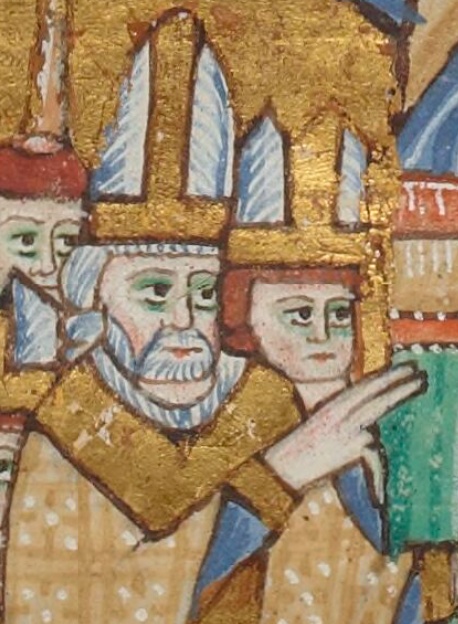
On 12 March 1088, a small gathering of cardinals met in Terracina, a coastal town about 100 kilometres south-east of Rome, and elected a new pope by acclamation. They could not meet in Rome — the previous occupant had been expelled by the Holy Roman Emperor Henry IV, who had his own pope installed there. The man they elected, Odo of Châtillon, a French Benedictine monk who had been prior of Cluny, took the name Urban II. He would reign for eleven years, spend much of that reign unable to enter his own city, and in November 1095 deliver a speech at Clermont that set in motion what we now call the Crusades. He died on 29 July 1099, fourteen days after the fall of Jerusalem to his crusaders, without ever receiving the news, communications being somewhat slow in the XI century. The machine he had built outlasted him by two hundred years.
It is one of the stranger enterprises in recorded history: a religious official, locked out of his own headquarters by a political dispute, managing to mobilise tens of thousands of soldiers to march 3,000 kilometres and capture a city most of them had never seen, in the name of a theology most of them barely understood — and doing so by giving a speech whose precise words nobody thought to write down at the time.
Urban was not an obvious revolutionary. Born around 1035 to a noble family in Châtillon-sur-Marne, he received his early education at the cathedral school of Reims, entered the abbey of Cluny — the most powerful monastery in Europe, at the centre of the Gregorian reform movement that sought to free the church from lay control — and rose to be its prior. Pope Gregory VII made him cardinal-bishop of Ostia around 1080. He was, in other words, a church bureaucrat of the most refined kind: a reformer, a diplomat, a man who understood ecclesiastical politics from the inside out.
The politics he inherited were ugly. Gregory VII had spent his papacy in a ferocious contest with Henry IV over who had the right to appoint bishops — the Investiture Controversy, as historians call it, the central political crisis of eleventh-century Europe. Henry IV had marched on Rome in 1084 and installed Guibert of Ravenna as Antipope Clement III. Gregory VII died in exile in Salerno in 1085, reportedly saying: “I have loved righteousness and hated iniquity; therefore I die in exile.” His short-lived successor Victor III was barely settled before he too died. Urban was elected to inherit this catastrophe.
For the first years of his papacy, Urban governed from wherever he could find support — Norman Sicily, northern Italy, France. He held synods in Amalfi, Benevento, Troia. He worked the levers he had: arranging marriages, supporting rebellions against Henry IV, building coalitions. Rome was occupied by his rival. He finally manoeuvred his way back into the city in 1094, four years after his election. Even then his grip was partial. He was a pope without a capital, trying to run a universal church from a series of temporary addresses.
In March 1095, Urban held a council at Piacenza. Among the visitors was an ambassador from Alexios I Komnenos, the Byzantine emperor, asking for military assistance against the Seljuk Turks who had overrun most of Anatolia following their victory at Manzikert in 1071. Alexios wanted soldiers — mercenaries, ideally, or auxiliaries from the West, the kind of professional help he had used before. What he got was rather more than he bargained for.
Eight months later, Urban convened the Council of Clermont. Church business dominated most of the sessions: simony, clerical celibacy, the usual Gregorian agenda. But on 27 November 1095, at the end of the council, Urban spoke to a crowd assembled outdoors — too large for any building in the city to contain — and called on Christendom to take up arms and march to the East.
We do not know what he said. Five versions of the speech survive; all were written down years later; none agrees with any other on the details. One account, by Robert the Monk, has Urban invoking population pressure and endemic warfare: “This land which you inhabit… is too narrow for your large population; nor does it abound in wealth, and it furnishes scarcely food enough for its cultivators. Hence, it is that you murder one another, that you wage war, and that frequently you perish by mutual wounds.” Another version, by Fulcher of Chartres, who was there, stresses aid to Eastern Christians and the liberation of Jerusalem. Urban’s own letters to Flanders and Bologna frame the objective as freeing the Eastern churches generally rather than recapturing any particular city. Jerusalem may not even have been the primary stated goal at Clermont — it appears to have become one as the enterprise took shape.
What seems certain is that the crowd’s response was overwhelming. “Deus vult!” — “It is the will of God!” — filled the square at Clermont. Whether the phrase was coined there, or constructed afterward as a catchy slogan, nobody can say with confidence. Either way, the response was far beyond anything Urban had planned for.
The People’s Crusade set off in the spring of 1096, months before the military expedition was assembled. Peter the Hermit, a wandering preacher, had recruited thousands of non-combatants — farmers, tradespeople, women, children — and led them through Hungary and the Balkans toward Constantinople. Alexios I regarded this ragged column with alarm and shipped them across the Bosphorus as quickly as he could. The Seljuks massacred most of them near Nicaea in October 1096. The main military expedition, assembled from the armies of several French and Norman lords, arrived in Constantinople that autumn rather more intact, and pushed on through Anatolia and Syria.
The First Crusade was, by its own objectives, a success. Jerusalem fell on 15 July 1099. The crusaders killed most of the city’s population — Muslim and Jewish, and a number of Eastern Christians who happened to be in the way. Contemporary accounts, including those by crusaders themselves, describe the streets running with blood, the Temple Mount strewn with bodies. Eyewitness numbers are unreliable, but the massacre was not contested. The crusaders established the Kingdom of Jerusalem and three smaller Crusader states — the County of Edessa, the Principality of Antioch, the County of Tripoli — that between them covered much of what is now Israel, the Palestinian territories, Lebanon, and parts of Syria and Turkey. They would survive, in attenuated form, for nearly two centuries.
Urban II died on 29 July 1099, without learning any of this. The news from Jerusalem had not yet reached Italy. He had reigned for eleven years, recovered Rome, seen the antipope driven out — Clement III was removed from the city in 1097 by one of the very French armies now marching east — and died, as best we can tell, unaware that his greatest gamble had paid off.
The bill, when it arrived, was addressed to people who had not sent the invoice. The immediate beneficiaries of the Crusades included not the papacy but the Italian merchant republics — Venice, Genoa, and Pisa — who supplied transport, provisioned armies, and established trading colonies in Crusader-held ports. The commercial networks they built in the eastern Mediterranean funded the wealth that would, over the following two centuries, pay for the Italian Renaissance. The military orders — the Knights Templar, founded around 1119; the Hospitallers, already operating in Jerusalem before the crusade — grew into proto-states with their own territories, armies, courts, and, in the Templars’ case, a pan-European banking network. They were among the most sophisticated organisations in medieval Europe, and neither would have existed without Urban’s speech at Clermont.
The damage, meanwhile, accumulated slowly but durably. The Second Crusade in 1147 failed. Saladin retook Jerusalem in 1187. The Third Crusade, led by Richard I of England and Philip II of France, fought Saladin to a draw and secured a corridor to the coast but not the city. Then came the Fourth Crusade.
In 1202, a crusading army assembled in Venice with the intention of sailing to Egypt. Through a combination of debt, diversion, and cynical opportunism — the Venetians, who controlled the fleet, were owed money they could not collect any other way — the expedition ended up sacking Constantinople in 1204. The city was stripped, the Byzantine Empire effectively dismembered, and a Latin emperor installed on the throne of the Caesars. Byzantium never fully recovered. The empire staggered on in reduced form until the Ottomans took Constantinople in 1453 — an event that might have happened anyway, but was substantially hastened by a century and a half of Latin interference and permanent mutual resentment. The Fourth Crusade did more lasting damage to Eastern Christianity than any Muslim conquest of the era, and it was the direct institutional descendant of Urban’s initiative at Clermont.
The East-West Schism of 1054 — the formal break between Roman and Eastern Orthodoxy — had predated Urban. But the Crusades transformed a theological disagreement into something harder to repair. The Greek clergy did not forget 1204. They did not forget it in 1439, when the Council of Florence attempted reunion, or in 1453, when the Byzantine emperor begged for Western help and got almost none. “Better the Turkish turban than the Latin mitre” was a sentiment widely attributed to Lucas Notaras, a senior Byzantine official, in the weeks before the city fell. Whether he said it or not, it expressed something real about what the Crusades had cost.
The conceptual legacy is harder to measure. “God wills it” is still in circulation, used as a slogan on the internet by people who may have heard of the Crusades only dimly and who are usually not endorsing anything Urban II would have recognised. The template he established — religious violence as a penitential act, warfare as a form of spiritual merit, the holy war framed as defence of the innocent — proved extraordinarily durable. Subsequent medieval popes called crusades against heretics in southern France, against political enemies in Sicily, against the Mongols, against anyone who needed to be fought for reasons that could be dressed in theological language. The machinery was too useful to retire.
Urban II was a capable, flexible, politically astute man who spent most of his papacy solving immediate problems with the tools he had. His call at Clermont was, among other things, a political calculation: the Crusade gave him credibility at home, an enemy to unite against, and — as it happened — the mechanism by which his rival’s antipope was finally ejected from Rome. He did not intend to reshape the medieval world. He intended to survive his papacy and advance the Gregorian reform agenda. He did both. The world that followed was not his fault, exactly, but it was his doing.
He was elected on 12 March 1088 in a town where he had no particular desire to be, by men who were making the best of a bad situation. He died, just over eleven years later, in a city he had spent years trying to re-enter, having launched an enterprise he did not live to see complete. The machine he set in motion ran until the last Crusader state fell in 1291, and left marks that have not entirely faded nine centuries later. Nobody plans for that. But then, nobody plans to start something quite that large.