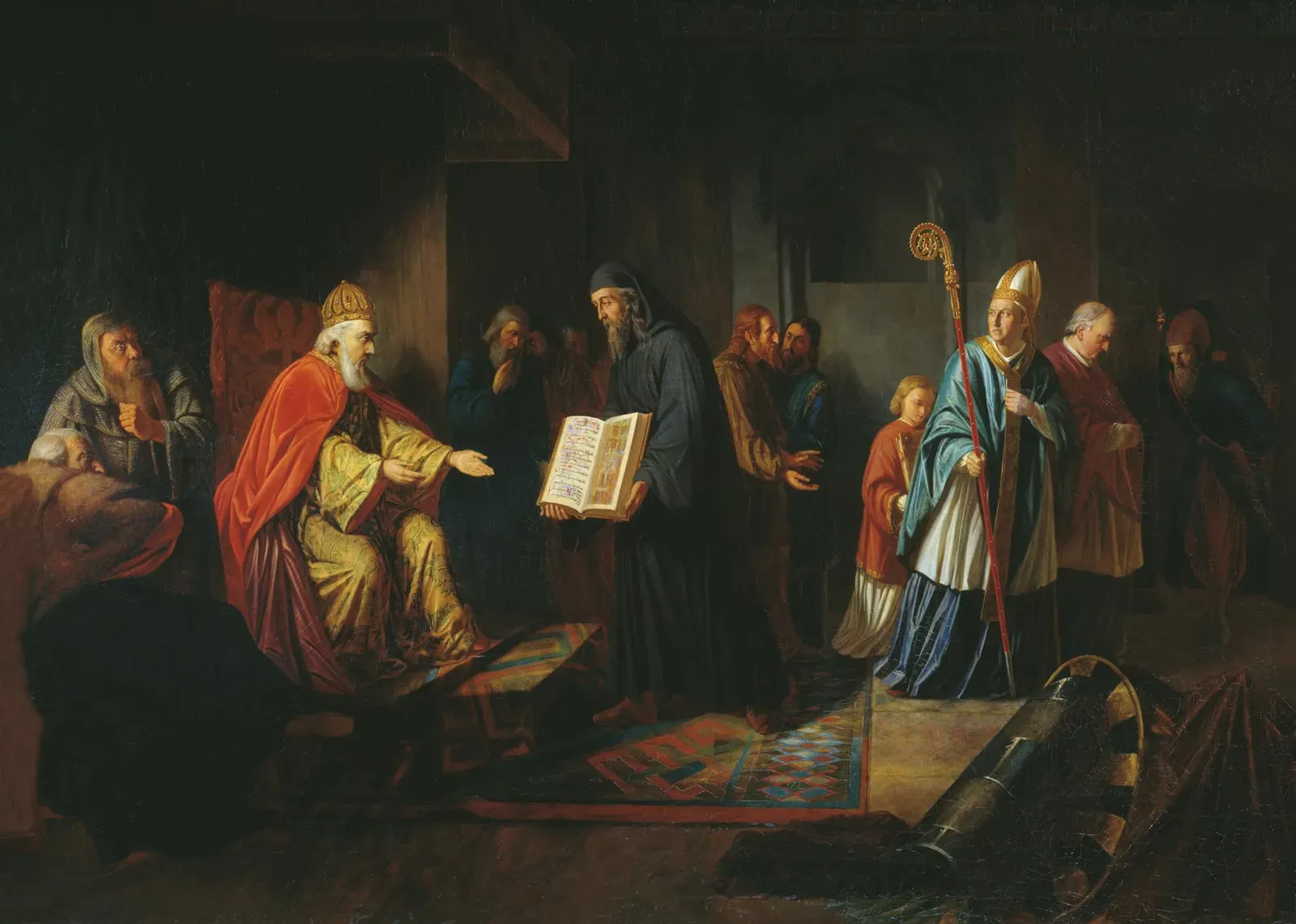
The man proclaimed ruler of all Kievan Rus’ on 11 June 980 had taken the throne by arranging his brother’s murder during peace negotiations. He would die a saint. The Orthodox Church styles him Equal-to-the-Apostles, Moscow raised a sixteen-metre statue of him within sight of the Kremlin in 2016, and Kyiv has had its own monument to him above the Dnieper since 1853. Two states at war both claim Vladimir as a founding father. Neither dwells much on how he came to power.
The succession crisis that produced him began with his father’s death. Sviatoslav I, the last great pagan warlord of the Rurikid line, spent his reign campaigning - he crushed the Khazars, fought the Bulgarians, alarmed Byzantium - and was killed by Pechenegs at the Dnieper rapids in 972, ambushed on his way home. The Pecheneg khan, by tradition, had his skull made into a drinking cup. Sviatoslav left three sons in three seats: Yaropolk in Kiev, Oleg among the Drevlians, and Vladimir in Novgorod. Vladimir was the youngest and the least legitimate - his mother, Malusha, was a housekeeper in the service of his grandmother Olga. The arrangement of three brothers in three capitals lasted about as long as such arrangements usually do.
In 977, Yaropolk moved against Oleg. The Drevlian prince died in the retreat from a lost battle, crushed in the press of men and horses on a bridge outside his own fortress at Ovruch. The chronicle has Yaropolk weeping over the body. The tears, if they happened, did not change the arithmetic: two brothers remained, and Vladimir understood what came next. He fled Novgorod for Scandinavia, leaving the city to Yaropolk’s governors. For a moment, the realm was united under Kiev - by conquest, under the elder brother.
Vladimir came back with an army. He had spent his exile recruiting Varangians - Norse mercenaries, the same stock his great-great-grandfather Rurik had come from - and he retook Novgorod, then turned on Polotsk, a principality sitting on the route between his city and his brother’s. He had sought the hand of Rogneda, daughter of Polotsk’s prince Rogvolod, and she had refused him with a phrase the chronicler preserved: she would not pull off the boots of a slave’s son - the boot-removal being a wedding ritual, the slave’s son being precisely what the insult says. Vladimir stormed Polotsk, killed Rogvolod and his sons, and took Rogneda by force as a wife. The chronicle records this without flinching. So should we. The man being described was a Viking-age warlord, and he behaved like one.
Then came Kiev. Vladimir did not take the city by storm; he took it by purchase. Yaropolk’s voivode Blud was persuaded to change sides, and on his advice Yaropolk abandoned the well-fortified capital, then agreed to meet his brother for negotiations at the residence of Rodnya. As he entered the hall, two Varangians ran him through with swords. The Primary Chronicle dates Vladimir’s accession to 11 June 980 - some modern historians, working from a Byzantine source, prefer 978 - and from that day he was knyaz, grand prince, of all the lands of the Rus’: from Kiev on the Dnieper north through Polotsk and Smolensk to Novgorod, and onward to the tribute-lands reaching the Baltic and the Gulf of Finland. One ruler, one realm, built on a brother’s corpse. He even took Yaropolk’s widow, a former Greek nun, into his household.
What he ruled was less a state than a network. The Rus’ realm was a river system with armed men at the junctions - Norse-descended princes and their retinues collecting tribute from Slavic, Baltic, and Finnic tribes, and shipping the proceeds south. The great artery ran from the Baltic to the Black Sea, the route the chronicles call the way from the Varangians to the Greeks: furs, wax, honey, and slaves moving down the Dnieper toward Constantinople, silver and silk coming back. Kiev sat at the point where the forest met the steppe and taxed everything that passed. Vladimir’s achievement was to hold the entire length of the artery in one pair of hands, and then to spend three decades fighting - against the Poles for the Cherven towns, against the Volga Bulgars, against the Pechenegs, for whom he built chains of fortified lines south of Kiev - to keep it there.
A network needs more than garrisons; it needs something shared. Vladimir’s first attempt at this was pagan. Early in his reign he erected a pantheon on a hill in Kiev - Perun the thunder god foremost, with a silver head and a golden moustache, flanked by five other deities - in what looks like an effort to standardise the realm’s scattered cults into a single official religion with himself as patron. It did not take. The gods of the pantheon meant different things to different tribes or nothing at all, and the experiment is remembered mainly for the chronicle’s claim that human sacrifices were made there. Eight years later, Vladimir solved the problem differently: he converted to Byzantine Christianity, married Anna, the sister of Emperor Basil II - a porphyrogenita, born in the purple, a bride previous emperors had refused to barbarian kings as a matter of principle - and had the population of Kiev baptised in the Dnieper. Perun’s idol was dragged to the river behind a horse, beaten with sticks, and thrown in.
The conversion of 988 is the act for which Vladimir is canonised, and it deserves its reputation. It bound the Rus’ lands into the Byzantine world - its alphabet, its law, its architecture, its art - and it gave the realm the shared identity the pantheon on the hill had failed to provide. But the conversion only mattered because of what had happened eight years earlier. A baptism can unite a realm; it cannot create one. The realm was created on 11 June 980, by a slave’s son with a Varangian army and no scruples worth recording.
The afterlife of that realm is the contested part. Kievan Rus’ fragmented among Vladimir’s descendants - he had a dozen sons by various wives, and the succession wars began before his body was cold - and the Mongols finished it off in 1240. Out of the wreckage grew several successor claims, and two of them are now at war. Russian historiography runs a straight line from Vladimir’s Kiev through Vladimir-Suzdal to Moscow, which is why Putin unveiled that statue beside the Kremlin and why the argument that Russia begins at Kiev is doing such heavy political work today. Ukrainian historiography points out the obvious: the city is Kyiv, the realm’s heart was on the Dnieper, and Volodymyr - the Ukrainian form of the name - ruled there, not in Moscow, which would not exist for another century and a half. Both lines of descent are real in the way such things are real, which is to say partially, and selectively, and in the service of the present.
Vladimir himself would have found the dispute strange. He was not building a nation; the concept did not exist. He was a Rurikid prince of Norse descent ruling Slavic tribes from a city on a trade route, and the unity he created was personal - it lived exactly as long as one man could dominate his relatives, and it died with him in 1015, when his sons went to war just as he and his brothers had. What survived was not the state but the idea of it: a single realm of the Rus’, baptised in one river, ruled from one city. A thousand years on, the idea is still potent enough to fight over. The fratricide of 980 became a saint, and the saint became an argument, and the argument is not finished.