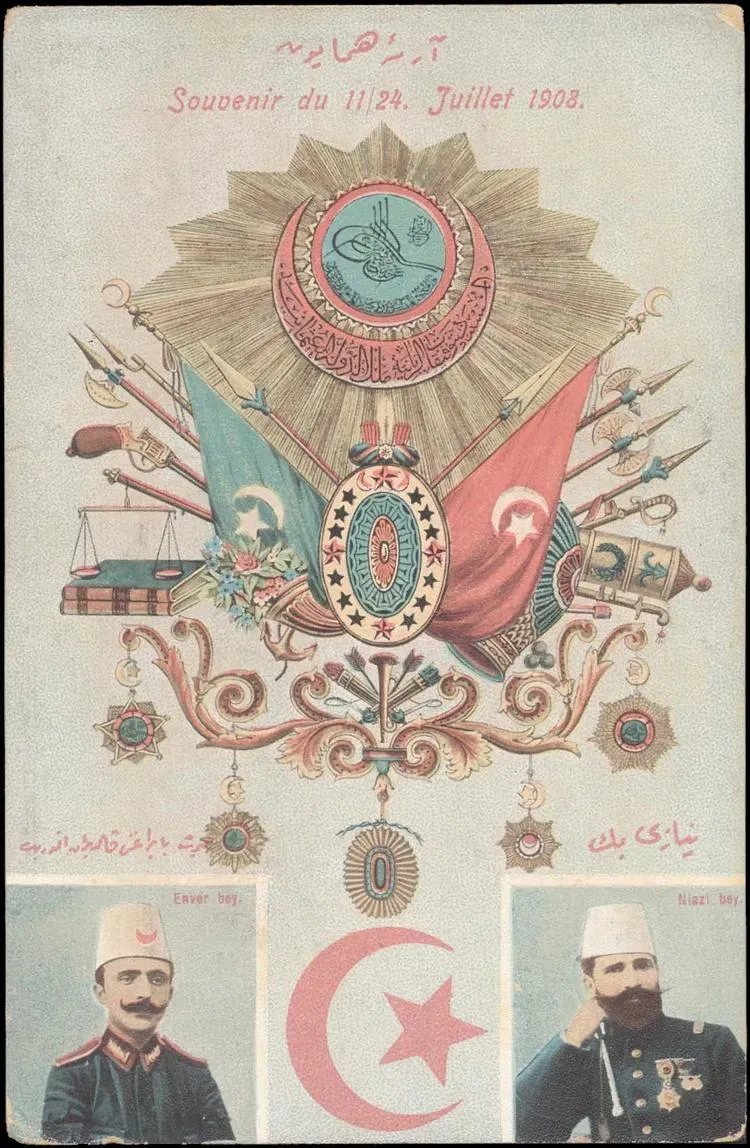
On 3 July 1908, a mid-ranking Ottoman officer named Ahmed Niyazi spread a rumour that a Bulgarian guerrilla band was approaching Resne, in Ottoman Macedonia, and used the panic to lure his own garrison commanders away to deal with it. While they were gone, he and two hundred followers raided the town’s military depot, took seventy rifles, fifteen boxes of ammunition, and 600 gold liras from the safe, and marched into the mountains. He left behind a proclamation calling for the restoration of the constitution of 1876. Three weeks later, Sultan Abdul Hamid II - the most feared autocrat the Ottoman Empire had produced in a century - agreed to give it to him. That is usually filed under liberal triumph: the end of despotism, a free press, an empire finally dragged level with the nineteenth century. It was also the opening act of a project that would organise a genocide within seven years and empty out the empire it was supposed to save.
Abdul Hamid had suspended the 1876 constitution and its short-lived parliament in 1878, two years after taking the throne, and ruled for the next thirty years through an informal network of spies, censors, and secret police so extensive that even the word “revolution” was reportedly struck from newspapers. Opposition to this survived mainly among exiled intellectuals and, more dangerously, inside the officer corps of the Ottoman Third Army stationed in Macedonia - men who watched the empire lose ground in the Balkans year after year and concluded the Sultan’s system, not just the Sultan, was the problem. They organised themselves as the Committee of Union and Progress, the CUP, a secret society threaded through garrisons from Salonica to Monastir. By the summer of 1908, an investigatory commission sent from Istanbul was closing in on the network, and officers implicated in it faced a choice between exposure and open revolt. Niyazi chose revolt.
The choice spread faster than the Sultan’s officials could contain it. Other CUP officers, including a young major named Enver, followed Niyazi into the mountains within days. Loyalist agents sent to report on the unrest were assassinated in the street. Whole regiments of the Third Army declared for the constitution rather than march against their own colleagues, which left Abdul Hamid without troops he could trust to put the revolt down. On 23 July he announced the restoration of the constitution and the recall of parliament. Istanbul erupted in something the empire had rarely seen: Muslims, Christians, and Jews celebrating together in the same streets, under banners reading liberty, equality, fraternity, and justice. For a few weeks in the summer of 1908, the empire’s various peoples behaved as though they might actually share a future.
That illusion did not survive the autumn. Within three months, Austria-Hungary formally annexed Bosnia and Herzegovina, Bulgaria declared full independence, and Crete announced its union with Greece - each move timed precisely to exploit an empire that had just advertised its own internal disorder to the world. The CUP’s revolution had been fought in the name of saving a multi-ethnic empire from collapse. Instead it functioned, for outside powers watching from Vienna and Sofia, as a starting gun.
The domestic version of the same problem took longer to show itself but proved harder to fix. Ottomanism - the idea that Turks, Arabs, Armenians, Greeks, and Slavs could hold a shared constitutional citizenship - kept running into Balkan nationalities that had no interest in staying inside the empire under any constitution at all. Conservative and religious opposition to the new order erupted in April 1909 as a countercoup in Istanbul, put down by an “Action Army” sent from Macedonia whose chief of staff was a CUP officer named Mustafa Kemal - the same man who would found the Republic of Turkey fourteen years later. The CUP used the crisis to depose Abdul Hamid outright, replacing him with his more pliable brother, Mehmed V. The Sultan had blinked in 1908 and lost the throne for it in 1909.
The Balkan Wars of 1912-13 finished off what Bosnia and Bulgaria had started, stripping the empire of nearly all its remaining European territory in a matter of months and bringing Bulgarian forces within artillery range of Istanbul. The CUP’s answer to catastrophic defeat was not soul-searching but a coup of its own: in January 1913 Enver led an armed raid on the Sublime Porte, shot the war minister dead in his office, and installed a government the CUP controlled outright. Ottomanism was finished as a serious policy from that point on, replaced by a harder, narrower Turkish nationalism run by three men - Enver, Talaat, and Djemal - who answered to no parliament worth the name.
It was this triumvirate that took the empire into the First World War, signing a secret alliance with Germany in August 1914 and then, in October, having two German warships flying Ottoman colours bombard Russian ports on the Black Sea before the full cabinet had even agreed to fight. Gallipoli followed in 1915, an Ottoman defensive victory that cost both sides tens of thousands of casualties. That same year, Talaat ordered the deportation of the empire’s Armenian population, marching men, women, and children into the Syrian desert in a campaign that killed somewhere between one and one and a half million people, with Greek and Assyrian communities targeted in overlapping campaigns of their own. The men who had promised equal citizenship to every Ottoman subject in 1908 spent 1915 deciding which of those subjects got to survive.
Defeat in 1918 brought Allied occupation of Istanbul, a punitive peace treaty, and the practical end of six centuries of Ottoman rule. What rose from the wreckage was not a restored empire but a new state, fought into existence between 1919 and 1922 by officers who had learned their trade, and often their politics, inside the same CUP-era military the 1908 revolution had reshaped - Mustafa Kemal chief among them. The secular, nationalist Republic he founded in 1923 kept the conscript army, the centralised bureaucracy, and the assertive nationalism the Young Turks had built, and discarded the multi-ethnic empire that project had originally set out to preserve.
Niyazi wanted a constitution and an end to the Sultan’s spies. What his revolt actually produced, by way of a chain of officers, coups, and wars none of them fully controlled once it started, was both Atatürk’s Turkey and Talaat’s death marches - achievements and atrocities issuing from the same movement, often the same men. Revolutions do not get to choose which of their children survive them, and 1908 is as clear a demonstration of that as the twentieth century has to offer.