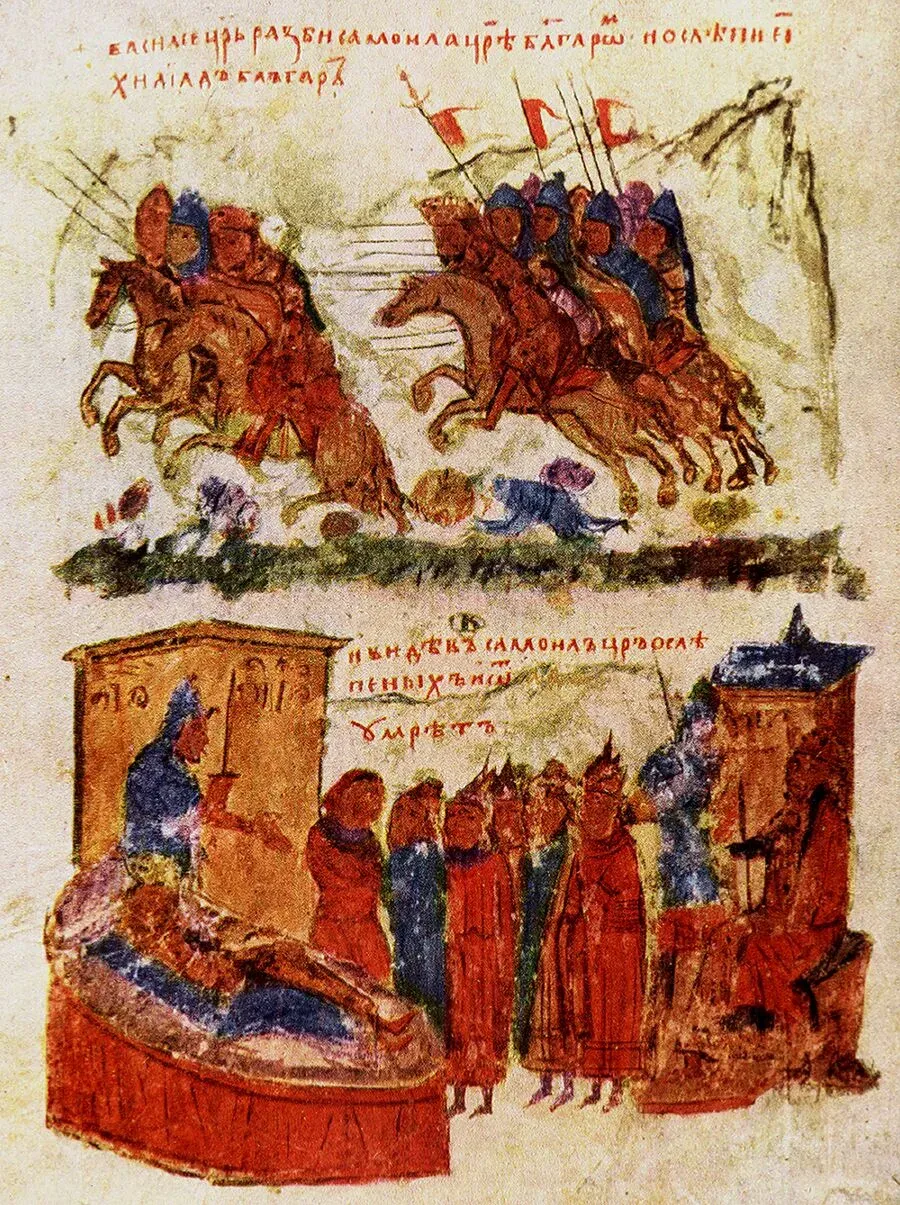
Picture the column: fifteen thousand men, or fourteen thousand, or eight thousand, depending on which chronicler you trust, strung out along a mountain road in single file. Every hundredth man can see. He is walking because Basil II, Emperor of the Romans, decided that ninety-nine blinded soldiers per century needed exactly one guide to get them home, and not one more. That is the image the Battle of Kleidion left behind, and it is the only reason most people have heard of it at all. The battle itself, on 29 July 1014, was not the moment that broke Bulgaria. It was one engagement in a war that had already run for the better part of forty years and would grind on for four more. What made it famous was what came after the fighting stopped.
The war itself is easy to summarise and tedious to narrate in full: since 976, Basil II had made the destruction of independent Bulgaria his life’s project, and Tsar Samuil had made denying him that satisfaction his own. Basil’s first campaign, in 986, nearly got him killed at the Gates of Trajan. For the next decade and a half he was busy with revolts closer to home, which gave Samuil room to retake lost ground and push raids as far south as Corinth. Then, from the year 1000 onward, Basil came back with patience rather than ambition: annual campaigns, methodical sieges, farmland burned on schedule. Samuil couldn’t match him in the field, so he didn’t try. He harassed, retreated, and waited. By 1014 the Bulgarian state was running out of land to trade for time, and Samuil resolved to make a stand at the one place Basil’s army had to go through.
That place was the Kleidion pass, on the Struma River, where Samuil had spent years building a wooden wall across the valley floor between the mountains of Belasitsa and Ograzhden. It worked, for a while. The Byzantine army hit the palisade and bounced off it with heavy losses. Basil, characteristically, didn’t quit: he sent his general Nikephoros Xiphias up and over the mountain on a route nobody was watching, and on 29 July, Xiphias came down into the Bulgarian rear at the same moment Basil renewed the frontal assault. Caught between two directions at once, the wall’s defenders broke. Samuil himself was nearly captured and escaped only because his son put him on his own horse and rode him clear.
None of that, on its own, ended the war. Basil’s follow-up siege of Strumitsa failed outright - the Bulgarians let his general Theophylact Botaneiates tear down the outer defences, then ambushed his men on the way back and killed him. Bulgaria held out for four more years after Kleidion, and it took the death of Samuil’s heir Ivan Vladislav at Dyrrhachium in 1018, not this battle, to finally end the Bulgarian Empire as an independent state. Historians still argue over how decisive Kleidion actually was. Some rate it the turning point of the whole conflict; others point out that the Bulgarian army had already been bled white by fifteen years of exactly this kind of attritional defeat, and Kleidion was simply the one that happened to come with a lurid postscript.
That postscript is the part everyone remembers, and for good reason. Basil took his prisoners - Skylitzes says fifteen thousand, Kekaumenos says fourteen thousand, a later Bulgarian chronicle says eight thousand, and none of them agree because nobody was in a position to count carefully - and divided them into groups of a hundred. In each group, ninety-nine men were blinded. The hundredth kept one eye, specifically so he could lead his comrades on the walk home. It is hard to improve on that as an act of theatre: not just mass mutilation, but mass mutilation with a built-in stage direction for how the survivors would be seen arriving. Every village the columns passed through got the message before a single word of news travelled ahead of them. Samuil, watching his army return like this, reportedly collapsed and died of a heart attack two months later, on 6 October. Whether the story is literally true or a chronicler’s flourish, it has survived a thousand years precisely because it sounds like the kind of thing that should be true.
It is worth asking why Basil did it, because the reasons on offer are more interesting than the outrage. Byzantine chroniclers frame it partly as revenge for Botaneiates, killed shortly after in that failed follow-up campaign, and partly as ordinary Byzantine practice: blinding was the standard punishment for rebellion against legitimate authority, and from Constantinople’s point of view, the Bulgarians were rebellious subjects rather than a foreign nation. That framing matters. It tells you this wasn’t a spontaneous burst of cruelty from an emperor who’d lost his temper. It was policy, applied with the same bureaucratic tidiness the Byzantines brought to everything else, right down to the fixed ratio of blind men to guides. The Byzantines had, of course, signed no convention on the treatment of prisoners of war, being some nine hundred years early for the Geneva original. I raise this only because it is worth remembering how recent an invention “the rules of war” actually are, and how much of history was conducted entirely without them, by people who saw nothing to apologise for.
Basil earned the name Boulgaroktonos, the Bulgar-slayer, for this. Not for winning at Kleidion, not for the annexation of Bulgaria that followed four years later, but specifically for what he did to the men he’d already beaten. That is the detail history kept. It didn’t keep the wall, or the flanking march over the mountain, or the argument between modern historians about whether this particular battle mattered more than the twenty that came before it. It kept the column on the road, walking blind, led by the one man Basil decided should still be able to see where they were going.