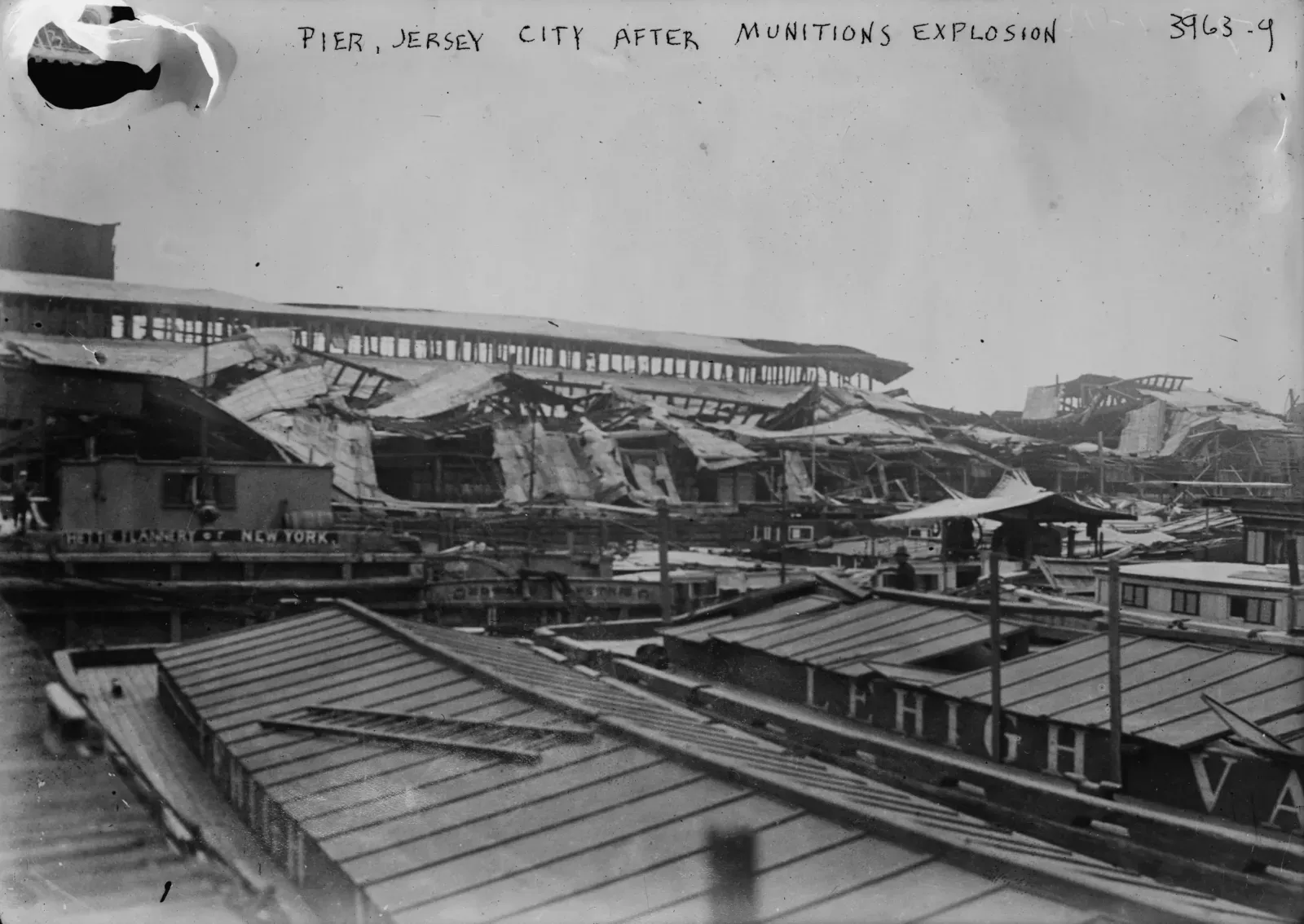
At 2:08 in the morning on 30 July 1916, a Jersey City pier packed with Russian-bound artillery shells and fifty tons of TNT went up in what is still counted among the largest man-made explosions of the pre-nuclear age. The blast registered somewhere between 5.0 and 5.5 on the Richter scale. It cracked the outer wall of Jersey City’s own City Hall, shook the Brooklyn Bridge, shattered windows twenty-five miles away in Times Square, and threw fragments over a mile inland into the clock tower of the Jersey Journal building, stopping the hands at 2:12 am. Shrapnel also tore into the Statue of Liberty’s skirt and torch - damage severe enough that the torch has stayed closed to the public for the century since, through a full restoration and beyond. People as far off as Maryland, woken by what they took for an earthquake, had in fact felt Imperial Germany’s war reach American shores, eight months before the United States ever declared it had a war to fight.
Nobody in Washington wanted to say that out loud. Germany had sent field agents from its naval intelligence service to sabotage the depot precisely because Woodrow Wilson’s neutral America had become the Allies’ arsenal. The Royal Navy’s blockade meant American manufacturers could sell munitions only to Britain, France and Russia; Berlin, unable to buy a single shell, decided instead to burn them on the dock before they shipped. Black Tom held roughly two million pounds of small arms and artillery ammunition that night, along with a hundred thousand pounds of TNT sitting on a barge that had reportedly been tied up there rather than moved on, to avoid a twenty-five dollar mooring fee. A small fire started after midnight. Guards ran. Two explosions followed, roughly half an hour apart, the first one levelling more than a hundred railroad cars and warehouses and gouging a crater 375 feet long and 175 feet wide into the island.
At least seven people died, among them a Jersey City police officer, a railroad police chief, and a ten-week-old infant named Arthur Tosson. Property damage came to twenty million dollars, close to six hundred million today. And still, Wilson’s own public verdict on the attack was that it amounted to “a regrettable incident at a private railroad terminal.” That sentence is worth sitting with. A foreign power had just detonated the equivalent of a small earthquake in New York Harbor, and the President of the United States described it in the language you’d use for a warehouse fire caused by a faulty space heater.
Part of that was genuine uncertainty; investigators spent weeks chasing the theory that mosquito smudge pots had started the blaze by accident. But part of it was structural. The United States in 1916 had no domestic intelligence service, no federal law against espionage or sabotage in peacetime, and only the thinnest apparatus for tracking foreign agents operating on its own soil. When the case against a ring of German operatives - Kurt Jahnke, Lothar Witzke, and a Slovak immigrant named Michael Kristoff who took bribes for pier access - finally came together, there was no legal machinery built to prosecute it as what it was. Kristoff was arrested and released for lack of evidence. Witzke was caught in 1918, sentenced to hang as a spy, then pardoned by Calvin Coolidge in 1923 and shipped home to Germany, where the Reichswehr gave him the Iron Cross. Jahnke went on to a second career in Abwehr intelligence before Soviet agents executed him in 1950. It took a special claims commission until 1939 to formally rule that Imperial Germany was behind the attack, and until 1953 for the Federal Republic to agree to pay for it. The final cheque didn’t clear until 1979 - sixty-three years after the fire started, and closer to our own time than to the explosion itself.
That gap is the real story here, more than the blast. Black Tom wasn’t ambiguous. It was a foreign intelligence service running a sabotage campaign against American industry, on American soil, months before America joined the war those munitions were meant for. And Washington’s first instinct was still to call it an accident, because naming it correctly would have demanded a response nobody in 1916 wanted to make. That instinct - explain the attack away rather than name the attacker - is not a quirk of the Wilson administration. It resurfaces every time a state finds it more convenient to treat sabotage as noise than as signal, and it hasn’t gone away just because the methods have moved from TNT to malware. Cut an undersea cable, disable a power grid, or torch a warehouse through a cut-out, and you can usually count on plausible deniability doing exactly the work it did for Germany in 1916: buying the saboteur years before anyone official is willing to use the word “war.”
Eventually, the United States did respond, though sabotage was only ever half the reason - the Zimmermann telegram and unrestricted submarine warfare did more of the work of pushing Congress toward declaration in April 1917. What Black Tom produced more directly was infrastructure: the Espionage Act, passed later that year, and a hardening consensus that a great power without a domestic intelligence service was a great power waiting to be sabotaged again. Arthur Woods, then the New York police commissioner, put it plainly: the country’s federal bureaus needed welding into one agency that would be, in his words, “eternally and comprehensively vigilant,” rather than the fractured, half-blind arrangement that had let Black Tom happen.
He got his wish, eventually, and that is where the story turns from tragic to genuinely troubling. The security apparatus born partly out of Black Tom’s failure did not stay confined to hunting foreign saboteurs. Franklin Roosevelt, who as assistant secretary of the navy in 1916 had watched the case unfold from inside government, invoked it directly a quarter-century later while building the case for interning Japanese Americans after Pearl Harbor. “We don’t want any more Black Toms,” he told John McCloy - the same McCloy who, as a young lawyer, had spent two decades helping the Lehigh Valley Railroad chase Germany for damages. A genuine, unpunished act of foreign sabotage against American soil became, in the hands of a wartime president, part of the justification for imprisoning some 120,000 people who had committed no sabotage at all. The lesson of Black Tom was supposed to be “build better intelligence.” What it actually taught the American state was that a single unresolved atrocity, invoked at the right moment, can justify almost anything that follows it.
The clock at Journal Square was eventually fixed and started ticking again. The instinct it commemorates - the reflex to look at an obvious act of war and call it a regrettable accident, and later to look at an old grievance and stretch it to justify whatever the moment requires - never really got repaired at all.