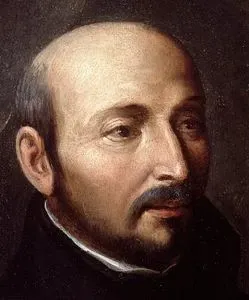
On 31 July 1556, a Basque priest named Ignatius of Loyola died in Rome, probably of the malaria then endemic to the city, with a body so riddled with stones that the anatomist who opened him found them in the kidneys, bladder, gall bladder, liver, and lungs. He was sixty-four. Sixteen years earlier he had founded the Society of Jesus with six companions and a papal bull. By the day he died, that society already ran seventy-four colleges on three continents. His feast day is still kept on the anniversary of his death. The organisation he built is still open for business nearly five centuries later. That last fact is the one that interests me, because almost nobody who is not Catholic, or Jesuit-educated, seems to realise it.
Ignatius was not born for the cloister. He was Íñigo López de Oñaz y Loyola, youngest of thirteen children of minor Basque nobility, a page and then a soldier who patterned himself on chivalric romances, strutted in open cape and tight hose, and, by one biographer’s account, used his status to dodge prosecution for violent crimes committed with a priest brother at carnival. In May 1521, defending Pamplona against a French-Navarrese force, a cannonball shattered his right leg. The surgeons broke and reset the bones without anaesthetic. The leg healed shorter than the other. The military career ended. The convalescence did not.
Stuck in his family’s castle with no romances to hand, he was given the lives of Christ and the saints instead. He noticed something practical: fantasies of courtly glory left him restless when they faded; fantasies of imitating the saints left him calm. That is the origin of Jesuit “discernment” in a nutshell - not a mystic’s fog, but a former officer comparing after-effects and choosing the campaign that did not hollow him out. He hung his sword at Montserrat, spent nearly a year in a cave at Manresa drafting what became the Spiritual Exercises, failed to settle in Jerusalem, got interrogated by the Inquisition for preaching without a theology degree, and finally, at an age when most Renaissance men were finished reinventing themselves, enrolled at the University of Paris.
There, in a crypt under Montmartre on 15 August 1534, he and six fellow students - among them Francis Xavier and Peter Faber - took vows of poverty, chastity, and obedience. In 1540 Pope Paul III approved their order as the Society of Jesus. Ignatius added a fourth vow: special obedience to the pope for whatever mission he assigned. The nickname “Jesuit” began as an insult. They kept it. Their motto, Ad maiorem Dei gloriam - for the greater glory of God - and their self-image as soldiers of Christ were not metaphors pasted on later by pious biographers. Ignatius had been a soldier. He organised like one. The Constitutions demanded a man empty of ego “as if a dead body,” ready to be posted anywhere on Earth.
They were posted. Francis Xavier reached Goa in 1541. Jesuit colleges multiplied across Catholic Europe and became the training grounds of lawyers, officials, and princes. Jesuit confessors sat at royal courts. In Poland-Lithuania and southern Germany they helped roll back Protestant advances. In Paraguay they built Indigenous Christian settlements that enraged Spanish and Portuguese slavers precisely because they kept Native labour out of colonial reach. In China, Matteo Ricci and his successors translated Euclid, mapped the empire, and argued that Confucian ancestor rites were civil courtesy rather than idolatry - an argument Rome eventually rejected, at catastrophic cost to the China mission. In Japan they briefly held a fief at Nagasaki. In New France they wrote the Jesuit Relations, still among the richest early sources on Indigenous North America. For roughly two centuries after Ignatius’s death, if you wanted a transnational organisation with educated manpower, a central command in Rome, and agents from Macau to Montreal, you were looking at the Jesuits.
That is why they were destroyed. Starting in 1759, Catholic monarchs expelled them from Portugal, France, Spain, and their empires. In 1773 Pope Clement XIV, under relentless Bourbon pressure, suppressed the entire order. Read that again: a pope abolished the society whose members had taken a special vow of obedience to the papacy, because secular Catholic courts found the Company too rich, too independent, and too politically inconvenient. Suppression is not what happens to obscure friars. It is what happens when an organisation has become a state within several states. The order survived only where rulers refused to publish the brief - notably in Catherine the Great’s Russia - until Pius VII restored it in 1814. Forty-one years of official nonexistence, and they came back.
Today the Society of Jesus remains the largest male religious order in the Catholic Church, with roughly fourteen thousand members across more than a hundred countries, down sharply from the thirty-six thousand of the mid-1960s but nowhere near extinct. It still runs universities from Georgetown to Tokyo, still publishes, still sends missionaries, and still answers to a Superior General in Rome. Pope Francis was a Jesuit. You would not know any of this from the ambient culture of the early twenty-first century, which treats “Jesuit” as either a brand of American college, a synonym for cunning, or the villain in a conspiracy thread. The most influential Catholic order of the early modern world has not disappeared. It has gone quiet in public imagination while remaining operational in fact.
I do not mourn the loss of Jesuit political clout. An order that once whispered in the ears of kings was always going to accumulate enemies, and some of those enemies had legitimate grievances. What I find striking is the mismatch between historical weight and present visibility. We remember the Tudors, the conquistadors, the Enlightenment philosophes. We half-forget the company that educated half of Catholic Europe’s elite, carried Western science into Ming China, and was powerful enough that a pope had to kill it on paper to satisfy the crowns of Europe. Ignatius died of fever in a city that barely noticed one more priest’s funeral. The machine he designed outlasted empires that looked far more permanent on the day of his death. It is still running. Most of us have simply stopped looking at it.