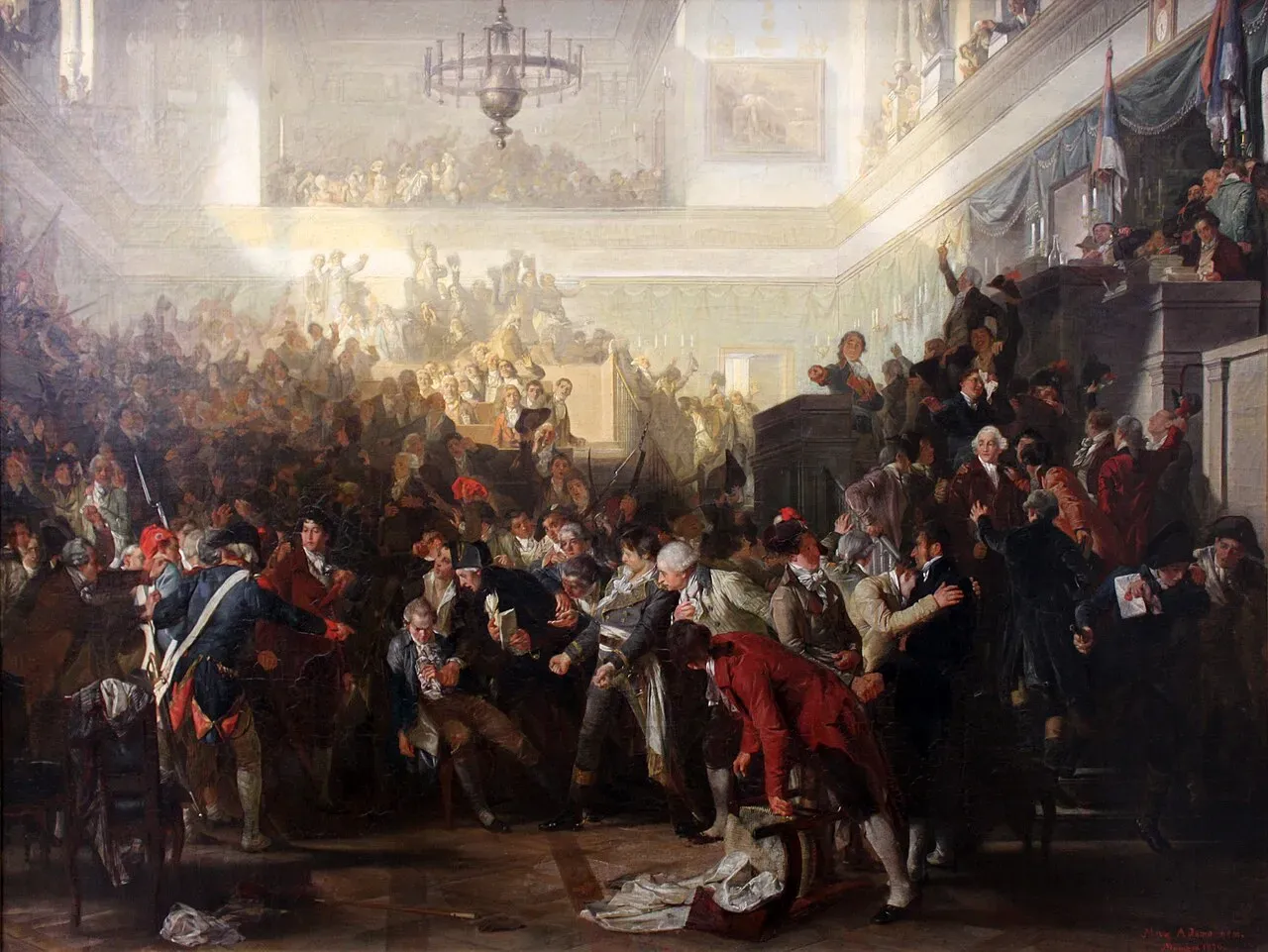
On the afternoon of 27 July 1794 - 9 Thermidor, Year II by the revolutionary calendar - Maximilien Robespierre climbed to the tribune of the National Convention to save his own life, and discovered that the assembly he had dominated for a year would not let him speak. Deputies drowned him out every time he opened his mouth. When he tried to stand with the deputies of the Right, someone reminded him whose bench it was: “Get away from here; Condorcet used to sit here.” When his voice finally cracked and failed him altogether, a deputy called Garnier shouted across the chamber, “The blood of Danton chokes him!” Robespierre found enough breath left to answer - “Is it Danton you regret? Cowards, why didn’t you defend him?” - but it was the last exchange he won. Within the hour the Convention voted his arrest. By six the following evening he was dead, guillotined alongside twenty-one of his followers while a Paris crowd cheered for a quarter of an hour.
The Girondin Pierre Vergniaud is credited with saying, as he went to that same guillotine in October 1793, that revolution devours its own children like Saturn. Whether he actually said it, or historians tidied up the line afterward, it fits no one better than the man who sent him there. Robespierre spent fourteen months perfecting the machinery that consumed the Girondins, then Hébert’s faction, then Danton and Desmoulins, and then Robespierre himself - on the same procedural terms, denied the same right to speak in his own defence that he had denied all of them.
By the summer of 1794 that machinery was running at a pace nobody had quite anticipated, its architects included. The Law of 22 Prairial, pushed through by Robespierre’s ally Georges Couthon on 10 June, stripped defendants of the right to counsel and left the revolutionary tribunal exactly two verdicts to hand down: acquittal or death. Within three days it had sent 156 people to the guillotine in batches, including the entire Parlement of Toulouse. Between that date and Robespierre’s own arrest, roughly 1,366 more died in Paris alone - more than double the previous rate. France’s tribunals had by then sent something over 16,000 people to the guillotine nationwide since the Terror began; fuller estimates, counting prison massacres and executions carried out with no trial at all, run past 40,000. Deputies who had voted for all of it now found their own parliamentary immunity, technically inviolable since April 1793, starting to feel like a formality. Robespierre had made an example of enough people that everyone in the chamber could do the arithmetic on how easily they might be next.
He answered the pressure by disappearing. He stormed out of a Committee of Public Safety meeting on 3 July, declaring he could no longer save the country without genuine support, and for the last month of his life he barely set foot in either the Convention or the committee. He signed decrees from a distance, dropped his oversight of the police bureau, and spent his afternoons walking a Danish dog through the fields outside Paris at Maisons-Alfort. His trusted circle had shrunk to four men: Saint-Just and Couthon on the Committee of Public Safety, and the painter Jacques-Louis David and Philippe Le Bas on the Committee of General Security. A man who had built his career on relentless, near-daily oratory - 328 speeches in 1791 alone - had gone quiet at exactly the moment silence looked like guilt.
The clearest evidence that Robespierre had lost his grip, though, isn’t the withdrawal. It’s the religion. It was one of the most bizarre acts of the revolution, a historical process full of those. On 7 May 1794, at the height of his influence, he had the Convention decree a new state faith, the Cult of the Supreme Being, built around belief in a god and an immortal soul and designed personally by Robespierre to replace both Catholicism and the atheistic Cult of Reason he despised. A month later he staged its inaugural festival on the Champ de Mars, around an artificial mountain built by David, in front of the entire Convention. Dressed in a sky-blue coat, he delivered the ceremony’s central speeches himself, declaring there would be no Christ and no Mohammed in his new faith, only virtue. Witnesses said he beamed with joy throughout. Thuriot, an old associate of Danton, watching him process to the summit ahead of everyone else, muttered a line that has outlived the festival itself: “Look at the blackguard - it’s not enough for him to be master, he has to be God.” Madame de Staël put it more plainly afterward: it was from that day, she said, that Robespierre was lost.
He compounded it weeks later. The Committee of General Security had uncovered an elderly mystic named Catherine Théot who was telling her small circle of followers that Robespierre was a messiah sent to fulfil prophecy. It was an obvious embarrassment rather than a real threat, the kind of thing a secure politician laughs off in five minutes. Robespierre instead demanded the investigation be shut down and the prosecutor replaced. On 9 Thermidor itself, in the middle of his own downfall, the deputy Vadier stood up and mocked him with the Théot affair in front of the whole Convention, to general laughter, and Robespierre - the same man who a year earlier had dictated who lived and died in France - found himself with nothing to say.
His real tactical error came the day before, on 26 July, when he delivered a two-hour address to the Convention warning of an unnamed conspiracy against the Republic, and by clear implication against him. Deputies pressed him to name names. He refused, naming only Joseph Cambon, a target too small to matter. It was a catastrophic miscalculation from a man once famous for surgical political speech: by accusing everyone and no one, he told every deputy in the room that any one of them might be marked for the guillotine next, and gave none of them a reason not to strike first. That evening, repeating the speech at the Jacobin Club, he spoke of drinking hemlock like Socrates. David told him he would drink it too. Robespierre had started writing his own martyrdom as scripture before anyone else had agreed to the ending.
They wrote a different one. After the Convention voted his arrest, the Paris Commune, still loyal to him, staged a counter-rising, freed him from custody, and gathered him with his allies at the Hôtel de Ville. It went nowhere. The armed men who had massed outside drifted home overnight rather than fight for a government that could not even organise its own defence. When troops loyal to the Convention broke in after two in the morning, Le Bas shot himself dead. Augustin Robespierre jumped from a window and shattered his pelvis. Robespierre was found with a gendarme’s pistol ball through his lower jaw - his own hand on the trigger, by most accounts, though which of them actually fired the shot was disputed for decades afterward. He spent his last night on a table in an antechamber, head propped on a wooden box, too badly wounded to do anything but bleed through his shirt.
The Revolutionary Tribunal that convicted him the next afternoon gave him the same procedure the Law of 22 Prairial had given everyone else: no real hearing, one possible verdict. At six that evening, the executioner Sanson ripped the bandage from his shattered jaw before the blade fell, and Robespierre screamed - the last sound anyone heard from the most feared orator of the Revolution. Twenty-one of his allies went to the same scaffold that day. The killing did not stop with him: the Convention executed seventy members of the Paris Commune the following day, the single largest mass execution Paris had ever seen.
Robespierre had built a system that ran on denunciation, procedural haste, and the presumption that anyone who hesitated to condemn the accused was probably guilty himself. On 9 and 10 Thermidor, that system simply changed hands and kept running, exactly as designed, with him underneath the blade instead of standing over it. He had spent his final two months persuading himself, through a religion built in his own image, that history had appointed him its instrument. History had other ideas. It usually does, for the people who claim to speak for it.