Here is a claim you will hear at almost any dinner party where someone has recently read a book about the eighteenth century: people back then didn’t love their children the way we do. They shipped infants off to wet nurses, dressed toddlers like miniature adults, and buried a third of them before the age of five without, apparently, much visible grief. We, by contrast, are the first generation in history to actually care.
It is a satisfying story. It flatters the present at the expense of the past, which is the oldest trick in the historical-commentary business. It is also almost certainly wrong, and the way it is wrong tells you something much more useful than the claim itself: most of what we think we know about “how things used to be” is not a picture of the past. It is a picture of whoever in the past could hold a pen, felt like using it, and had the good fortune of having the resulting paper survive a few hundred years in a dry archive.
Take marriage. Historians love to describe the arranged marriage as the great institution of pre-modern life: parents negotiating dowries, lawyers drafting contracts, families merging estates and consolidating land through a wedding rather than a romance. All true, as far as it goes. But an arranged marriage, in the sense that shows up in wills, marriage contracts, and family correspondence, is fundamentally a wealth-preservation instrument. It only makes sense if there is wealth to preserve. A tenant farmer with one cow and a leaking roof had nothing to negotiate and no lawyer to write it down even if he had. His marriage - however it was actually arranged, by whatever mixture of parental pressure, mutual attraction, or simple proximity - left no paper trail, because nobody involved could write and nobody who could write cared. So the record fills up with the marriages of people who had something worth documenting, and we quietly generalise from them to “how marriage worked” in an era when the overwhelming majority of people owned nothing worth merging.
This is not a minor gap in the evidence. It is closer to a structural blind spot, and it recurs in almost every domain of social history you can name.
For most of the twentieth century, a genuinely influential school of historians - Philippe Ariès with Centuries of Childhood in 1960, Lloyd deMause more luridly in the 1970s - argued that parents in pre-modern Europe were emotionally distant from their children, almost professionally detached, treating infancy as a phase to be managed rather than loved through. The evidence was real: aristocratic portraits showing children dressed as small adults, the widespread practice among the urban elite of sending newborns out to wet nurses for years at a time, diaries that mention a child’s death in a single flat sentence. What this evidence actually documents is the parenting of families wealthy enough to hire a wet nurse and educated enough to keep a diary. Poor mothers breastfed their own children because they had no other option, kept them close because there was nowhere else to keep them, and grieved their deaths without leaving a trace of it in any archive, because grief that isn’t written down disappears. The folklore, lullabies, and burial customs of the poor - where they survive at all, usually through nineteenth-century folklorists who arrived a bit too late - suggest something closer to fierce, ordinary attachment. We spent a century mistaking the parenting habits of people who could afford to outsource it for the parenting habits of everyone.
The same distortion runs through the history of religion. Read only the official record - church councils, inquisition files, theological treatises - and the pre-modern world looks like a battlefield between rigid orthodoxy and the occasional outbreak of heresy or witchcraft, mercilessly suppressed. What that record leaves out almost entirely is what most people actually did on a Tuesday: a working religious life that mixed churchgoing with charms for a sick cow, offerings left at a local well, and a trip to the village cunning-man rather than the parish priest when the fever wouldn’t break. The historian Keith Thomas spent a landmark book, Religion and the Decline of Magic, mapping exactly this parallel economy of belief. The clergy only wrote these practices down when they were prosecuting them, which means the surviving paper trail records folk religion exclusively as crime, never as the unremarkable daily texture of most people’s spiritual lives. Read the archive literally and you would conclude ordinary Europeans were either devout Christians or occasional witches. They were mostly neither - they were pragmatists, borrowing from whatever source seemed likely to work.
Crime tells the same story from a different angle. Eighteenth-century England ran on the so-called Bloody Code, a body of law that eventually made well over two hundred offences punishable by death, including stealing a handkerchief worth a shilling or damaging a fishpond. Read only the court records and the statute books, and the period looks like a society besieged by hardened criminals requiring draconian deterrence. The historian E.P. Thompson offered a more accurate framing in 1971: much of what the law called theft, the rural poor called custom. Gleaning leftover grain from a harvested field, taking deadwood or the occasional rabbit from a lord’s estate, smuggling goods past a tax collector nobody respected - these were understood locally as inherited rights, part of what Thompson named the “moral economy,” not as crimes at all. They only entered the historical record as crime because the only people keeping records were magistrates, and magistrates by definition only wrote down what they were prosecuting. A moral economy that mostly worked, that mostly kept the peace between landlords and tenants through unwritten custom, leaves no file. A single hanged poacher leaves a court transcript that survives for three hundred years and gets cited in a dozen books about how lawless the countryside supposedly was.
Diet follows the identical pattern. Ask what people ate “back then” and you will usually get an answer drawn from surviving cookbooks - which is to say, from menus written for households that employed a cook, could afford imported spices, and wanted a written record of their kitchen in the first place. The actual diet of most of the population was pottage: a pot of grain, whatever vegetables were in season, and meat only on the days it was available, thickened and reheated for days at a stretch. None of this got written down because nobody who could write was eating it, and nobody eating it could write. Even the historical record of famine is skewed in a specific direction: recorded famines were usually failures of the cash-crop or urban grain market, the part of the food system that intersected with taxation and trade statistics. Rural households with a foraging patch, a single pig, and access to a stream had a food web that never touched a tax ledger and consequently never touched the historical record either, whether it was thriving or starving.
And then there is the matter of who was having children with whom. Parish registers - baptisms, marriages, burials - are the backbone of a huge amount of demographic history, and they show, in various times and places, spikes in what the clergy recorded as “illegitimate” births. Historians have periodically read this as evidence of moral collapse among the lower orders. It is more plausibly evidence that a great deal of ordinary cohabitation, informal handfasting, and long-term unsanctioned partnership was common, socially tolerated within the communities where it happened, and simply invisible to a Church that only counted marriages it had personally blessed. The parish register does not record what a community considered a legitimate union. It records what the Church considered one, and treats the difference as sin because a child born outside that boundary was the parish’s financial problem. Read the register at face value and you get a story about moral decline. Read it as an artefact of institutional bookkeeping and you get a much duller, much more accurate story about the limits of what the Church chose to count.
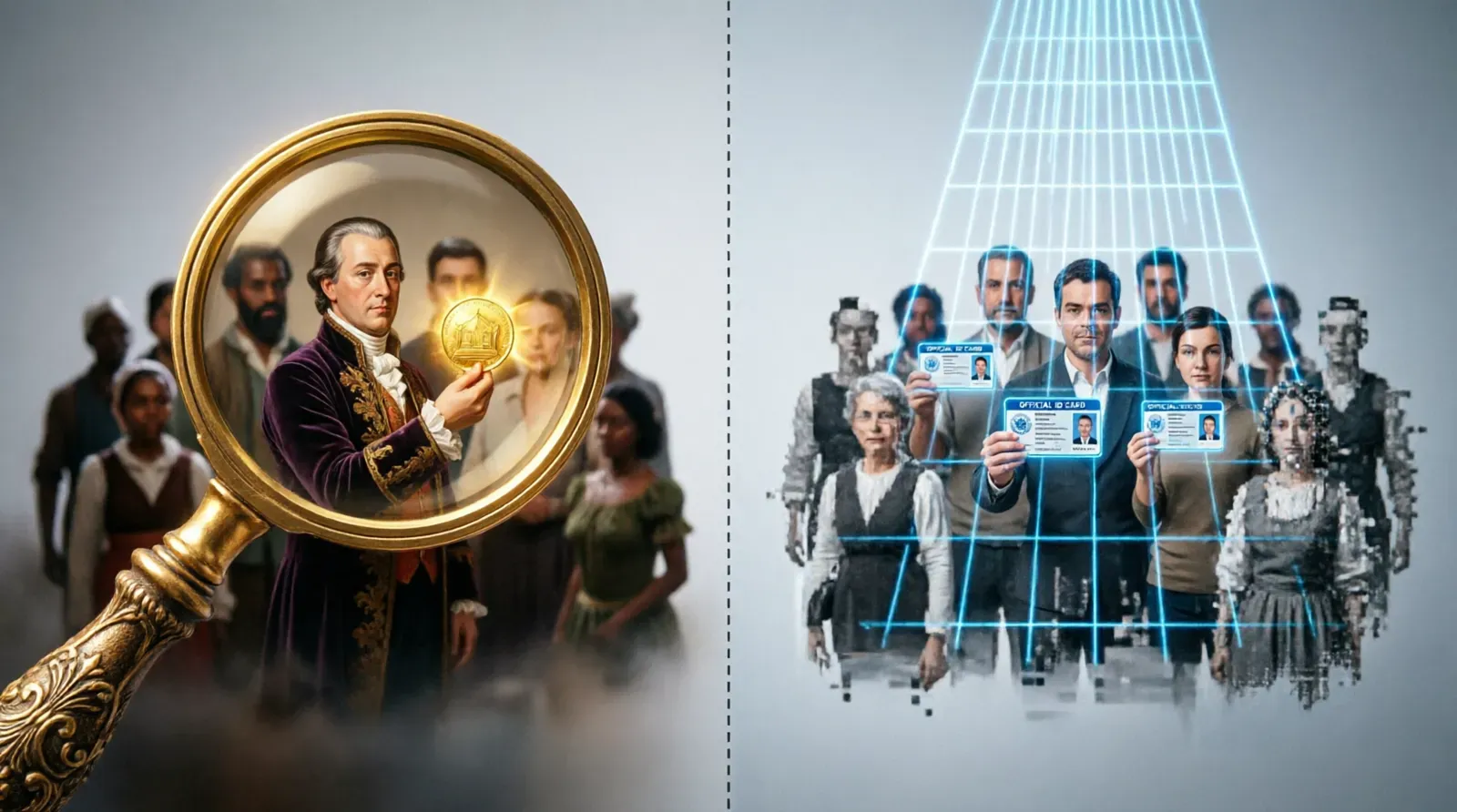
The pattern across all five examples is the same one embedded in the marriage story I started with. Historical sources were produced almost exclusively by a literate minority, about the parts of life that minority found worth recording, filtered further by whatever survived fire, damp, war, and the passage of centuries. When historians treat that residue as a representative sample of “how people lived,” they are not being lazy. They are working with the only evidence that exists. But the result is a past that looks disproportionately aristocratic, disproportionately urban, disproportionately clerical, and disproportionately concerned with property, because those are the interests of the people who could write things down and arrange for the writing to be kept.
The tempting next move is to conclude that we have finally escaped this trap. Mass literacy, dense cities where a nosy neighbour notices everything, and governments that survey their populations with censuses, tax records, and household panels - surely all of this gives us, for the first time, an accurate picture of how people actually live. More people can write. More behaviour happens somewhere a record-keeper can see it. Surely the twenty-first century, unlike the eighteenth, sees clearly.
I do not think that conclusion survives much scrutiny, and the reason is not that we collect too little data. It is that more data does not automatically mean less distortion; it just moves the distortion somewhere harder to see. The economist Charles Goodhart pointed out in 1975 that once a measure becomes a target, it stops being a reliable measure, because people change their behaviour specifically to satisfy the metric rather than the thing the metric was designed to capture. Police forces graded on clearance rates find ways to close cases without necessarily solving crimes. Hospitals graded on waiting-time targets find ways to make the clock start later. Universities graded on graduation rates find ways to keep struggling students technically enrolled. None of this is fraud, exactly. It is the entirely predictable consequence of turning a description into an incentive, and it means that the moment a government statistic becomes important enough to matter, it starts measuring the behaviour it produced rather than the behaviour it was meant to observe.
There is also a more basic problem: coverage. Unemployment statistics, to take the most argued-over example, are built around specific bureaucratic definitions of who counts as “in the labour force.” Someone who has stopped actively searching for work after months of rejection quietly exits the official unemployment rate, not because their situation improved but because the definition stopped counting them. Informal economic activity - cash work, barter, the rotating credit associations that immigrant and low-income communities have run for generations under names like tandas, susus, or chit funds - is close to invisible to GDP calculations and to the credit-scoring algorithms that decide who gets a loan, not because it doesn’t exist but because it doesn’t generate the kind of paper trail modern institutions are built to read. Modern content-moderation systems, trained overwhelmingly on formal written English, have been repeatedly shown to misclassify African-American Vernacular English as toxic or threatening at higher rates than standard English carrying identical meaning - a twenty-first-century version of the same old problem: the institution doing the recording built its instruments around one dialect of life and treats deviation from it as an anomaly rather than as an equally valid way of living.
None of this is a conspiracy, any more than the parish clerk conspired to erase informal marriages. It is what happens whenever the people running the recording apparatus - clergy in 1650, magistrates in 1750, data scientists and central banks in 2026 - build systems around the categories that matter to them, and then mistake the resulting dataset for reality itself. The eighteenth-century clergyman thought he was recording sin. He was recording the boundary of his own bureaucracy. The modern algorithm designer thinks she is recording toxic speech, or creditworthiness, or unemployment. She is recording the boundary of her own bureaucracy too, just implemented in Python instead of Latin.
The honest way to describe the shift from “then” to “now,” in other words, is not a shift from ignorance to objectivity. It is a shift from one kind of filter to another: from the archival silence of a literate elite who wrote down what interested them and stayed quiet about the rest, to the bureaucratic surveillance of a state and corporate apparatus that measures what serves its purposes and struggles to see what falls outside them. Both eras produce genuine knowledge. Both eras also produce a confident, well-documented picture that leaves out enormous portions of how people actually lived, for the same underlying reason: the people holding the pen, or running the algorithm, were never a neutral instrument. They were always looking from somewhere, at something, for a reason.
That dinner-party claim about pre-modern parents not loving their children the way we do was never really a claim about the eighteenth century. It was a claim about which eighteenth-century sources happened to survive, dressed up as a claim about human nature. We should be more careful before we make the equivalent mistake about ourselves - assuming that because we now generate unprecedented volumes of data, we have finally achieved the clear-eyed view of society that eluded every generation before us. We haven’t escaped the filter. We’ve just built a much bigger one, and convinced ourselves that its size makes it transparent.