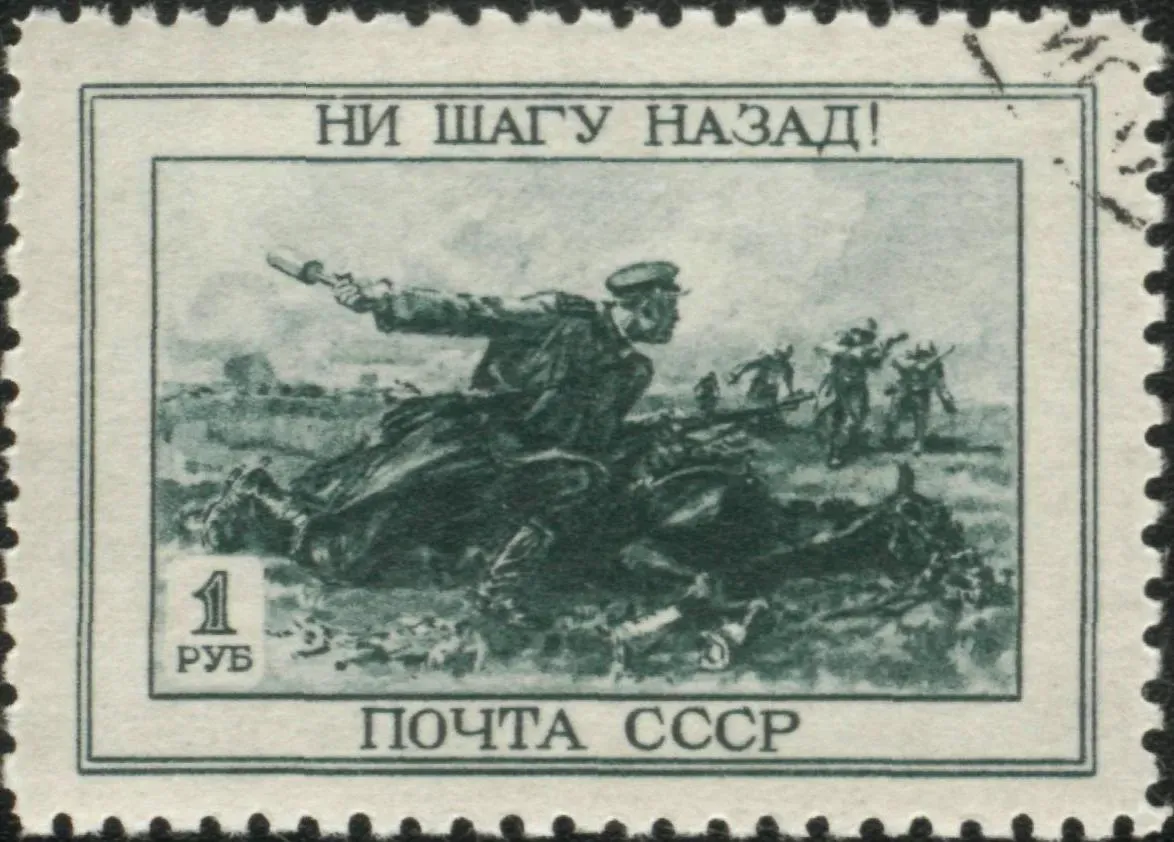
On 28 July 1942, Joseph Stalin signed an order that told the Red Army it was no longer allowed to lose. Not “should try not to lose” - not allowed to. Order No. 227, read aloud to every company, battery, and headquarters in the Soviet armed forces, carried a slogan that would outlive the war itself: “Ni shagu nazad” - not one step back. Any unit that retreated without written authorisation from above had committed a crime against the Motherland. The punishment ranged from a penal battalion sent to the worst sector of the front, to imprisonment, to execution on the spot by soldiers of their own army, positioned behind them for exactly that purpose. Stalin did not simply demand that his soldiers stop losing to the Germans. He arranged for a second front behind their backs, aimed the other way.
The order arrived out of catastrophe. By late July 1942, the Wehrmacht had taken Voroshilovgrad, Rostov-on-Don, and half of Voronezh, and was driving on two objectives at once: Stalingrad, on the Volga, and the oilfields of the Caucasus. Soviet forces on the southern front had abandoned Rostov and Novocherkassk without a serious fight and without orders from Moscow - the text of the order names this explicitly, and calls it shameful. Stalin’s own accounting, embedded in the document, is blunt about what had already been lost: more than 70 million people, most of the country’s grain-producing regions, and a large share of its industrial base, all now behind German lines. The Soviet Union no longer had the numerical or material advantage over Germany that its size was supposed to guarantee. Retreat, the order says, is no longer a survivable strategy. It has become a way of surrendering the country one province at a time.
What Order No. 227 established to stop this was a machine for consuming its own soldiers. Each army front was to form one to three penal battalions of up to 800 men - officers accused of cowardice or “bewilderment,” stripped of rank and sent to the most exposed sectors of the line, given the chance to “redeem with blood their crimes against the Motherland.” Each army was to form up to ten penal companies for ordinary soldiers and NCOs, on the same terms. And behind the front-line divisions considered unreliable, each army was to station three to five blocking detachments of up to 200 men, armed and under orders to shoot “panic-mongers and cowards” where they stood, before they could infect the rest of the unit with retreat. By the end of 1942, close to 25,000 men were serving in penal battalions; the following year the number climbed past 177,000. Over the whole war, courts-martial sentenced 994,300 Red Army personnel under measures the order set in motion - 422,700 of them to penal units, the rest to imprisonment. In the first three months alone, blocking detachments shot 1,000 of their own retreating comrades and referred another 24,000 to the penal system.
None of this should surprise anyone who has read anything else about Stalin. I’ve written before, in the piece on his death, about the scale of what he was already responsible for by 1942: collectivisation’s five to eight million famine deaths, the Great Purge’s three-quarters of a million executions, a Gulag system holding a million and a half prisoners at any given moment. Order No. 227 does not stand out from that record for its cruelty - it stands out for how openly it wrote the cruelty into military doctrine, distributed it to every unit in the army, and had it read aloud, in public, as policy. This was not a secret directive discovered decades later in an archive. It was meant to be heard by the men it applied to.
Here is the uncomfortable part. Order No. 227 may have worked. Marshal Vasilevsky, who helped run Soviet strategy through the war, called it one of the most powerful documents to come out of those years - not despite its harshness, he suggested, but because of it. The order landed in the exact week the Wehrmacht’s push on Stalingrad began to intensify, and the city that summer became the place where the German advance finally stopped moving. Whether soldiers held their positions at Stalingrad because they feared their own blocking detachments more than they feared the Germans, or because the order gave shape and urgency to a resolve that already existed, is not a question with a clean answer. But the timing invites the argument, and I understand why some Soviet veterans made it.
I don’t think the argument survives close examination, though. The idea that shooting your own men into staying is what won Stalingrad has to compete with everything else that actually decided the outcome: the industrial base the Soviets had relocated east of the Urals and rebuilt at extraordinary speed, the manpower reserves that let Moscow throw fresh armies into the breach after catastrophic losses that would have broken most states, the matériel arriving through Lend-Lease, and an operational encirclement at Stalingrad in November 1942 that trapped an entire German army through generalship, not through fear of blocking detachments. Even the Soviet military itself seems to have reached a similar conclusion. By October 1942 - less than three months after the order was issued - commanders were already treating the blocking detachments as a drain on manpower they could not spare, and the practice was quietly abandoned well before Stalin formally disbanded it in 1944.
So the honest position is not “it worked, therefore it was justified,” and it is not “it was monstrous, therefore it achieved nothing” either. Both of those are more comfortable than what actually happened, which is messier. The order almost certainly stiffened resolve in specific units at a specific, desperate moment, and it almost certainly did so partly by terrorising soldiers into staying in positions they would otherwise have abandoned. It also shot Soviet citizens for the crime of retreating from a war their own government had catastrophically mismanaged in the first place, and it built that practice into standard procedure rather than treating it as an emergency exception. A regime can extract short-term battlefield discipline from terror and still be indicted by the fact that terror was its first instrument, not its last resort.
Stalin won the war. The Soviet Union absorbed twenty-seven million dead and still ended up in Berlin. None of that required Order No. 227 to be a good document, or a necessary one, or anything other than what it plainly was: a government formalising its right to murder its own soldiers as an alternative to losing ground. Historians will keep arguing about how much of the eventual victory the order can actually claim. I doubt it can claim much. What it can certainly claim is 1,000 men shot by their own side in three months, and a slogan that told an army it was no longer permitted to survive by retreating - only by winning, or dying in place. That the Soviet Union went on to win anyway does not make the order wise. It makes Stalin, once again, a man who reached for the harshest tool available and got away with it.