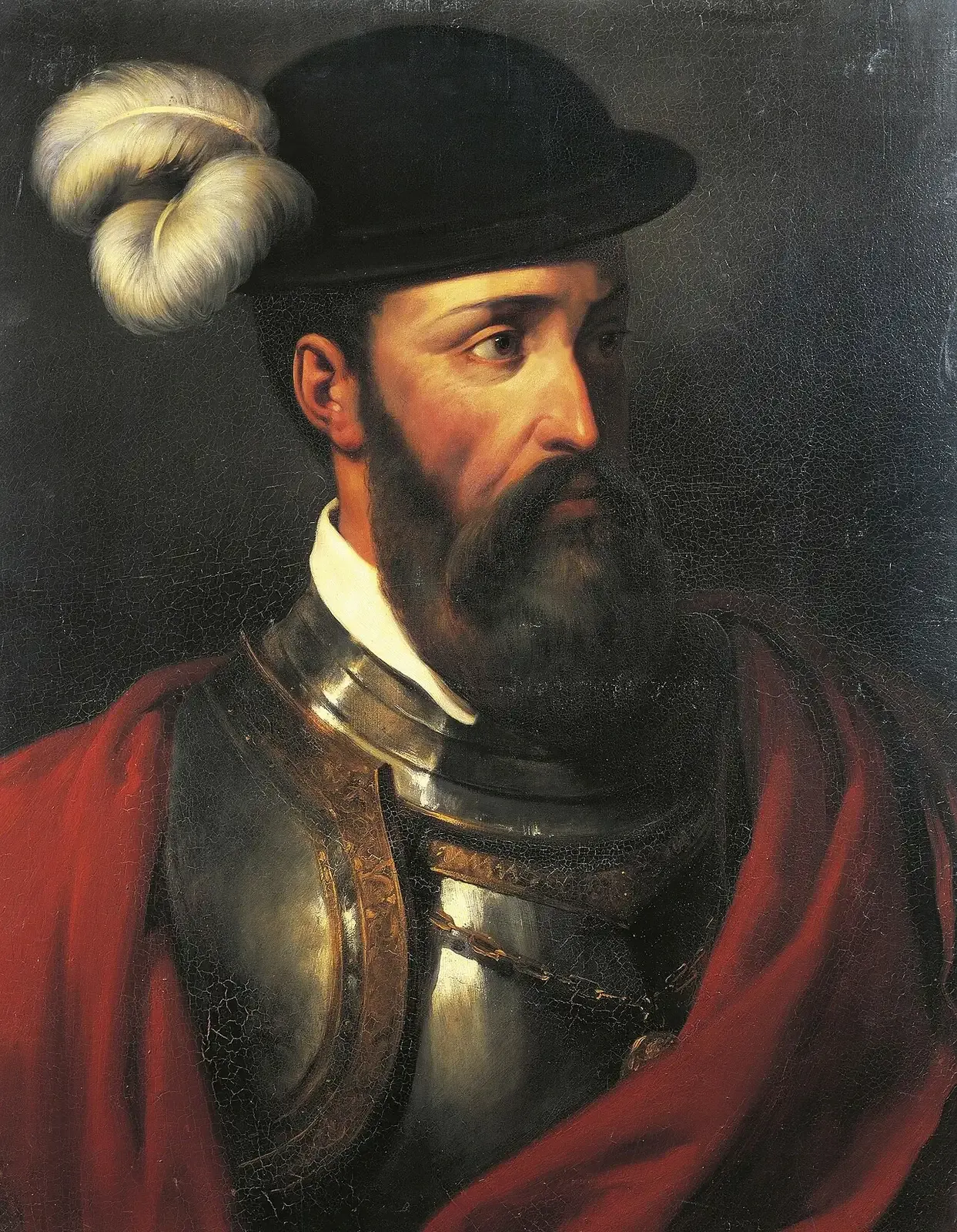
On 26 July 1529, the Spanish crown made Francisco Pizarro governor and captain general of a country that, as far as any Spaniard had established, might not have been worth the paper. He had not conquered it. He had not even properly entered it. He had sailed along its coast twice, lost most of both crews to starvation and disease, and come home with some llamas, a few gold ornaments, and a story about a rich empire somewhere over the horizon. On the strength of that story, a royal document signed at Toledo handed him a governorship, a salary, and the title of Adelantado over a place called New Castile, which nobody in Spain had seen and which turned out to be Peru. If you wanted a single document that captures the entire conquistador enterprise - audacity first, verification later - the Capitulación de Toledo is it.
Pizarro earned that audacity the hard way. He was born around 1478 in Trujillo, in the dry hill country of Extremadura, the illegitimate son of an infantry colonel and a woman of no particular standing. Nobody bothered to teach him to read. He crossed to the Indies in 1502 as an ordinary and largely undistinguished soldier, spent time on Hispaniola, then joined Vasco Núñez de Balboa’s expedition across the Panamanian isthmus in 1513 and stood among the party that became the first Europeans to see the Pacific from the American side. He was still there a few years later when the governor of Panama ordered Balboa’s arrest on trumped-up charges, and Pizarro was the man who carried it out. He was not sentimental about old comrades, and he was not going to let anyone’s downfall get in the way of his own advancement. By his mid-forties he was a modestly comfortable rancher and encomendero in Panama, respectable and going nowhere, which is exactly the position that makes a man of his temperament dangerous.
In 1524 he formed a partnership with two other Panama residents: Diego de Almagro, a soldier of fortune as tough and ambitious as Pizarro himself, and Hernando de Luque, a priest who supplied money and connections. The three of them financed an expedition south along the Pacific coast, chasing rumours of a golden kingdom that had been circulating around Panama for years. The first attempt, in 1524, was a catastrophe - Pizarro’s men starved in the mangrove swamps of Colombia so badly that the site became known as Puerto del Hambre, the Port of Hunger, and he lost fingers and nearly his life. The second attempt, in 1526, went further and returned with something more convincing than rumour: an Inca balsa raft loaded with fine cloth, silver cups, and gold jewellery, sailed by men who described a great lord ruling cities in the mountains to the south.
The governor of Panama, tired of funding an expedition that mostly produced corpses, ordered the survivors home. Pizarro’s response was the moment that made him famous before he had conquered anything. Standing on the beach at Isla del Gallo, he drew a line in the sand with his sword and told his men that to the south lay Peru and its riches, to the north lay Panama and its poverty, and each man should choose which kind of Castilian he wanted to be. Thirteen men crossed the line. History remembers them as the Trece de la Fama, the Thirteen of Fame, and with that ragged company Pizarro pushed on to Tumbes, where he saw enough - a walled town, a temple lined with silver, warehouses of textiles - to confirm that the rumour was real and considerably understated.
What he could not get in Panama was a governor willing to fund a conquest on that scale, so in 1528 he sailed to Spain to ask the crown directly. He brought his evidence with him: llamas, gold and silver vessels, fine cloth, and a couple of Peruvian boys taken as living proof that he was not making any of this up. In today’s parlance that translate as flying to California to pitch to VCs in San Francisco, with an MVP and a PowerPoint presentation. The king Charles V was in Italy arranging his imperial coronation, so it was his wife, Isabella of Portugal, acting as regent, who signed the Capitulación de Toledo on 26 July 1529. It made Pizarro governor, captain general, and Adelantado of New Castile, with authority over two hundred leagues of coastline he had barely skimmed with a ship’s hull. It made Hernando de Luque a bishop-in-waiting. And it made Almagro - who had put up as much money and risked as much as Pizarro over five years of failure - commander of a fortress at Tumbes that did not yet exist, with the rank of hidalgo and nothing resembling equal authority. Almagro had been a full partner in the enterprise. The crown, at Pizarro’s evident preference, made him a subordinate. It was a small unfairness on paper that would eventually get a great many people killed.
Three years later, in 1532, Pizarro landed at Tumbes with fewer than 200 men and marched inland to Cajamarca, where he met the Inca emperor Atahualpa, fresh from winning a civil war against his own half-brother, at the head of an army that outnumbered the Spanish by perhaps forty to one. Pizarro sprang an ambush anyway, slaughtered several thousand unarmed retainers in the town square, and took Atahualpa prisoner. What followed was the single largest ransom in the history of mankind: a room filled once with gold and twice with silver, delivered over months from across the empire, in exchange for a promise of the emperor’s release. Pizarro took the treasure and had Atahualpa garrotted regardless, on a manufactured charge of plotting rebellion, because a captive emperor was a permanent liability and a dead one was not.
That ransom is the part everyone remembers, and it deserves its notoriety - I don’t know of another single transaction in history that moved so much precious metal for so little in return. But the ransom was not really the prize. Peru was. Once the gold was melted down and shipped home, what remained was an empire with fertile terraced valleys, an existing administrative system the Spanish could simply commandeer, and a population that had just fought a civil war and had no immediate means of uniting against a new set of rulers claiming the same throne. Pizarro spent the rest of his life running that country rather than looting it, founding Lima as its new capital in 1535 because Cuzco sat too far from the sea to be governed conveniently from Spain. New Castile turned out to be worth more, for far longer, than any single ransom.
The document that made him governor also carried the seed of how he would die. Almagro never accepted the lesser share he had been handed at Toledo, and the resentment curdled into open civil war between the two former partners once Peru had actually been divided up. Pizarro’s brother Hernando had Almagro garrotted in 1538. Three years later, on 26 June 1541, a group of Almagro’s old supporters forced their way into Pizarro’s palace in Lima and killed him with their swords, avenging a grievance that had been written into his own governorship twelve years earlier at Toledo. The crown had made him ruler of a country he had not yet taken. It took him rather longer to notice that the same paperwork had also written the terms of his downfall.