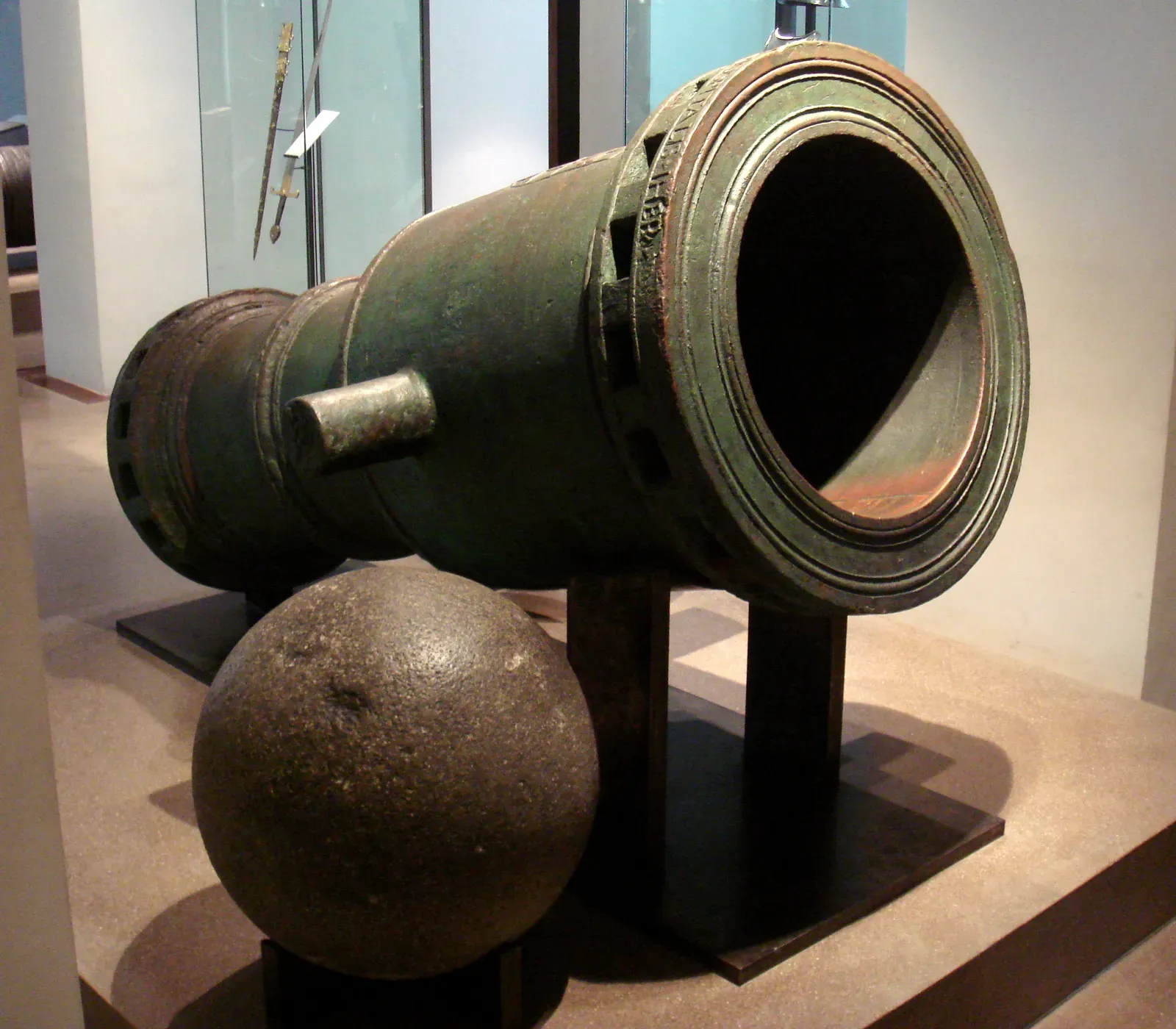
On 25 July 1467, along the Idice river between the villages of Riccardina and Molinella, gunners loaded bronze cannon with barrels ten to twelve feet long. Each shot took up to two hours to clean before the piece could fire again. That should have made the guns a footnote to a battle otherwise fought the way Italian battles had been fought for a generation: by armoured cavalry, hired by the day, more interested in surviving the encounter than winning it. Instead, over sixteen hours, those slow, filthy, half-reliable weapons - alongside hand-held arquebuses fired by infantry who had trained for weeks rather than a lifetime - helped kill somewhere between five hundred and seven hundred men and close to a thousand horses. It was, by the reckoning of the historians who have studied it, the first battle in Italy in which firearms and artillery were used extensively. Nobody who survived it went home thinking war worked the way it used to.
The two armies were led by the era’s two most sought-after condottieri, mercenary captains. Bartolomeo Colleoni brought fourteen thousand men in Venetian service, allied with Ferrara and a handful of Florentine exiles, and was using the campaign to advance a private ambition to weaken Milan. Federico da Montefeltro led thirteen thousand men for a coalition of Florence, Milan, Naples, and Bologna. Historians still argue over who won. The one certain outcome is that Colleoni gave up on Milan. Everything else about the battle is contested except the casualty count, and the casualty count is the part that mattered.
To see why, it helps to know what an Italian battle was supposed to look like before 1467. Niccolò Machiavelli, writing two generations later with an axe to grind against mercenary armies, held up the 1440 Battle of Anghiari as the model of what the condottieri system had become: a contest that lasted four hours, involved thousands of men, and - in his telling - killed exactly one of them, a soldier who fell off his horse and was trampled. Modern historians think Machiavelli was exaggerating for effect; other accounts of Anghiari suggest a far bloodier day. But he was not inventing the reputation out of nothing. Condottieri fought for pay, not for a cause, and a captured knight in plate armour was worth more ransomed than dead. Combat between men who might be comrades or rivals in the same racket next season had every incentive to end in surrender rather than slaughter. Machiavelli’s complaint, stated plainly in The Prince, was that mercenaries would take your money in peacetime and refuse to die for it in war. Whether or not one man really died at Anghiari, the system he was describing was real, and it had made Italian warfare, by the standards of the century, oddly survivable.
Molinella broke that arrangement, and it broke it by removing the thing the whole system depended on: a fighting man’s ability to control his own risk. Plate armour and a willingness to surrender protected a knight against a lance or a sword swung by another professional with the same incentives to spare him. It did nothing useful against a cannonball, and not much against a lead ball fired by an infantryman who had never met him and had no stake in whether he lived. That, more than raw stopping power, is the case for firearms as a genuine break in military history rather than just a louder crossbow. A longbowman took years, often starting as early as the childhood, to build the strength and technique a war bow demanded. An arquebusier could be made lethal enough in a few weeks, even though the weapon he carried was clumsy, slow to reload, and wildly inaccurate past fifty paces. Skill stopped being scarce. Once it stopped being scarce, so did the class of men who had built a lucrative peace around monopolising it.
Artillery did something even more disruptive, because it had almost no precedent to build on. Battering rams, siege towers, and trebuchets were mechanical solutions to a stone wall, and a wall built to withstand them had centuries of engineering behind it. A cannon was a chemical solution, and chemistry does not respect a wall’s age. Fourteen years before Molinella, Mehmed II had used enormous bronze bombards to bring down walls at Constantinople that had turned back every siege for a thousand years. Once Italian states had watched artillery decide field battles as well as sieges, the long, patient siege warfare that had defined the peninsula’s conflicts - blockades measured in months, fortresses that could out-wait an attacker’s supplies - gave way to something faster and considerably more destructive. When Charles VIII marched a French artillery train into Italy in 1494, he reduced fortresses that had never fallen to a siege in living memory in a matter of hours. The guns at Molinella had barely announced themselves. Twenty-seven years later, they had already rewritten how a war was won.
None of this happened because anyone involved cared about scientific progress. It happened because gunpowder war created problems that only better science could solve, and rulers who wanted deadlier guns had to pay for the solving. A cannon that misfired killed its own crew, which meant gun-founders needed more reliable bronze and iron casting, and casting on that scale pushed forward the same furnace technology that would later drive industrial metalworking generally. Gunpowder itself went from a coarse, unreliable serpentine mix to granulated corned powder, more powerful and far less likely to separate into its component chemicals in transit - a direct answer to the demands of an army that needed its charges to work the same way twice. And because a gunner who could only guess at range and elevation was wasting expensive shot, states eventually paid for the mathematics to fix that too: Niccolò Tartaglia published the first systematic tables for cannon trajectories in 1537, work that fed, a century later, into Galileo’s demonstration that a projectile follows a parabola. Venice, one of the two powers at Molinella, ran its Arsenal as a state-owned production complex employing thousands of workers to turn out standardised ships and ordnance - an early experiment in the kind of organised mass output that gunpowder warfare increasingly required and individual armourers could no longer supply alone. Metallurgy, chemistry, mathematics, and industrial organisation all took a shove forward from men trying to kill each other more efficiently. They are also, not coincidentally, the same disciplines that built everything else the modern world runs on.
The guns at Molinella took two hours to clean after every shot and settled nothing about who controlled Bologna’s approaches. But they settled something larger. War between professionals, played by rules that let the losing side walk away, had been a viable business model for the length of a man’s career. After Molinella, and far more emphatically after the French guns arrived in 1494, it stopped being one. Once a lead ball or a cannon shot no longer cared what a man was worth in ransom, the whole incentive structure that had kept fifteenth-century Italian warfare relatively survivable collapsed, and it did not come back. Machiavelli got to write his complaint about the condottieri precisely because he was already living in the aftermath, watching a system die that firearms, more than any general, had killed.