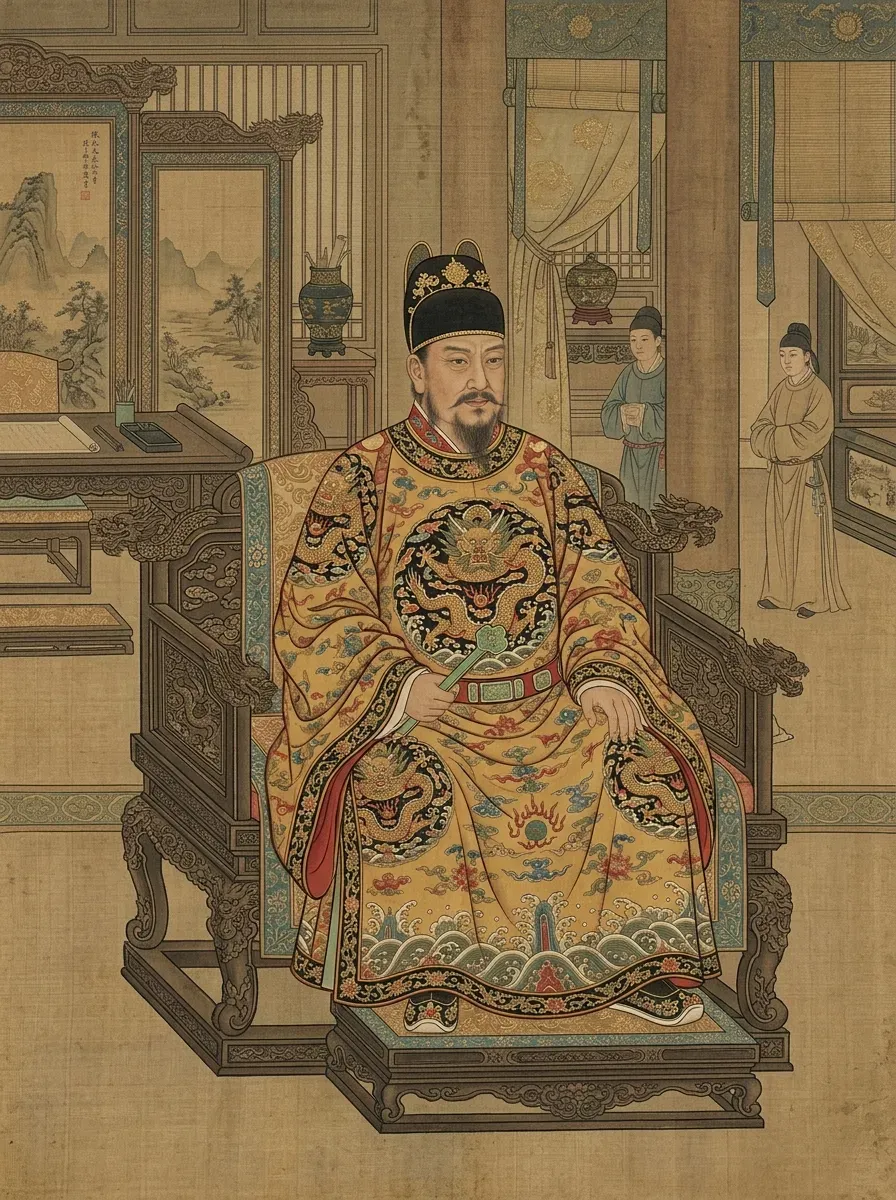
There is a comforting moral myth in political history that noble regimes are founded by noble men, and that tyrants build only tyrannies. But Chinese imperial history offers no such easy consolation. On 4 September 626, a twenty-eight-year-old general named Li Shimin ascended the imperial throne in Chang’an as Emperor Taizong of the Tang dynasty. He was arguably the most gifted soldier and administrator of his century. He was also a fratricide who had clawed his way to the crown over the corpses of his own family.
Two months earlier, on 2 July 626, Li Shimin had staged a cold-blooded ambush at the Xuanwu Gate, the northern entrance to the imperial palace complex. For years, a bitter succession rivalry had raged between Li Shimin - who had won virtually all the critical military victories that established the dynasty - and his elder brother, Crown Prince Li Jiancheng, backed by their younger brother Li Yuanji. Sensing that his brothers were closing in on him, Li Shimin struck first. When the Crown Prince rode into the gate courtyard at dawn, Li Shimin drew his bow and shot him through the throat. Li Yuanji was run down and killed moments later.
To ensure no vengeance could ever be organised, Li Shimin ordered the immediate execution of all ten of his brothers’ sons - his own nephews, ranging from teenagers to infants. Then he dispatched his trusted general, Yuchi Jingde, in full battle armour and dripping with blood, into the private boating pavilion where his father, Emperor Gaozu, was idling on a palace lake. The message was polite, unmistakable, and backed by thousands of veteran cavalry: the Crown Prince was dead, the state was secure, and it was time for the Emperor to retire. Gaozu, understanding perfectly that abdication was the only thing standing between him and an accidental drowning, handed over executive authority. Two months later, on 4 September, the transfer was formalized, and Li Shimin became the Son of Heaven.
If the chronicle had stopped there, Li Shimin would be remembered as just another ruthless warlord in the long, blood-soaked carousel of Chinese dynastic transitions. The Sui dynasty had imploded in chaos less than a decade earlier; the Yellow River basin was still scarred by civil war. Usurpers who purged their kin were a dime a dozen.
What makes Emperor Taizong singular in world history is what happened next. Instead of ruling with the paranoid brutality of a man who had stolen a throne, he inaugurated the Zhenguan era (627–649) - twenty-three years of administrative restraint, legal codification, economic recovery, and intellectual vitality so extraordinary that for the next fourteen centuries, every subsequent Chinese ruler looked back on his reign as the unreachable golden standard of Confucian statecraft.
The tone of the new regime was set in the very first days after the coup. Among the prisoners dragged before Li Shimin was Wei Zheng, a brilliant scholar who had served as the dead Crown Prince’s chief political strategist. Wei Zheng had repeatedly advised Li Jiancheng to assassinate Li Shimin before it was too late. When Taizong demanded to know why he had tried to turn brother against brother, Wei Zheng looked the new Emperor in the eye and replied: “If the Crown Prince had listened to my advice, he would never have died in this disaster.”
A standard autocrat would have had Wei Zheng sliced into ribbons. Taizong appointed him to his inner circle and made him chief imperial remonstrator - a role dedicated entirely to finding fault with the sovereign’s conduct. Over the next seventeen years, Wei Zheng submitted more than two hundred formal memorials criticising the Emperor to his face. He attacked Taizong’s extravagant hunting trips, warned him against expanding his palaces, rebuked his displays of imperial arrogance, and cautioned him against overtaxing the peasantry. Taizong frequently flew into private rages - on one occasion storming into the Empress’s chambers shouting that he would eventually kill “that country bumpkin” - but he never silenced him.
When Wei Zheng died in 643, Taizong cancelled court audiences in grief and delivered one of the most famous reflections on statecraft in Asian history: “With bronze as a mirror, one can adjust one’s cap and robes; with history as a mirror, one can understand the rise and fall of dynasties; with a man as a mirror, one can see one’s own mistakes. Now that Wei Zheng is gone, I have lost one of my mirrors.”
That willingness to be contradicted was not performative virtue; it was the foundation of an astonishingly competent government. Taizong slashed government spending, reduced the number of central ministries, and lowered agricultural taxes to a mere fraction of grain yields, allowing the war-shattered peasant economy to heal. He established the Tang Code - a monumental legal system based on precise penalties, systemic equity, and Confucian principles that became the statutory foundation for law codes across East Asia, from Japan to Vietnam. He revitalized the imperial examination system (Keju), breaking the suffocating monopoly of the hereditary aristocratic clans and creating a meritocratic civil service that drew the sharpest minds in the empire into provincial administration.
The dynasty’s domestic stability was matched by an audacious foreign policy. In late September 626, barely three weeks after Taizong’s coronation, Illig Khagan of the Eastern Turkic Khaganate marched 100,000 nomadic horsemen straight to the banks of the Wei River, just miles north of Chang’an. With the capital garrison depleted, Taizong did not retreat behind the city battlements. In a legendary display of cold nerve, he rode out to the Bianqiao bridge accompanied by only six aides, stared down the Khagan across the water, and bluffed him into believing a massive Tang army lay in wait. He negotiated an immediate peace, sealed by the ritual sacrifice of a white horse.
Four years later, having rebuilt his cavalry and allied with rival steppe tribes, Taizong struck back. In the winter of 630, Tang forces under General Li Jing launched a lightning strike through a blizzard across the Gobi Desert, crushed the Eastern Turks at the Battle of Yinshan, and captured Illig Khagan alive. When the nomadic chieftains arrived in Chang’an to submit, they offered Taizong a title never before held by a Chinese monarch: Tian Kehan - the “Heavenly Khagan.” For the first time in history, the sedentary agrarian civilization of China and the nomadic horse cultures of the Eurasian steppe were united under a single sovereign.
Under Taizong, Chang’an became the undisputed capital of the medieval world - a grid-planned metropolis of over a million inhabitants where Persian merchants, Nestorian Christian missionaries, Zoroastrian priests, and Japanese scholars rubbed shoulders in the Western Market. When the Buddhist monk Xuanzang returned in 645 from a sixteen-year pilgrimage across Central Asia and India, Taizong received him with imperial honours, financed the translation of hundreds of Sanskrit sutras, and questioned him extensively about the geography and customs of the kingdoms to the west.
Yet the blood at the Xuanwu Gate was a stain that no amount of golden-age glory could entirely wash clean. In classical Chinese historiography, an ancient constitutional convention held that reigning emperors were strictly forbidden from inspecting the Imperial Diaries (qijuzhu) and daily records kept by court historians, ensuring that the historical truth could be recorded without royal interference. Taizong broke that rule. Obsessed with how posterity would judge his accession, he repeatedly pressured his Chancellor, Fang Xuanling, until he was permitted to read the draft chronicle of his reign. Under the Emperor’s watchful eye, the history was sanitized: the Crown Prince was retroactively painted as a degenerate conspirator, and Li Shimin’s violent coup was reframed as a reluctant, noble act of national salvation. Much like the Yongle Emperor eight centuries later, who rewrote Ming chronicles to erase his nephew’s reign, Taizong discovered that controlling the past was simply another frontier of imperial power.
I have always found something deeply revealing in that anxiety. It is tempting to look at the Zhenguan era and separate the enlightened philosopher-king from the ruthless murderer at the gate - to treat the coup as an unfortunate prelude to an otherwise spotless reign. But the truth is almost certainly the opposite: Taizong was a magnificent ruler precisely because he was a usurper.
A prince who ascends the throne through legitimate primogeniture can afford to be mediocre. He has the law on his side, his father’s blessing, and the unquestioned deference of the court; if the harvest fails or the administration rots, his legitimacy remains technically intact. But a man who has shot his brother through the neck, butchered ten children, and strong-armed his father into abdication has no such margin for error. He is operating under an existential debt to the Mandate of Heaven. The only way he can justify his survival - to his subjects, to his ministers, and to his own conscience - is to govern so brilliantly, so justly, and so selflessly that history is ultimately left with no choice but to forgive him.
When Li Shimin rode through the Xuanwu Gate on that July morning in 626, he committed a crime that should have doomed his memory to the ranks of China’s bloody tyrants. But over the next twenty-three years, looking constantly into the critical mirror of Wei Zheng and the unforgiving mirror of history, he built an empire that outshone the crime that made it. It remains one of the darkest ironies of statecraft: that the highest summit of Chinese virtue was built to outrun a ghost.