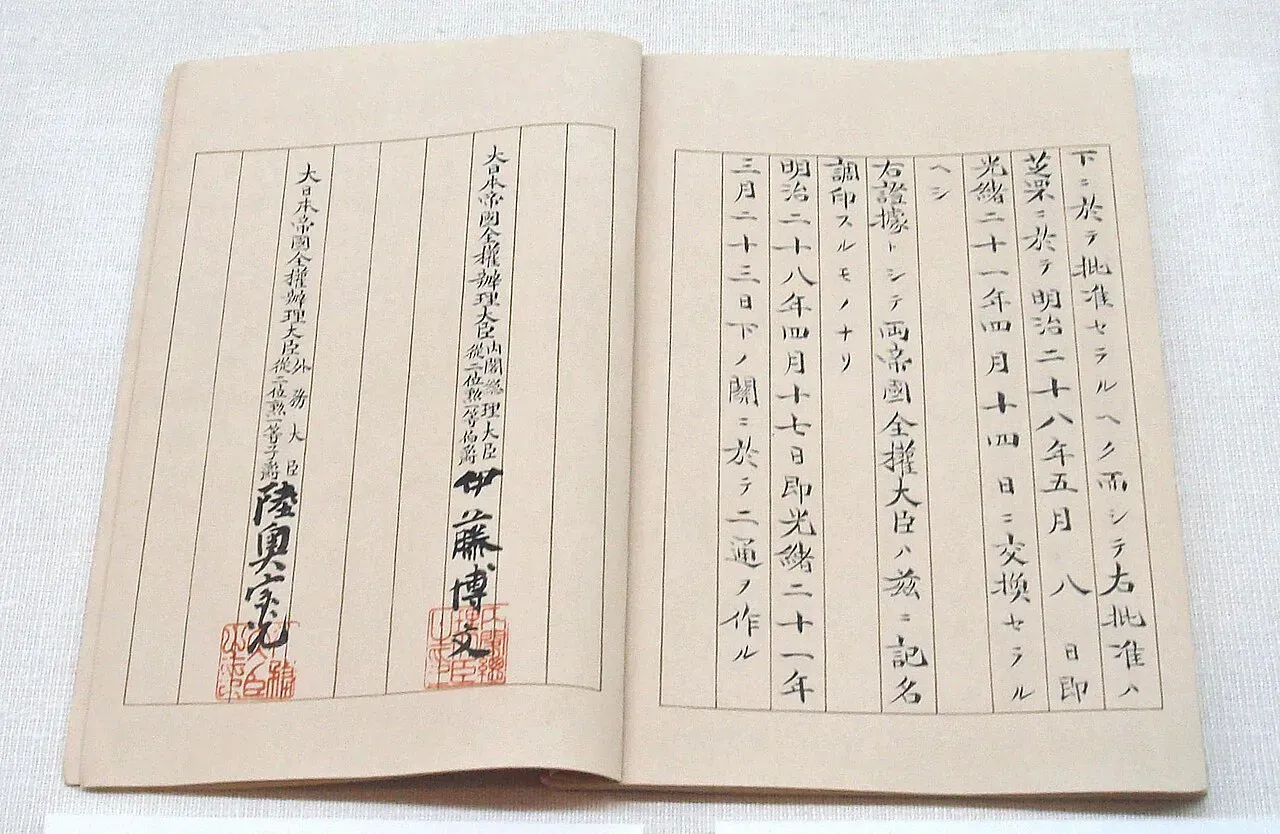
On 17 April 1895, in a conference hall in the Japanese port city of Shimonoseki, Li Hongzhang - China’s most experienced statesman, the man who had spent three decades trying to modernise the Qing empire - signed a document that ended the First Sino-Japanese War. He had been negotiating with a fresh bullet wound in his cheek; on 24 March, a Japanese nationalist had shot him as he left a meeting. His injury won China a partial armistice and some international sympathy, and not much else. The treaty he signed ceded Taiwan and the Penghu Islands to Japan in perpetuity, surrendered China’s suzerainty over Korea, and obligated the Qing government to pay 200 million taels of silver in reparations - more than Japan spent on the entire war.
The result surprised almost everyone paying attention. Before the war began, the German general staff assessed a Japanese victory as improbable. William Lang, a British military adviser who had served with the Chinese fleet, told Reuters that “in the end, there is no doubt that Japan must be utterly crushed.” The Beiyang Fleet was considered the strongest navy in East Asia. The Qing could put enormous numbers of men into the field. On paper, this looked like a mismatch in China’s favour.
What paper missed was everything that mattered: command culture, logistics, training, institutional coherence. The Qing army in 1894 was a patchwork - Eight Banner troops, Green Standard units, irregular braves, a few partially modernised Huai Army battalions - stitched together under provincial commands that barely coordinated with each other. Some units had modern Mauser rifles. Some had spears, bows and arrows. The Chinese declaration of war referred to the Japanese repeatedly as wojen - “dwarfs,” the traditional pejorative - in keeping with a court that had spent centuries treating its neighbours as tributary subordinates and saw no reason to revise that view. Eight months and every major engagement later, the dwarf had won.
The divergence formalised at Shimonoseki had been building for forty years. When Commodore Perry’s black ships forced Japan open in 1854, the humiliation went to work immediately. The Meiji Restoration of 1868 was the result: a government that demolished feudalism, conscripted a national army on Prussian lines, built railways and arsenals and a modern legal code, and dispatched delegations across Europe and America with the explicit brief of learning everything Japan did not yet know how to do. China had attempted something similar - the Self-Strengthening Movement, launched in 1861 - but it was surgery performed only on the surface. Modernise the guns, keep the dynasty. Reform the arsenals, not the institutions. The gap between the two countries in 1894 was not primarily a gap in hardware. It was a gap in how seriously each had been willing to question itself.
The war ran from July 1894 to April 1895. Japan won at Pyongyang, where 13,000 Chinese troops fled after a single day of serious fighting, abandoning 35 artillery pieces. It won at the Yalu River, where eight of ten Beiyang warships were sunk or driven off in a five-hour afternoon battle. It won at Port Arthur, which fell in a single day. It won at Weihaiwei in February 1895, where the surviving Chinese fleet surrendered after a 23-day siege and Admiral Ding Ruchang committed suicide rather than sign the papers. There was no reversal, no near-run battle, no engagement that suggested the result might have gone differently.
The treaty’s terms were punishing, but what followed them was worse. Russia, Germany, and France - the Triple Intervention - forced Japan to return the Liaodong Peninsula three weeks after the treaty was signed, on the grounds that Japanese control of it would “threaten the peace of the Far East.” Japan, unable to resist three European powers simultaneously, complied. It was a humiliation of a different kind, and Japan absorbed its lesson carefully: Western powers would not allow an Asian nation to keep territorial gains until they accepted it as a peer. Japan spent the next decade building the alliances and the fleet to ensure it would not be put in that position again. The Anglo-Japanese Alliance of 1902 and the annihilation of Russia’s Baltic Fleet at Tsushima in 1905 were both directly downstream of Shimonoseki.
For China, what followed was a scramble. Russia took Port Arthur - the very peninsula Japan had been forced to return - on a 25-year lease in 1898. Not for long, of course, Russia will have its own encounter with the nacent empire in ten years. Germany took Qingdao. France took Guangzhouwan. Britain extended its posessions in Hong Kong and took Weihaiwei. The Boxer Rebellion of 1900 was the violent response: a mass movement of anti-foreign fury that ended with another foreign military expedition, another round of reparations, and another layer of imposed obligations on the Qing. The dynasty that signed away Taiwan in 1895 lasted until 1912.
Japan was on the rise. China kept going down. What Shimonoseki set in motion - Japan’s imperial expansion, China’s deepening fragmentation, the sequence running through the Russo-Japanese War and ultimately the full-scale Second Sino-Japanese War of 1937 - took another half-century to resolve. When Mao Zedong stood at Tiananmen in October 1949 and announced that the Chinese people had “stood up,” he was speaking to a wound opened in a conference room in Shimonoseki. The bullet in Li Hongzhang’s cheek barely slowed the proceedings. The reckoning he signed into existence took fifty-four years to arrive.