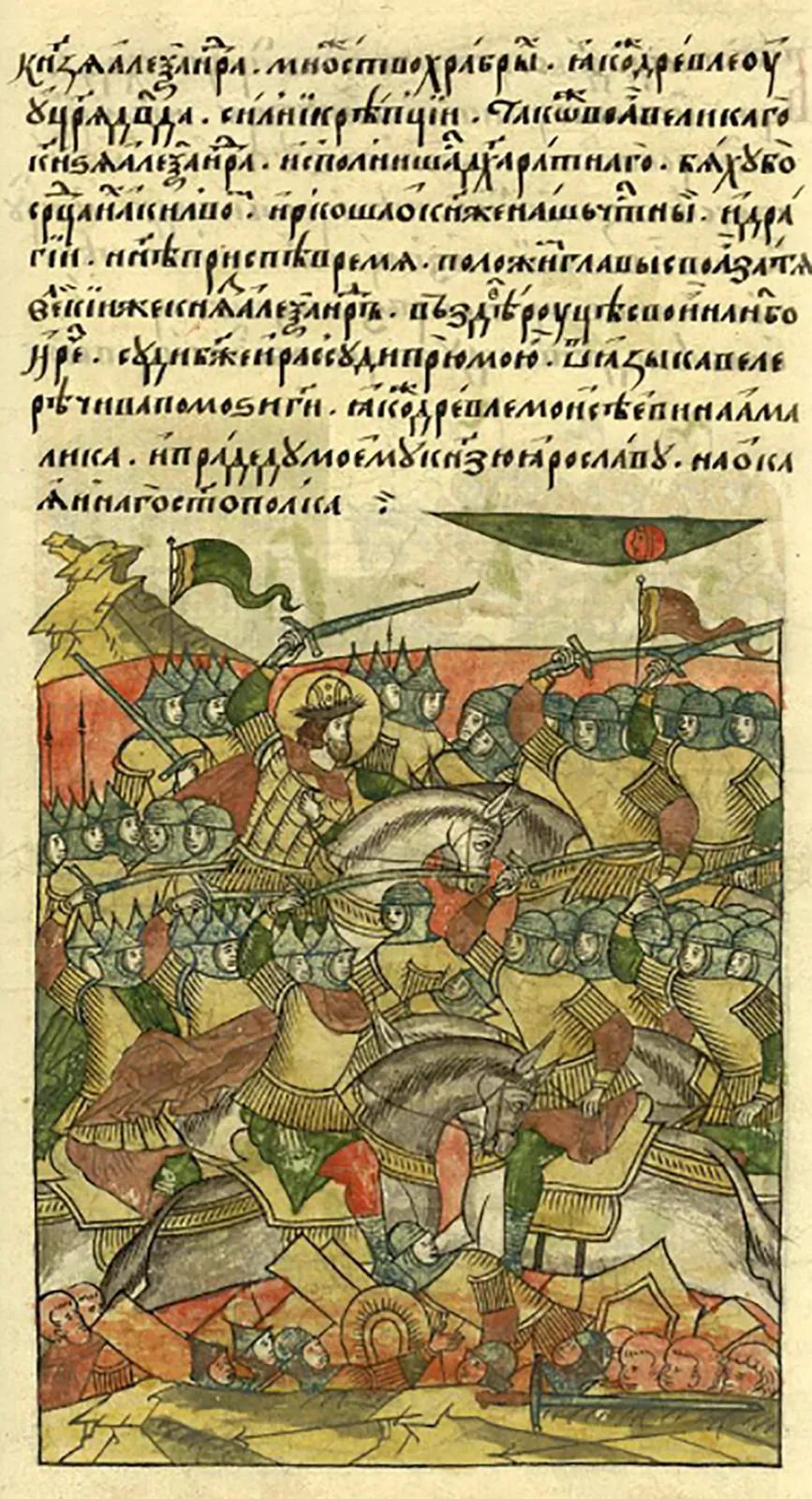
The battle is best known through a film. Eisenstein’s 1938 classic, Alexander Nevsky contains the scene everyone pictures: heavily armoured Teutonic Knights crashing through thawing ice, dragged under by metal and the weight of a bad tactical decision. It won a Stalin Prize. It was pulled from Soviet screens in August 1939 when the Molotov-Ribbentrop Pact made Nazi Germany a friend. It reappeared in cinemas in June 1941, the same week Germany invaded the Soviet Union, and was watched by millions. The battle it depicts took place 696 years before anyone filmed it. The two have been inseparable ever since.
The historical event behind the mythology was this: on 5 April 1242, a Novgorodian army commanded by Prince Alexander Yaroslavich met a force of Livonian crusaders and their Estonian allies on the frozen surface of Lake Peipus - a large, flat, shallow body of water on the border of modern Russia and Estonia - and defeated them. The German advance eastward stopped. It did not resume in any serious form for over a century.
To understand why this mattered, you need to know what the Republic of Novgorod was sitting between. To the east: the wreckage of Mongol invasion. Batu Khan’s armies had swept through the Russian principalities between 1237 and 1240, burning Vladimir, Suzdal, and Moscow, killing an unknown but enormous number of people, and reducing most of the Russian lands to subordinate status under the Golden Horde. Novgorod itself was spared, apparently because the spring thaw turned the surrounding marshland into ground the Mongol cavalry could not cross before the campaign season ended. To the west: the Livonian Brothers of the Sword, a crusading military order that had been subjugating the Baltic peoples since the early thirteenth century and had begun pressing toward Pskov and Novgorod.
In 1240, the Livonians took Pskov - a major Russian city, sixty kilometres south of Lake Peipus, and a commercial gateway into Novgorod’s trading network. In the same year, Novgorod’s boyar council drove Alexander out of the city in a dispute over his authority. The sequence of decisions that followed would be extraordinary even for a seasoned commander. Alexander was twenty years old at the time. He was the son of Yaroslav II, Prince of Vladimir, who was simultaneously navigating tribute obligations to the Mongols. Alexander had already defeated a Swedish force at the mouth of the Neva in July 1240 - hence the name “Nevsky” - and he was recalled by the council after the fall of Pskov, presumably having demonstrated that they needed him more than they needed to win arguments with him.
In early 1242, he retook Pskov. He then moved his army onto the ice of Lake Peipus, choosing the terrain deliberately. The ice was thawing by April. The German-Estonian force pursued him onto the lake, organised in the heavy wedge formation that the crusading orders favoured - the “pig’s snout,” a concentrated point of armoured cavalry designed to break an enemy centre. Novgorodian cavalry held the flanks; a stronger infantry core absorbed the German charge. When the wedge punched through and found itself inside an encirclement rather than a routing line, the Livonian force lost cohesion. The pursuit lasted several kilometres north across the ice.
The primary sources disagree about almost everything except the result. The Novgorodian First Chronicle, written within a generation of the battle, says that “400 Germans fell and 50 were taken prisoner” - but Novgorodian chronicles have a tendency toward round numbers that reward scepticism. The Livonian Rhymed Chronicle, a German-language account composed around 1290, says that twenty brothers of the order were killed and six captured, and that the battle was a genuine setback but not a slaughter. Modern historians have suggested the engagement was considerably smaller than Soviet historiography required it to be. The famous sinking through the ice - the image Eisenstein turned into one of cinema’s great sequences - does not appear in any primary source written near the time of the battle. It enters the tradition later.
What is not in doubt is that the Teutonic Order’s eastern campaign ended. The Order sent envoys to Novgorod and signed an agreement renouncing claims to Pskov, Novgorod, and the Vod and Latvian territories. A border along the Narva River and Lake Peipus held as a rough eastern limit of Catholic expansion for more than a hundred years. Whatever the precise scale of the fighting on 5 April 1242, the strategic consequence was real.
Alexander’s subsequent career is the part that complicates the legend. Having repelled the crusaders from the west, he spent the rest of his life managing Novgorod’s relationship with the Golden Horde to the east - and managing it, by most accounts, through cooperation rather than resistance. He travelled to the Mongol court multiple times. When Novgorodians revolted against a Mongol census and tax-collection drive in 1257, it was Alexander who suppressed the uprising and handed over the ringleaders. He argued, apparently, that armed resistance to the Mongols would be suicidal and that survival required submission. The argument was probably correct. It is also the argument of every collaborator in history, and it does not sit easily alongside the image of the great national defender.
The Russian Orthodox Church canonised Alexander Nevsky in 1547, three centuries after his death. Peter the Great had his bones moved to Saint Petersburg in 1724. Stalin commissioned Eisenstein’s film in 1938. In 2008, a Russian television poll declared him the greatest Russian of all time - ahead of Lenin, Pushkin, and Dostoevsky, three men who had done rather more with their time. The national icon that accumulated around the man who died in 1263 at forty-two, on his way back from another tribute visit to the Golden Horde, is a construction of such thorough and layered elaboration that the original event is almost buried beneath it.
The irony at the centre of the legend is not hard to find. The man celebrated for halting Western penetration of Russia spent his most consequential years facilitating Eastern domination of it. The West was turned back on a frozen lake in April 1242. The Mongols stayed for two and a half centuries. Alexander Nevsky chose his enemies carefully, and the one he is remembered for defeating was the smaller of the two. Stalin, who commissioned the film and presided over the cult, understood something about that kind of choice. He did not publicise the understanding.
The ice of Lake Peipus held on 5 April 1242. Whether knights sank through it is a good question for historians and a bad question for myth-makers, who have long since decided which version of events they prefer.