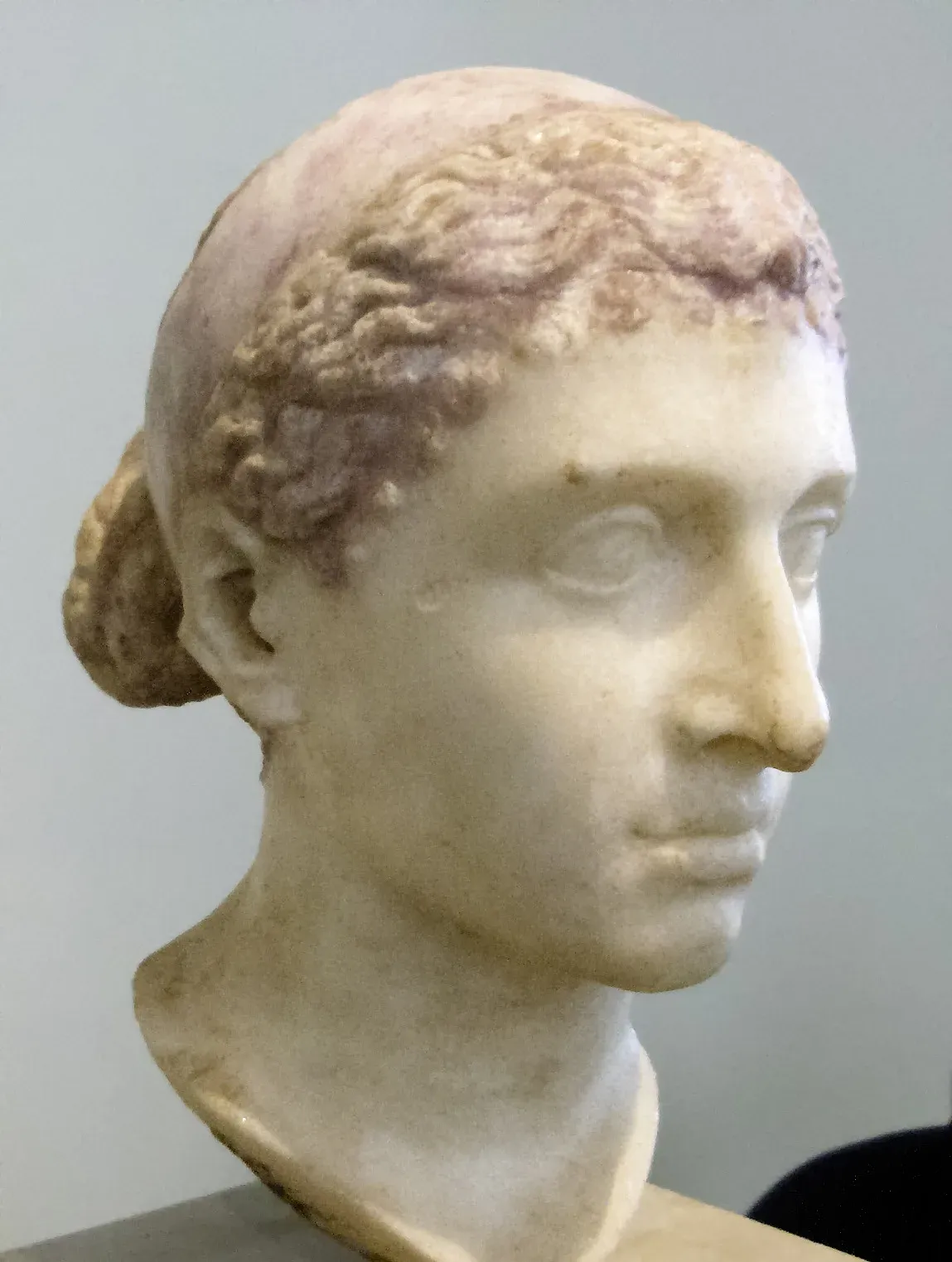
When modern culture summons Cleopatra, it invariably pictures Elizabeth Taylor reclining on silk cushions, drenched in heavy kohl, bathed in asses’ milk, and entangled in the romantic melodrama of Rome’s most glamorous warlords. Hollywood turned her into an exotic siren whose power resided entirely in the bedchamber - an erotic sideshow to the serious business of Roman empire-building.
The reality was colder, sharper, and far more impressive. Cleopatra VII Philopator was not an Egyptian seductress lounging in an oriental fantasy. She was a hard-bitten Macedonian Greek autocrat operating at the tail end of a three-century dynasty that functioned less like a royal house and more like an armed criminal syndicate with a Mediterranean battle fleet.
Most people forget that she was Cleopatra Number Seven. The name itself - Klēopátra, ancient Greek for “Glory of her Father” - had been recycled through seven generations of ruthless dynastic infighting since Alexander the Great’s general, Ptolemy I Soter, seized the satrapy of Egypt in the fourth century BC. By the time our Cleopatra inherited the throne in 51 BC at the age of eighteen, the Ptolemies had spent two hundred and fifty years perfecting the arts of sibling incest, palace insurrection, and family murder.
To understand why Cleopatra made the choices she did, you have to look at the family tree she survived. Ptolemy VIII Physcon had married his sister, Cleopatra II, then raped and married her daughter, Cleopatra III, and when his teenage son by the first marriage posed a political threat, Physcon had the fourteen-year-old boy butchered, dismembered, and shipped in a wooden chest to the boy’s mother as a birthday present. Cleopatra’s own father, Ptolemy XII Auletes - the “Flute Player” - spent decades bankrupting the state to bribe Roman senators into keeping him on the throne. When the Alexandrian mob finally chased him out and placed his eldest daughter Berenice IV in power, Auletes borrowed a Roman army under Aulus Gabinius, retook the capital, and promptly cut off his daughter’s head.
That was the household curriculum. When Cleopatra VII came to power, she knew with total clarity that in Alexandria, family was not a sanctuary; it was an execution queue.
Egyptian religious tradition and Hellenistic legal custom made it virtually impossible for a woman to rule as sole monarch. A queen regnant required a male co-ruler. Cleopatra was initially paired with her ten-year-old brother, Ptolemy XIII. Within three years, the boy’s regents and palace eunuchs had raised an army against her and driven her into the Syrian desert. When Julius Caesar sailed into Alexandria in 48 BC pursuing Pompey the Great - only to be presented with Pompey’s pickled head in a bronze jar - Cleopatra famously smuggled herself back into the royal palace inside a sack to pitch her case directly to the Roman dictator.
The resulting Alexandrian War saw the Roman garrison besieged in the palace quarter, the Great Library damaged by fire, and young Ptolemy XIII drowned in the muddy waters of the Nile under the weight of his golden armour. Caesar restored Cleopatra to the throne, but the dynastic rules still demanded a male partner. So she married her remaining brother, Ptolemy XIV, who was barely twelve years old.
In the summer of 47 BC, Cleopatra gave birth to a boy: Ptolemy Caesar, known across the Mediterranean as Caesarion - “Little Caesar”.
For Cleopatra, the child was both a triumph and a mortal risk. Caesar never officially acknowledged the boy in his Roman will; Roman law did not recognise marriages to foreigners, and Caesar’s political enemies in Rome were already hysterical at the prospect of an Egyptian queen installing an autocratic monarchy over the Republic. Yet Caesar allowed Cleopatra to bring the infant to Rome, housed them in his private villa across the Tiber, and provocatively dedicated a gilded statue of Cleopatra in the Temple of Venus Genetrix - the mythical ancestral mother of the Julian clan.
Then came the Ides of March, 44 BC. Caesar was stabbed twenty-three times on the Senate floor by aristocrats terrified that his perpetual dictatorship and foreign queen were dragging the Republic into Hellenistic tyranny, as I explored in The Last Days of the Republic.
With Caesar dead and Rome descending into factional chaos, Cleopatra gathered her child and her retinue and took ship for Alexandria. She returned to a kingdom hit by famine, failing Nile floods, and deep civil instability. Worse, her younger brother and co-ruler, Ptolemy XIV, was growing older - and an adult Ptolemaic prince with a claim to the throne was a lethal liability.
Within weeks of her return to Alexandria, Ptolemy XIV was dead. The contemporary Roman and Jewish historians were under no illusions about what had happened: Cleopatra had him poisoned with aconite.
On 2 September 44 BC, Cleopatra made her definitive political gamble. She formally elevated her three-year-old toddler, Ptolemy XV Caesar, as her official co-pharaoh and King of Egypt, bestowing upon him the royal title Theos Philopator Philometor - “The God who loves his father and mother”.
It was a stroke of absolute tactical brilliance. By replacing an ambitious teenage brother with a three-year-old toddler, Cleopatra eliminated the threat of palace coups from within her own family. A child in a crib could not hire mercenary bodyguards, could not plot with Alexandrian courtiers, and could not sign execution warrants against his co-ruler. For the next fourteen years, Cleopatra VII governed Egypt with undisputed, undivided authority.
At the same time, the appointment was a brazen geopolitical declaration. By placing Caesar’s name and bloodline onto the double crown of Upper and Lower Egypt, she married the immense agrarian wealth of the Nile valley to the most prestigious brand in the Roman world. On the exterior walls of the Temple of Hathor at Dendera, she had herself and Caesarion carved in colossal stone reliefs, offering incense to the gods as living deities - a pharaoh and her divine heir.
Yet the very move that secured her crown in 44 BC proved fatal to the dynasty she tried to save.
By stamping Caesar’s name on her son, Cleopatra created an intolerable challenge to the young man who held Caesar’s legal name in Rome: Gaius Octavius, Caesar’s adopted heir. Octavian could tolerate Mark Antony; he could negotiate with Egyptian client kings; he could even spare Antony’s children by Cleopatra. But he could never permit Julius Caesar’s only biological son to exist. A legitimate biological heir to Caesar was an existential bullet aimed at the foundation of Octavian’s political legitimacy.
History has a strange fondness for grim calendar symmetries. Exactly thirteen years to the day after Cleopatra proclaimed Caesarion co-ruler - on 2 September 31 BC - Octavian destroyed the combined fleet of Antony and Cleopatra at the Battle of Actium.
When Alexandria fell the following year, Antony fell on his sword and Cleopatra took poison in her mausoleum. Caesarion, then seventeen years old, was packed off with a fortune in gold toward the Red Sea port of Berenice, with instructions to take ship for India and disappear. He never made it. Octavian’s philosopher and political adviser, Arius Didymus, gave the new master of Rome the decisive counsel, adapting Homer’s Iliad with lethal wit: “Ouk agathon polykaisarie” - “It is not good to have too many Caesars.”
Caesarion was lured back to Alexandria with false promises of safety and quietly strangled in a palace corridor.
Cleopatra VII was neither the tragic romantic victim of Shakespearean tragedy nor the sensual courtesan of Roman propaganda. She was the final, calculating survivor of a dynastic bloodbath that had consumed the eastern Mediterranean for three centuries. On 2 September 44 BC, she thought she had outmanoeuvred the lethal machinery of her family by using a child as a political shield. She had simply ensured that when the blow fell, the empire would extinguish the mother, the son, and the three-thousand-year line of pharaohs all in a single afternoon.