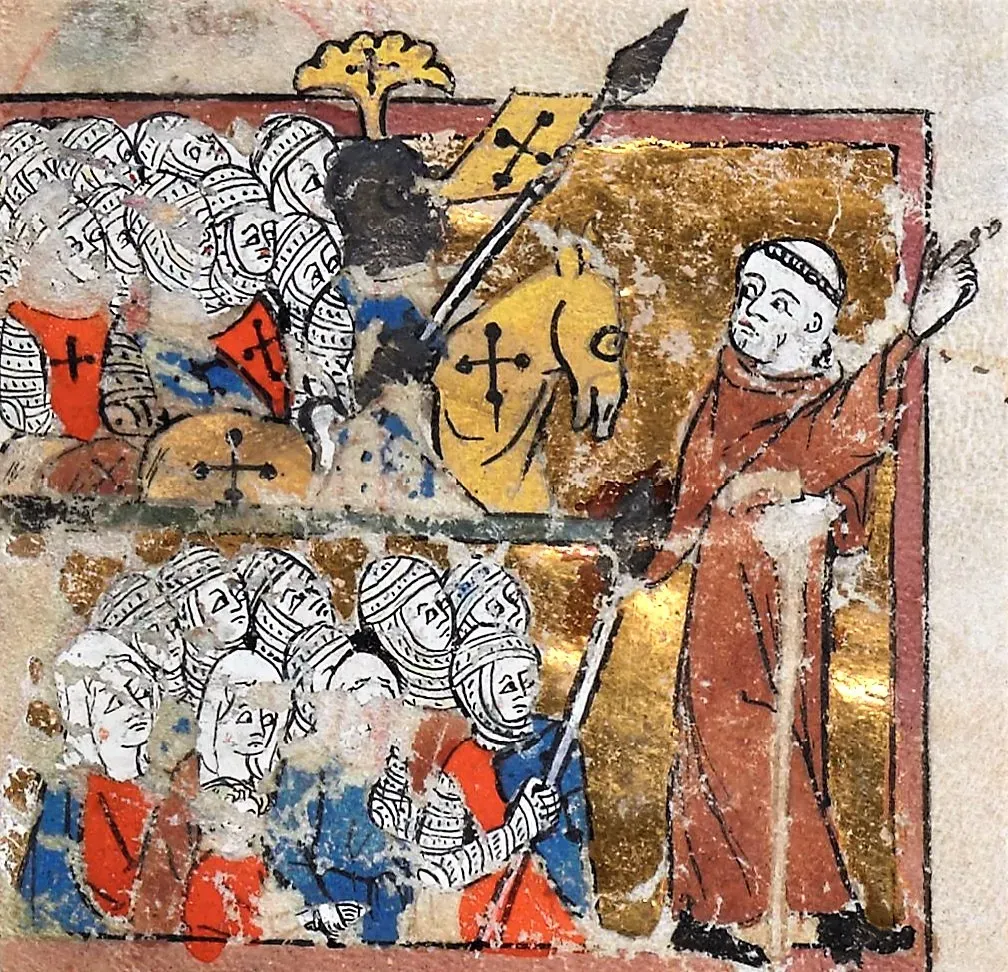
There is a footnote to the story of the First Crusade — covered in more detail here — that the official chronicles preferred to keep small. In the spring of 1096, months before the organised military expedition of knights and lords set off for Jerusalem, an enormous and disorganised mass of peasants, labourers, and wandering poor had already begun moving east. Somewhere in that column, a woman was travelling with a goose from her farm. The goose kept following her. The people around her decided it was a sign from God.
This was not, in the medieval context, quite as absurd as it sounds. The world in 1096 ran on omens. Portents filled the chronicles: comets, eclipses, meteor showers, unusual animal behaviour. Pope Urban II’s speech at Clermont in November 1095 had produced a response far beyond anything he had planned for, drawing tens of thousands of non-combatants — farmers, the destitute, women, children — into what became known as the People’s Crusade, led nominally by Peter the Hermit, a wandering preacher who rode a donkey and claimed to carry a letter written by Christ himself. In this company, a persistent goose was perhaps not the least credible guide on offer. The crusaders had no maps. They had no military command structure. They had very little reliable information about where Jerusalem was or how to get there. An animal that seemed to know where it was going had a certain logic to it.
Three chroniclers recorded the incident, and it is worth being precise about which one said what, since the story has been getting reshuffled between them for nine centuries. Albert of Aachen, in his Historia Ierosolimitana, described a goose “inspired by the Holy Spirit” and a she-goat “not less filled by the same Spirit,” made into guides for the holy journey and “worshipped excessively” by a crowd he says followed them “like beasts.” Guibert of Nogent, in his Dei gesta per Francos, told a fuller and funnier version: a poor woman set out with a goose that had followed her since it was a gosling, and within days rumour had the story backwards - the woman was not leading the goose, the goose was leading her. At Cambrai, Guibert wrote, the woman walked through a packed church to the altar with the goose waddling behind her in her own footsteps, unprompted, while the congregation watched in something close to awe. He could not resist a coda: the goose, he noted drily, would have made better progress toward Jerusalem if, the day before setting out, “she had made of herself a holiday meal for her mistress.” He also lingered on the animal’s sex, remarking that its devotion “clearly exceeded the laws of her own dull nature” - a jab less at the goose than at the woman leading it, and at what it meant for a female pilgrim to be taken seriously as a channel of divine guidance. Albert and Guibert were educated clerics writing for audiences who needed the Crusade to be a coherent, divinely sanctioned enterprise led by men of rank and purpose. The People’s Crusade, with its chaos, its violence, and its barnyard leadership, was a problem for that narrative, and a story about peasants venerating a goose solved part of it without either author needing to argue the point outright. It said: these people were not crusaders. They were a rabble. They were, in Albert’s own word, beasts.
The goose, in any case, did not survive long. It died somewhere in northeastern France - Lorraine, according to Guibert - never having come close to the Byzantine border, let alone Jerusalem. The woman’s fate is unrecorded. The broader column pushed on through Hungary and the Balkans, pillaging as it went, falling into violent disputes with local populations, losing thousands at the Siege of Niš, crossing into Byzantine territory in a state of considerable disorder, and finally being ferried across the Bosphorus by a deeply alarmed Alexios I Komnenos, who wanted them out of Constantinople before they burned anything else. In October 1096, the Seljuk army of Kilij Arslan caught the main body of the People’s Crusade in a narrow wooded valley near Civetot in Anatolia and destroyed it. The men were slaughtered. The women, children, and young men were taken as slaves. Some three thousand survivors made it back to Constantinople.
What the column had left behind it in Europe is where the story turns dark, and where the third chronicler matters most. Solomon bar Simson, writing his account of the Rhineland massacres in the mid-twelfth century, recorded the goose incident too, but not as comedy. In his version, a gentile woman went about announcing to passers-by that her goose “understands my intention to go astray and desires to accompany me” - proof, as she meant it, that the bird knew the crusaders’ cause was righteous. Solomon bar Simson set that story next to words he says the burghers and peasants of the Rhineland used against his own community that same year: “Now you will see the wonders which the crucified one works for them.” For him, the goose was not a charming eccentricity. It was evidence, offered by the perpetrators themselves, of the mindset that made the killings possible - a conviction of divine favour so total that anything standing in its way, geographic or human, could be read as an enemy of God’s plan. Between April and July 1096, that conviction produced a massacre of Jewish communities across the Rhineland. In Speyer, twelve Jews were murdered; the bishop intervened to save the rest. In Worms, around 800 were killed. In Mainz, over 1,000. In Trier, Metz, Cologne, and elsewhere, the killings continued. The estimates of the total dead range from 4,000 to 10,000 — roughly a quarter to a third of the Jewish population of Germany and northern France at the time. The preacher Emicho of Flonheim was the chief inciter; Albert of Aachen, no friend of the massacres, calls the killing at Mainz a “detestable crime” in the very same passage where he first brings up the goose and the goat, as if the two events belonged, in his own mind, to one register of disorder. The clergy and nobility of Europe condemned the killings. None of that helped anyone in Mainz.
There is a modern habit of trying to explain away the frenzy with biology instead of theology. A popular theory holds that rye bread contaminated with ergot fungus, which produces compounds chemically related to LSD, was circulating through parts of France and the Rhineland at exactly this time, and that ergotism’s hallucinations and convulsions could account for the visions, the portents, and the goose. It is a tidy explanation, and I do not buy it, not as the main event. Ergotism was real, and it did periodically sicken medieval populations, but you do not need poisoned bread to explain why tens of thousands of frightened, landless people, primed by a decade of famine and disease and told by their own preachers that the end of days had a departure date, found meaning in an animal that seemed to know where it was going. The frenzy had perfectly good causes that owed nothing to fungus: poverty, apocalyptic preaching, and a Church that had just told an entire continent that killing for Jerusalem bought forgiveness for a lifetime of sin. Blaming the bread lets everyone else off the hook.
The goose is the funny part of the story, and it has stayed the funny part for nine centuries. The chroniclers made sure of that. What they were less interested in recording, at least in the same tone of incredulous amusement, was that the crowd following the goose was the same crowd carrying out one of the largest pogroms of the medieval period. The two things are connected. The same millenarian excitement, the same certainty of divine mission, the same indifference to evidence, that made a farm bird look like a messenger of God also made Jewish communities look like enemies of Christendom who stood between the mob and its destiny. The goose was just the version of the story that everyone found easy to repeat.
It died in France. The violence it represents did not.