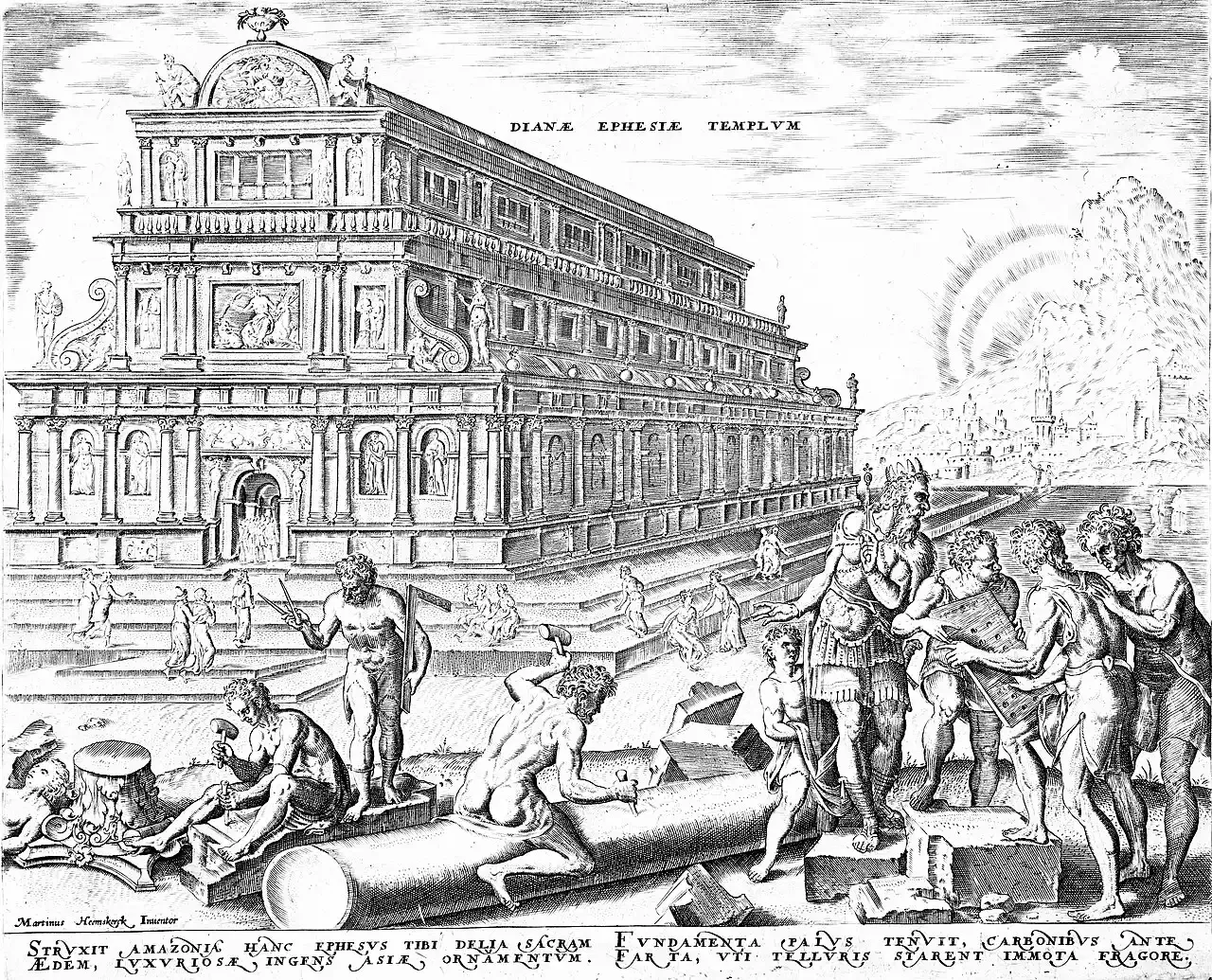
On 21 July 356 BC, according to the tradition that ties the date to Alexander the Great’s birth, a man set fire to the wooden roof of the Temple of Artemis at Ephesus. The marble colonnade did not burn. The roof did. That was enough. One of the Seven Wonders of the ancient world collapsed into smoke and ash because an obscure figure decided that destruction was the shortest route to immortality. His name was Herostratus. We know it because the city tried, with unusual thoroughness, to make sure we never would.
That is the core of the story, and it has not aged a day. Plenty of beautiful and important things have been destroyed in history - by armies, by zealots, by accident, by the slow indifference of weather. This fire is different. It coined a phrase: herostratic fame, the celebrity you buy by wrecking something the rest of us care about. I find the phrase more useful now than it has been in centuries. We live among people who will do almost anything ridiculous, outrageous, or criminal for a spell of attention. Herostratus would have recognised the market immediately.
A Wonder worth burning
The temple he burned was not a provincial shrine. The version standing in 356 BC had been raised, from around the mid-sixth century, under the Cretan architects Chersiphron and Metagenes, with heavy funding from Croesus of Lydia. Pliny the Elder later put its footprint at roughly 115 metres by 46, and claimed it was the first Greek temple built largely of marble, with columns some thirteen metres high. Merchants, kings, and pilgrims came to it. It offered sanctuary. Antipater of Sidon, listing the Seven Wonders, said that once he had seen Artemis’s house “those other marvels lost their brilliancy.” That is the kind of building you destroy if you want the outrage to travel.
Herostratus was arrested quickly. Under torture he confessed the motive that has kept him famous: everlasting renown. The Ephesians executed him and then did something sharper than execution. They passed a damnatio memoriae - a ban on speaking or writing his name, so that the prize he had bought with arson would be voided. It was a clever sentence. It treated fame as the currency of the crime and tried to cancel the payment.
It failed, of course. Theopompus, a contemporary historian, recorded the name anyway. Valerius Maximus, Lucian, and a long line of later writers kept it circulating. The ban may even have helped. Forbidden names have a way of becoming more interesting than permitted ones. Chaucer invoked him. Colley Cibber’s Richard III sneered that the youth who fired the Ephesian dome outlived, in fame, “the pious Fool that rais’d it.” By the time the phrase “herostratic fame” settled into European languages, the Ephesian strategy had become a historical joke with a bitter punchline: silence as punishment only works if everyone stays silent.
The template survives
Modern scholars have poked at the gaps. Confessions under torture are poor evidence. A man hunting publicity might have shouted his name in the street rather than waiting for the rack. Some historians suspect a useful idiot, or a cover story for temple officials who needed an excuse to rebuild a sinking foundation they were religiously forbidden to move. Those doubts matter for archaeology. They do not erase the cultural fact. Ancient and modern Europe agreed to treat Herostratus as the prototype of crime committed for the camera, even when the camera was still a scribe’s stylus.
The temple was rebuilt after Alexander’s death, larger than before. Alexander had offered to pay; the Ephesians declined with exquisite diplomacy, saying it would be improper for one god to build a temple to another. Goths damaged the later structure in the third century. Christians finished the cult. Today, near Selçuk in Turkey, a single reassembled column marks the site. The wonder is gone. The arsonist’s brand name remains.
What changed between then and now is not the appetite. It is the distribution. Herostratus needed a Wonder and a city’s collective memory. His modern heirs need a phone and an algorithm that rewards extremity. The old bargain was expensive: you had to destroy something irreplaceable and accept death. The new bargain looks cheaper. You can vandalise a painting, storm a sacred space for a stunt, film a crime, stage a public humiliation, or worse - and within hours the spectacle is mirrored across continents. Not every such act is Herostratic in the strict sense. Some are ideology wearing a mask. Some are illness. Some are ordinary cruelty. But a growing share follows the Ephesian pattern with depressing fidelity: target a symbol, produce panic or disgust, and convert both into personal visibility.
The media, old and new, are not innocent bystanders in this trade. Coverage is the oxygen. Luigi Lucheni, who stabbed Empress Elisabeth of Austria in 1898, performed for the courtroom as if it were a stage. Arthur Bremer shot George Wallace in 1972 after calculating which target would buy the most ink. After September 11, commentators reached for Herostratus again, because the logic rhymed even when the scale did not: smash a symbol the world recognises, and your name rides the smoke. I do not claim every atrocity is vanity. I do claim that vanity is now an accelerant we keep pouring on the fire and then acting surprised when it spreads.
The Ephesians understood one half of the problem. They grasped that denying the perpetrator his name was the only punishment that matched the motive. They failed because enforcement cannot be total across centuries of curious historians. We understand the same half, and then we do the opposite. We repeat the name, loop the footage, argue about the stunt, and feed the metric that made the stunt rational from the perpetrator’s point of view. Moral condemnation without informational discipline is just another broadcast.
I am not arguing for amnesia about victims or about facts needed for justice. I am arguing against the free gift of mythic status to people whose only achievement was a willingness to desecrate. Herostratus won because enough writers decided the story was too good to bury. Every age since has repeated the mistake with better tools.
On 21 July 356 BC a roof burned in Ephesus and a Wonder fell. The city answered with execution and a gag order. The gag order cracked, the name stuck, and we have been living with the template ever since. Beautiful things still burn. What distinguishes this fire is not the ash. It is the business model. Fame prepared in flames remains on offer - and today the queue looks longer than ever.