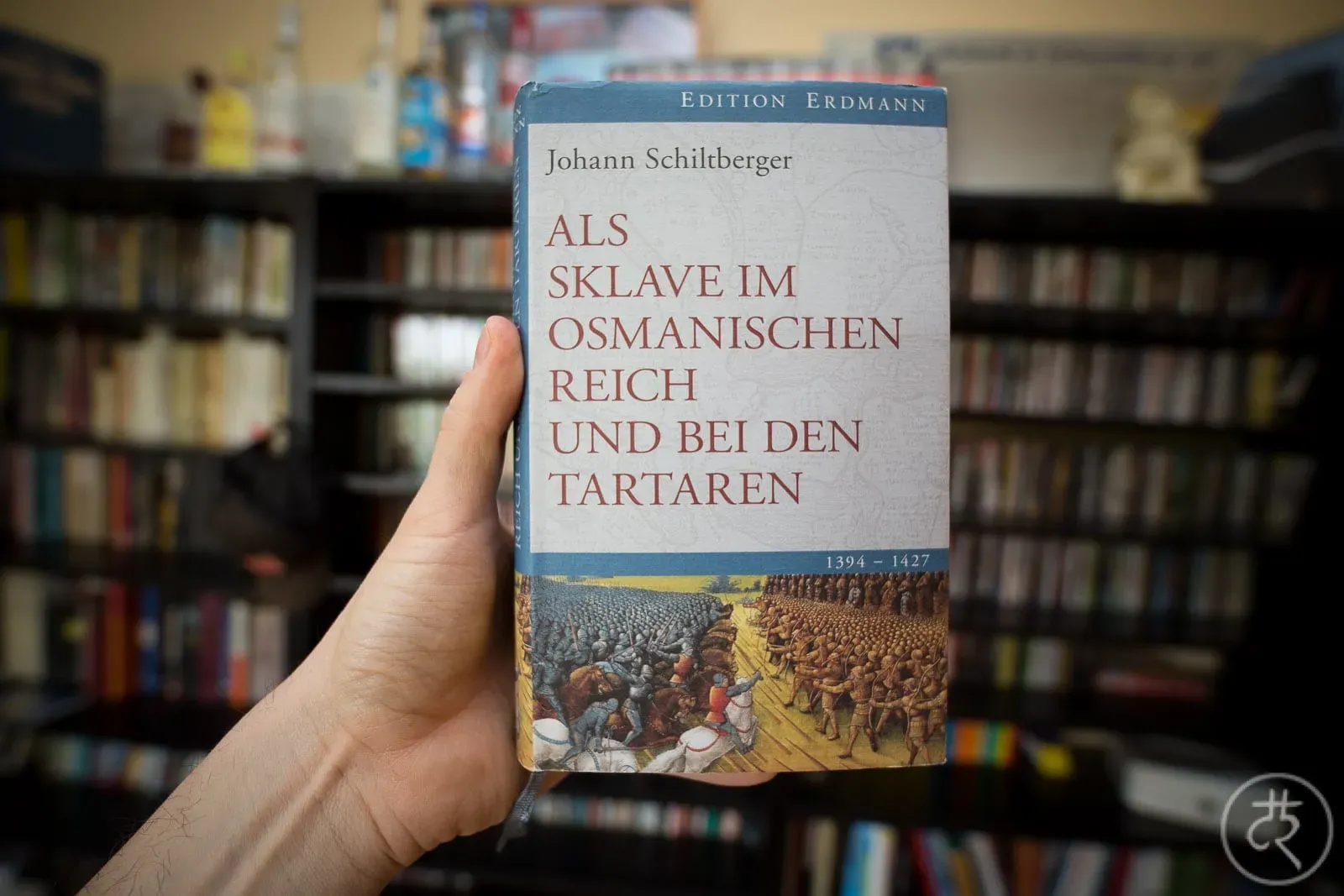
At sixteen, Johann Schiltberger watched Ottoman soldiers work through the prisoners taken at Nicopolis, cutting off heads one by one. When they reached him, the sultan’s son Süleyman looked him over and decided he was too young to kill. That pause bought Schiltberger thirty-three years of captivity, took him across three continents, through the courts of two of history’s most formidable rulers, and eventually deposited him back in Bavaria with a story nobody in Europe had told before.
The story begins two years earlier, in 1394, when the fourteen-year-old from a noble Bavarian family near Munich joined the service of King Sigismund of Hungary. He ended up at Nicopolis in September 1396, where a large Crusader force prepared to stop the Ottoman westward advance and was destroyed in an afternoon. The massacre of prisoners that followed was methodical. Schiltberger survived it because Ottoman practice spared captives under twenty. He recovered from his wounds and entered the personal service of Sultan Bayezid I - Yıldırım, the Thunderbolt - as a runner, carrying orders across the empire. For six years he traveled through Asia Minor, watched Ottoman administration function up close, accompanied a diplomatic mission to Egypt, and learned Turkish. The outer boundary of medieval Bavaria receded to something he could barely locate in memory.
Then, on 20 July 1402, near Ankara, everything was rearranged by a single afternoon’s fighting. Timur - Tamerlane - destroyed Bayezid’s army and captured the sultan himself. Schiltberger, standing in the sultan’s camp, was transferred on the spot to the service of the man who had just ended the world he had spent six years observing. He was twenty-two years old and owned by his second empire.
Timur is one of those figures who tends to become either a romantic conqueror or a catalogue of violence, depending on which sources get quoted. Schiltberger saw both at close range. He recorded the siege of Sivas in 1400, where Armenian cavalry were thrown alive into pits and buried, and thousands of civilians were enslaved and marched east to Samarkand. He described Timur’s entry into Damascus, where the great Umayyad Mosque was set ablaze. He noted the towers of skulls erected after Isfahan’s revolt was suppressed - not editorialising about the monster, but describing the arithmetic of control. Timur’s strategic ingenuity impressed him as much as his brutality. At Delhi, the conqueror panicked the enemy’s war elephants by driving camels loaded with burning straw directly into their formation. Schiltberger recorded the tactic with the interest of a man who understood that wars are decided by solving problems, not by being braver than the opposition.
Timur died in February 1405 while staging to invade China. His empire began fracturing before the body was cold, and Schiltberger found himself passed among its pieces: first to Shah Rukh, the capable heir ruling from Herat; then to Miran Shah, a more volatile prince whose campaigns ranged through Armenia; then to Abu Bekr, Miran Shah’s son. Each transfer was another roll of a die whose faces were all labelled “survives” or “doesn’t.” For twenty years his life depended on the continued usefulness he could demonstrate to rulers who had larger concerns.
During these years he made the journey that gave him his single most durable claim on historical memory. Accompanying a Tatar prince on an expedition north - past the steppes and into territory no Western European had previously described in writing - Schiltberger produced the first clear European reference to Siberia. He also passed through the Golden Horde’s capital at Sarai on the Volga, the Genoese-Venetian trading hub at Azov, Crimea, Circassia, and the Caucasus. He moved through a world medieval Europe barely knew existed, carried along by the momentum of a dying empire.
Around 1425, near Batum on the Black Sea coast, he escaped. He made his way to Constantinople, crossed to the Danube, moved through Moldavia and Galicia, passed through Kraków and Wrocław, and set foot on Bavarian soil in 1427. He had been gone since 1394. He was in his late forties, which in the fifteenth century meant he had already outlived most people who had lived ordinary lives.
He then did what survivors of long extraordinary misfortune rarely manage: he sat down and described it. The result was the Reisebuch - “Travel Book” - dictated to a scribe and first printed around 1460. It is not a polished piece of literature. It has chronological errors, compressed sections, moments where the narrative skips months without explanation. He miscalculated some dates and worked from memory that had been strained by three decades and several languages. None of this diminishes what the book actually contains: firsthand accounts of Ottoman court life, Timurid Central Asia, the Caucasus, and the steppe - written by someone who was present, not as a diplomat or a merchant adventurer, but as a slave whose survival depended on remaining useful and observant.
He has been called the Bavarian Marco Polo. The comparison is flattering but misses what’s distinctive about him. Marco Polo traveled as a free man with diplomatic backing and a powerful merchant family behind him. Schiltberger traveled as property. He saw what he saw because he was valuable enough to keep alive, moved often enough to see widely, and clear-headed enough to remember it. His book is not the account of a man who went looking for adventure. It is the account of a man who was dragged through thirty-three years of it and had the presence of mind to understand what he had witnessed.
The Ottoman sultan who enslaved him died in captivity within a year of Nicopolis. Timur, who inherited him, died before his China campaign began. The empire that followed Timur could not hold itself together long enough to produce a comparable successor. Schiltberger outlasted all of them, carried his account out of the wreckage, and handed it to a scribe in a Bavarian house - having spent three decades in the service of men who fill chapters in every medieval history textbook, while his own name barely rates a footnote in most. That is not injustice so much as an accurate record of what survival actually looks like from the inside. The Thunderbolt did not notice him until it was too late to kill him. Neither, for six centuries, did the rest of us.