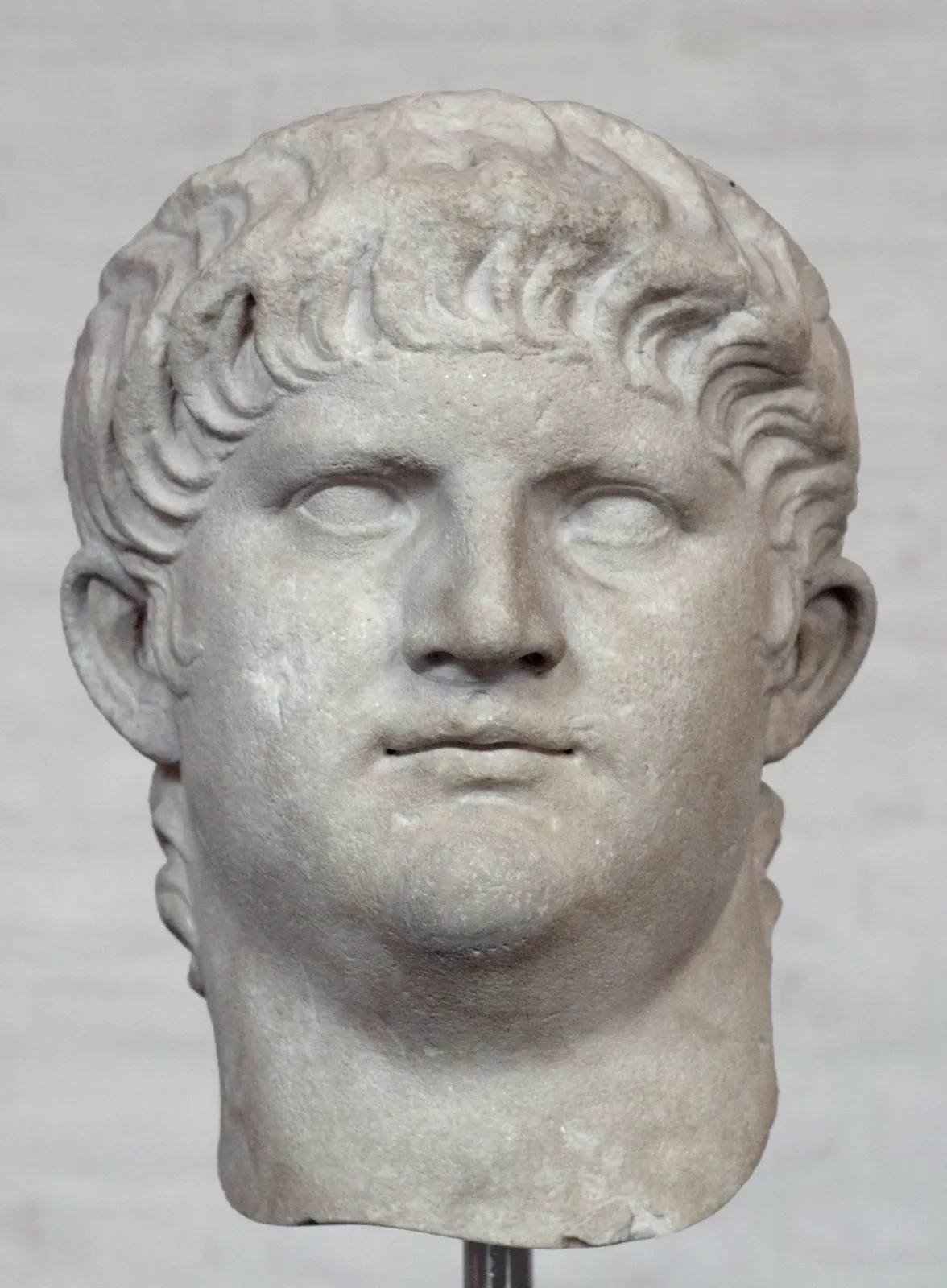
On 9 June AD 68, the last of the Julio-Claudians died in a garden villa about four miles north of Rome, his throat cut with a dagger he had been too frightened to use until the sound of cavalry made the choice for him. His name was Lucius Domitius Ahenobarbus - we know him as Nero. He was thirty years old, had been emperor for fourteen years, and died with four freedmen as his only company. His alleged last words, as reported by Suetonius, were “Qualis artifex pereo!” - what an artist dies in me. He was not wrong that he was dying. He was rather wrong about the rest.
The collapse that put him in that villa had been building for a decade, but it accelerated with unusual speed in 68. A Gallic governor named Gaius Julius Vindex revolted in the spring, declaring Nero “an incompetent lyre player” and inviting Galba, the elderly governor of Hispania Tarraconensis, to march on Rome. Vindex’s own forces were destroyed by the Rhine legions before Galba moved, which might have given Nero a moment of relief. It did not. The Praetorian prefect Nymphidius Sabinus, calculating the odds, told his guardsmen that Nero had already fled to Egypt and offered them 30,000 sesterces each to back Galba. The Guard accepted. The Senate declared Nero a public enemy and sentenced him to death in the ancient manner - beaten with rods until dead - and issued word to find him. By nightfall, he was running. By the next morning, he was dead.
What makes this worth examining is not the squalid end but the speed of the unravelling. Augustus had constructed a system that projected supreme authority through the person of the emperor while pretending to be a restored Republic. It required the emperor to maintain the loyalty of three overlapping groups simultaneously: the Senate, whose prestige gave the Principate its legal facade; the Praetorian Guard, whose swords enforced it in Rome; and the provincial legions, whose loyalty was the system’s actual foundation. Nero managed the trick for a while. His first five years - guided by Seneca and the Praetorian prefect Burrus - were competent enough that later admirers called them the Quinquennium Neronis: five good years. The finances were sound, the administration ran, and the young emperor showed genuine interest in art and performance rather than military conquest, which some senators found embarrassing but none found threatening.
The deterioration was neither sudden nor irrational, but it was thorough. He had his mother Agrippina murdered in 59, three years into his reign, after she attempted to influence his foreign affairs a little too aggressively. He divorced and executed his first wife Octavia in 62 to marry Poppaea Sabina. He was accused of kicking Poppaea to death while she was pregnant in 65, though this may be hostile invention. In 64, a fire burned ten of Rome’s fourteen districts, and while Nero almost certainly did not set it himself - he was at Antium when it started and raced back to organise relief - he used the cleared land to build the Domus Aurea, a vast pleasure complex covering the centre of the city, which did nothing to help the rumours. He blamed the fire on Christians and burned them in his gardens as torches. He had Seneca forced to commit suicide in 65, after an alleged conspiracy. By the time the Pisonian Conspiracy of 65 - a serious plot involving dozens of senators and equestrians - was uncovered and crushed, the Roman elite was not simply frightened of him. They had turned.
The deeper problem was not cruelty. Roman emperors were frequently cruel. Tiberius had men thrown from a cliff at Capri. Caligula was almost certainly mad. What undid Nero was a failure at the political mathematics that kept the system stable. He squandered money on a scale that alarmed even his supporters - the Domus Aurea alone reportedly required confiscating private land across central Rome. He debased the silver denarius by 10 percent in 64, the first significant debasement in Roman coinage history. He levied emergency taxes on the provinces to fund his building. And crucially, he never built any personal military loyalty. He commanded no armies, won no battles, never stood on a battlefield. His image - laurel-wreathed, lyre in hand - was that of an artist and charioteer, which suited his vanity but left him without the one thing that kept emperors alive when everything else went wrong.
Galba reached Rome in late 68. He was sixty-nine years old, stern, stingy, and almost immediately unpopular. He refused to pay the donative Nymphidius Sabinus had promised the Guard. He executed opponents without trial. He adopted an heir, the young aristocrat Piso, over the head of the general Otho, who had expected the honour and went directly from the adoption ceremony to the Praetorian barracks to start a counter-coup. Galba was assassinated on 15 January 69, seven months after Nero’s death. Otho lasted three months before the Rhenish legions behind Vitellius crossed the Alps and defeated him at the First Battle of Bedriacum; Otho fell on his sword in April. Vitellius held Rome until the Danubian legions declared for Vespasian, stormed the city in December, and killed him in the street. Four emperors, five if you count Nymphidius Sabinus who briefly claimed the position before anyone took it seriously, in eighteen months.
The Year of the Four Emperors revealed the architecture that Augustus had always disguised. An emperor was not a hereditary monarch - Rome had no such legal category. He was not an elected magistrate - real elections had been dead for half a century. He was a general whom enough soldiers agreed to follow that everyone else fell into line. When Nero’s soldiers stopped following him, he simply ceased to exist as a political actor. No dynasty, no bloodline, no senatorial decree could change that. Galba’s famous line - “I select, I do not buy” - captures his own failure to understand the lesson. He was stating a principle that nobody with a legion believed.
Nero’s body was buried by two of his nurses and his former concubine Acte in the Domitii family tomb on the Pincian Hill. Rumours circulated for years that he was still alive and would return from the east; several impostors calling themselves Nero appeared in the following decade and attracted genuine followings. His name remained a byword for tyranny, painted over in official histories by a Senate that could not forgive the executions and a church that did not forget the torches. He was, in fact, no worse than several emperors who kept their reputations intact by dying before anyone organised against them. His real crime was losing. The Principate had no mechanism for removing a bad emperor except the one that Nymphidius Sabinus used in the summer of 68 - bribery, desertion, and a death sentence posted while the emperor was already fleeing. It worked. What came next was arguably worse. The artist died in him. The empire carried on without missing a step.