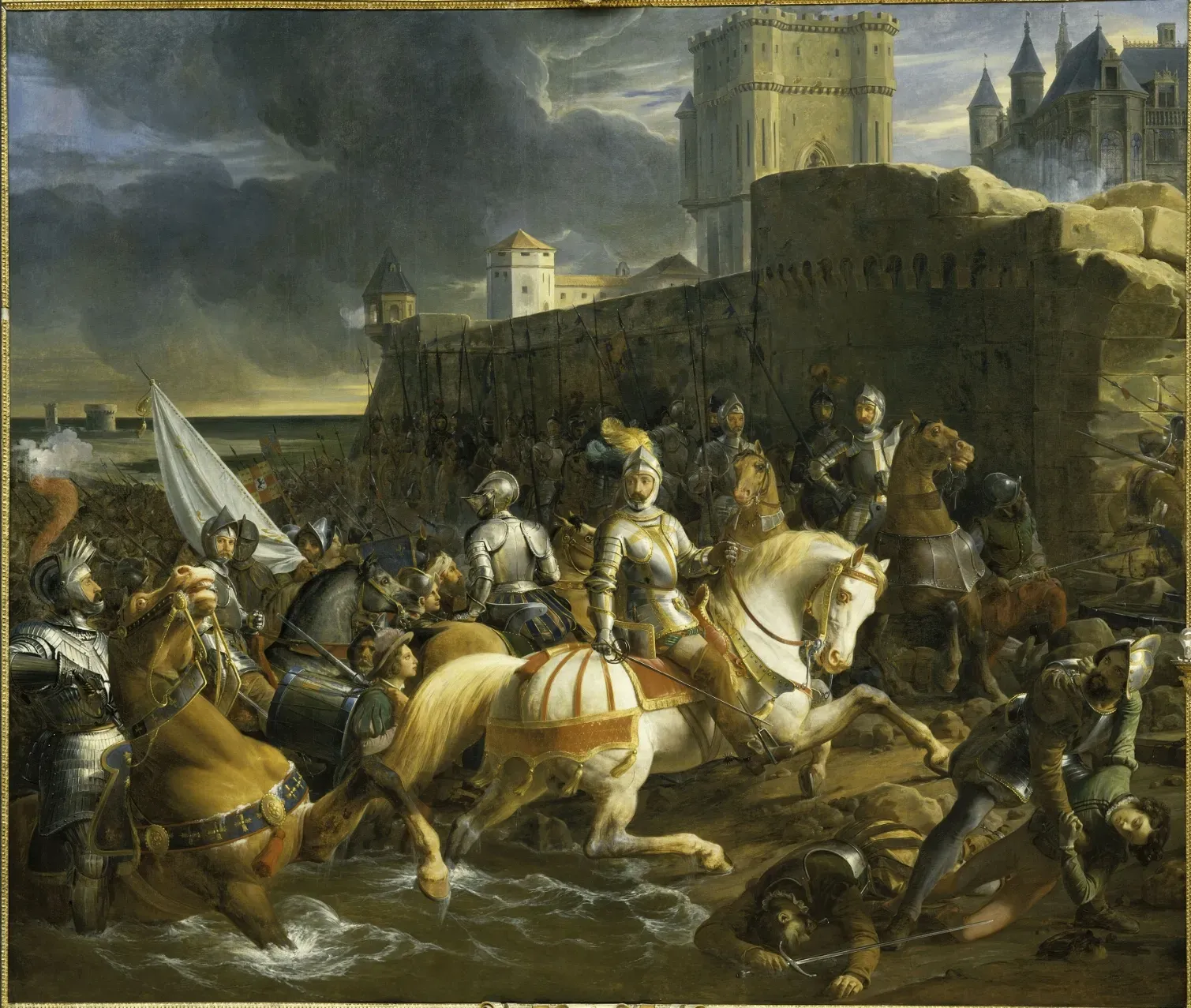
Calais was not a romantic ruin. It was a fortified harbour on the shortest crossing to England, a customs house with walls, and for 211 years it had been English. Edward III took it in 1347, in the middle of the Hundred Years’ War, and English kings spent fortunes keeping the fortifications up to date because without Calais the wool trade did not move on English terms. The Merchant Staplers - the chartered company that monopolised the export of raw wool - ran their business through the staple port at Calais. Lose Calais and you did not just lose a map colour; you lost the machine that turned fleeces into royal revenue.
By the 1550s the kingdom was ruled by Mary I and her husband Philip II of Spain. England was tied into Spanish wars against France - not as a spectator, but as an ally sending money and men into Picardy. Henry II of France had every reason to strike back, and he chose the coldest, most inconvenient season to do it. Francis, Duke of Guise, brought some 27,000 men against a garrison that could not match them for numbers or surprise. The French had assembled at Compiègne, Montreuil, and Boulogne in secrecy; the English were still thinking in terms of garrison routine when the vanguard invested the outlying forts on New Year’s Day 1558.
What followed was not a medieval epic of starvation and escalades. It was modern siege work, methodical, relentless: artillery brought up, outworks taken in sequence. Sangatte, Fréthun, and Nielles fell to the French vanguard on 1 January. Fort Risban went the next day. By 3 January the guns were in position at Nieulay and the English position was coming apart faster than reinforcements could be imagined, let alone landed. Thomas Wentworth, 2nd Baron Wentworth, governor of the Pale of Calais, was outmanoeuvred and outgunned. On 7 January he handed over the keys. The French found stores for three months and nearly three hundred guns - a haul that made the campaign look almost cheap.
Guînes and Hames held out briefly, then followed. Henry II entered Calais himself on 23 January. France had recovered the last scrap of territory it had lost to England in the Hundred Years’ War. The diplomatic maps were finally honest: English kings could still claim French crowns on parchment, but they no longer held French soil.
The shock in England was political as well as strategic. Mary was already unpopular: her marriage to Philip, her Catholic faith, her burnings of Protestants, her fiscal exactions. Calais was the kind of loss that turned grumbling into humiliation - proof that the Spanish alliance had bought England expensive wars and a ruined reputation. The story that she said on her deathbed, a few months later, that when she was opened people would find Calais engraved on her heart alongside Philip is probably embroidery, but it caught the mood. She died on 17 November 1558. Elizabeth inherited a realm that was solvent again in prospect but visibly smaller than the one Mary had been sworn to defend.
The treaties tried to paper over the hole. The Peace of Cateau-Cambrésis in 1559 allowed for England to buy Calais back for 500,000 crowns within eight years. The money never changed hands in that form; the town did not return. When Elizabeth sent forces into Le Havre in 1562 during the French Wars of Religion, she was still bargaining for a continental bridgehead. The French pushed her out in 1563. The settlement at Troyes in 1564 involved a cash payment to England and a quiet admission that Calais was gone for good.
I am wary of anyone who tells you a single siege “invented” England’s maritime empire. Navies and exploration had their own causes. What is true is that after 1558 there was no English France to subsidise or defend - only England itself, Ireland, and a growing argument with Spain. The wool trade adapted: merchants found other routes and other fights. The mental geography shifted. You could still call yourself king of France in Latin if you insisted; you could not march an army from Dover to a loyal English port on the continent anymore. The Channel stopped being a narrow moat in front of an English Calais and became the width that defined the realm.
On 7 January 1558, Wentworth surrendered the keys. The gates opened onto French soldiers and English exile. The last toehold went, and the island was left to work out what it meant to stand alone.