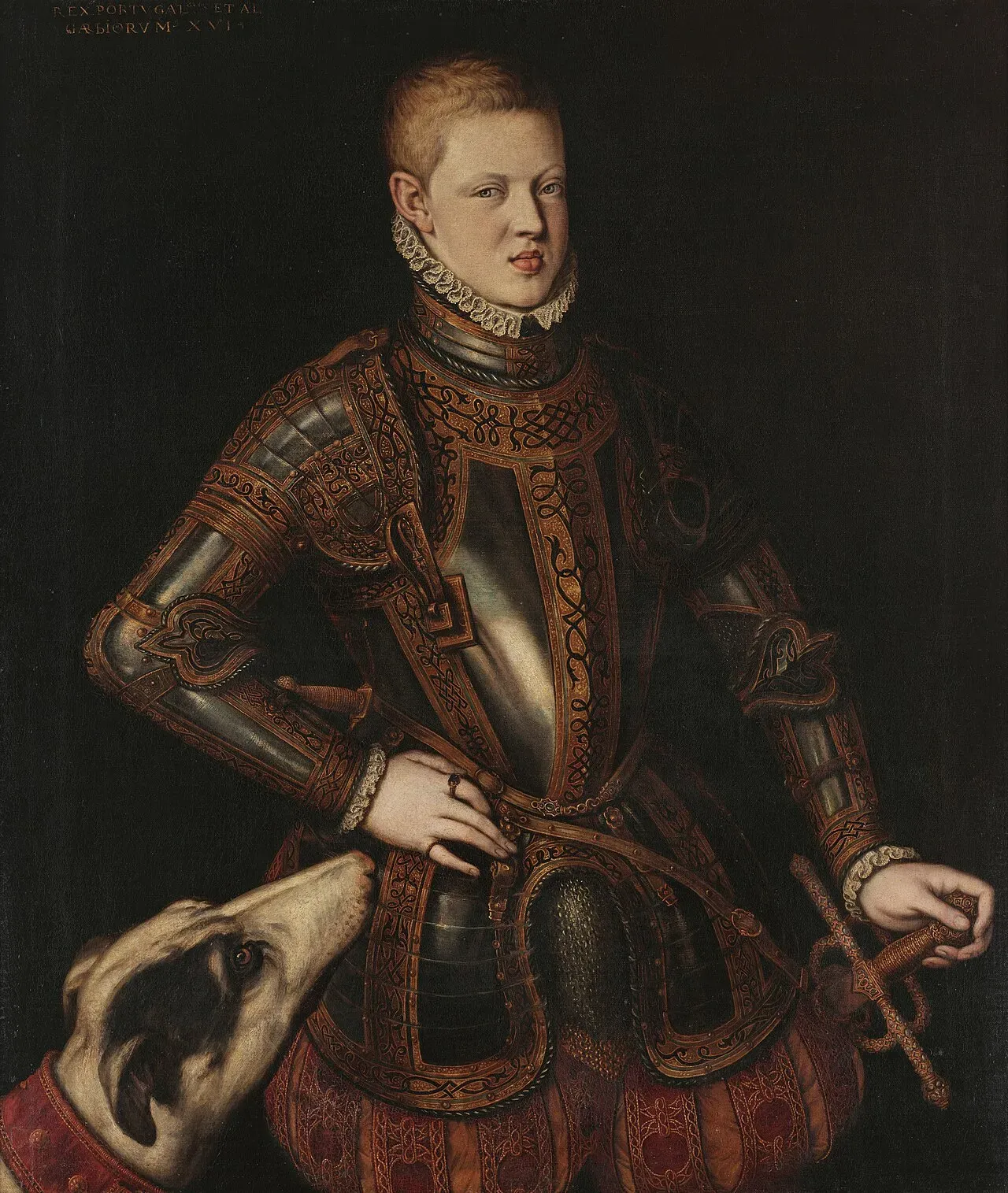
On 4 August 1578, near a Moroccan town the Portuguese called Alcácer Quibir, three kings went into battle and none of them came out. Abu Abdallah Mohammed II, the deposed sultan who had dragged a Christian army into his family quarrel, drowned fleeing across a river. Abd al-Malik, the uncle who had taken the throne from him, died during the fighting - of illness, poison, or exhaustion, depending on whom you ask - and his officers kept the news quiet until the victory was secure. Sebastian I of Portugal, twenty-four years old and unmarried, was last seen riding headlong into the Moroccan lines. His body was never reliably identified. By nightfall Morocco had a new sultan, Ahmad al-Mansur, and Portugal had a hole where its king and most of its nobility used to be. I think that afternoon did more damage to a European empire than any single day of fighting in the sixteenth century.
Sebastian had been born into expectation he never outgrew. His father died a fortnight before his birth in 1554. His mother, Joanna of Austria, left him as an infant to govern Spain for her father Charles V and never saw him again. He became king at three when his grandfather John III died, spent his childhood under Jesuit tutors and a grandmother who treated piety as a governing programme, and came of age convinced that God had cast him as a crusader. He carried Aquinas on his belt. He founded hospitals during the Lisbon plague of 1569, banned the enslavement of Brazilian Indians, and commissioned Luís de Camões’s Os Lusíadas. He was not a frivolous king. He was a serious one with a single catastrophic idea: that Portugal’s unfinished business in North Africa was a holy war waiting for him personally to finish it.
The invitation arrived in the form of a refugee. In 1576 Abu Abdallah lost the Moroccan throne to his uncle Abd al-Malik, who had taken Ottoman money and Ottoman officers to seize it. Abu Abdallah fled to Portugal and asked Sebastian to put him back. Sebastian’s own uncle, Philip II of Spain, refused to join the crusade - he was negotiating a truce with the Ottomans and had learned caution the hard way at Djerba - but he did promise Spanish volunteers. Sebastian sailed anyway in June 1578 with roughly 23,000 men: Portuguese nobles, Castilian volunteers, Flemish and German mercenaries, and six hundred Italians under the English adventurer Thomas Stukley. He landed at Arzila, joined Abu Abdallah’s six thousand Moors, and against the advice of every experienced commander he had, marched inland toward Ksar el-Kebir.
Abd al-Malik was waiting with an army that may have numbered sixty thousand or more - Moroccan cavalry on the wings, Andalusi musketeers in the centre who had been driven out of Spain and wanted a rematch, artillery drilled on Ottoman lines. The battle lasted about four hours. Stukley took a cannonball early. The Moroccan wings folded around the Portuguese flanks. Sebastian charged into the middle of it and disappeared. Roughly eight thousand of his men were killed. Fifteen thousand were captured and sold, and the ransoms that followed nearly emptied the Portuguese treasury. Around a hundred survivors made it back to the coast. Contemporaries called it the greatest military disaster Portugal ever suffered overseas, and for once the hyperbole was earned.
What followed was not a clean succession. Sebastian left no heir - he had never married, for all the dynastic proposals floated around him - so the crown passed to his great-uncle Cardinal Henry, an ageing cleric who had already served as regent and now found himself king of a bankrupt country. Henry tried to renounce his vows and marry so the House of Aviz might continue. Pope Gregory XIII, who happened to be on excellent terms with Philip II, refused to release him. Henry died in January 1580 without naming a successor, and Portugal’s dynastic cupboard was suddenly bare.
That was when the uncle collected. Philip II of Spain was Sebastian’s maternal uncle and a grandson of Manuel I of Portugal through his mother Isabella. He was not the heir by strict primogeniture - that claim ran through the Farnese dukes of Parma and then through Catherine, Duchess of Braganza - but he had the army, the money, and enough of the Portuguese aristocracy convinced that a personal union with Spain would keep their estates solvent. António, Prior of Crato, an illegitimate grandson of Manuel I, proclaimed himself king in Santarém and briefly held popular support. The Duke of Alba crushed him at Alcântara in August 1580. Philip was acclaimed Philip I of Portugal by the Cortes of Tomar in 1581, on the promise that Portugal would keep its own laws, currency, and overseas empire as a separate realm under the same Habsburg crown.
That promise held on paper for sixty years. In practice the Portuguese Empire became a target for every enemy of Spain. The Dutch, shut out of Iberian ports, systematically stripped Portuguese colonies across Asia and Brazil. English privateers treated Portuguese shipping as fair game. Lisbon watched its commercial primacy drain away while Spanish priorities - the Armada, the Dutch revolt, the endless Habsburg wars - consumed the resources that might have defended Goa or Bahia. Portugal was not annexed in the legal sense. It was absorbed into someone else’s strategic nightmare, and the difference turned out to matter less than the lawyers claimed.
The Braganzas finally took the crown back in 1640, when Portuguese nobles, tired of Philip IV’s tax demands and Flanders campaigns, offered the throne to John, Duke of Braganza - grandson of that same Catherine who had been shoved aside in 1580. The Restoration War lasted until 1668. From Alcácer Quibir to the recovery of independence was sixty-two years: more than half a century of foreign rule triggered by one afternoon in Morocco and a king who could not leave well enough alone.
Portugal never quite accepted that Sebastian was gone. Impostors claiming to be the returned king appeared through the 1580s and 1590s; the last was hanged in 1619. A folk belief called Sebastianism insisted he would come back on a foggy morning when the country needed him most - Portugal’s version of the sleeping king, Arthur for a maritime empire that had mislaid its monarch on a North African plain. Peasants in nineteenth-century Brazil were still waiting for him during the Canudos rebellion. Philip II eventually had mutilated remains shipped from Morocco and buried them in the Jerónimos Monastery in Belém. Nobody could prove they were Sebastian’s. I doubt Philip cared. He already had the kingdom.
Alcácer Quibir is remembered in Morocco as the Battle of the Three Kings, which is accurate as far as the body count goes. What it really was, from the Portuguese side, was a succession crisis fought in advance: a childless crusader king spent his empire’s treasure and its nobility on a war that killed him, and left the inheritance sitting on the table for the nearest relative with an army. That relative was his Spanish uncle. Sebastian rode into the Moroccan lines on 4 August 1578 looking for a crusade. What he found was the end of Portuguese independence for two generations - and a ghost story his subjects preferred to the truth.