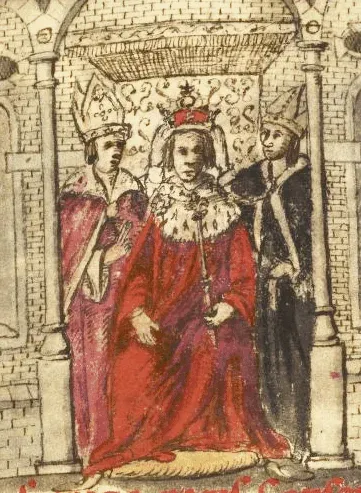
William Rufus went hunting in the New Forest on 2 August 1100 and came back on a cart with an arrow through his chest. The man who fired it, a Norman knight named Walter Tirel, was aiming at a stag, or so he said before galloping to the coast and taking the first boat to France. There were no other witnesses who cared to give a full account. The King’s body lay where it fell until a charcoal burner found it and hauled it to Winchester, where the clergy buried him the next morning under the cathedral tower with no eulogy, because nobody had anything decent to say about him. Three days after that, on 5 August, his younger brother Henry was crowned King of England in Westminster Abbey. This is not a pace of succession that suggests grief.
Henry had been in the hunting party that morning. So had several other men with reasons to want Rufus gone. Nobody was ever charged. Tirel spent the rest of his life insisting he hadn’t fired the shot at all, which is an odd thing to insist if you’d simply misjudged a stag, and a very sensible thing to insist if the alternative was a treason trial. Henry didn’t wait for an inquest. He rode straight to Winchester, seized the royal treasury before anyone else thought to, secured the support of the barons who happened to be on hand, and had himself crowned before his brother was cold in the ground and before anyone with a better claim could cross the Channel. Whatever actually happened under that oak tree, Henry was the only person who benefited from it instantly, completely, and without lifting a sword.
He needed to move fast, because by every rule of inheritance that mattered in 1100, the crown wasn’t his. William the Conqueror’s eldest surviving son was Robert Curthose, Duke of Normandy, and Robert outranked both of his younger brothers. The problem was that Robert was eight hundred miles away, working his way home from the First Crusade with a new bride he’d married in Apulia for her dowry, having pawned his own duchy to Rufus for ten thousand marks just to afford the trip in the first place. He had fought well at Antioch and at the fall of Jerusalem - by most accounts he was a genuinely brave soldier and a generous, likeable man. He was also, by every account, hopeless at the one skill that mattered more than courage in eleventh-century politics: he could not hold onto power once he had it. He had rebelled against his own father as a young man and been talked out of following through. As Duke, he gave away Norman castles and revenues to whichever noble flattered him most recently, and watched his own authority erode as a direct result of his generosity. Decency, in Robert’s case, functioned as a structural weakness. Henry didn’t have that problem. Henry had been raised knowing he would inherit nothing - he was the fourth son, destined for the Church until his prospects improved by attrition - and he had spent his life compensating for it by being sharper than everyone around him.
The coronation itself was the first move in a calculated campaign, not a formality. On the day he was crowned, Henry issued what became known as the Charter of Liberties: a written promise to undo the abuses of Rufus’s reign, cap the arbitrary fees the Crown charged on inheritances, respect the Church’s rights, and restore “the law of King Edward” - a nod to the Anglo-Saxon past that Norman kings usually ignored. It was a bribe dressed as a reform, aimed squarely at the barons and bishops whose support he needed before Robert could organise a rival claim. It worked. It also sat in English archives for the next 115 years as a precedent, until a set of barons with grievances of their own dug it out and used it as a template for a rather more famous document at Runnymede. Three months after his coronation, Henry married Matilda of Scotland, a descendant of the old Anglo-Saxon royal line through Edmund Ironside. The marriage bought him something no charter could: the loyalty of the English population his father’s conquest had never fully absorbed.
Robert reached Normandy in September, found the throne gone, and did what a man with a real grievance and no talent for exploiting it does: he invaded anyway, landed at Portsmouth in the summer of 1101, watched half his expected support evaporate before a shot was fired, and settled for a pension. The Treaty of Alton gave him three thousand marks a year and Henry’s recognition of his title in Normandy, in exchange for dropping his claim to England for good. It was a reasonable deal for a man who’d just discovered his own barons preferred his brother. It also proved to be the last reasonable moment either of them would get. Robert went back to misruling Normandy exactly as before, and Henry spent the next five years building the case, and the army, to take the duchy outright. He invaded in 1105, won the decisive engagement at Tinchebrai in September 1106, and captured his brother on the field. Robert spent the next twenty-eight years in captivity - Devizes first, then Cardiff - and died there in 1134, an old man who had once knelt at the walls of Jerusalem and ended his life unable to leave a Welsh castle.
Henry got everything Robert’s decency had cost him: the crown, the duchy, and nearly three decades to run both with a competence Rufus had never shown and Robert had never managed. He built an administration - the exchequer, the itinerant justices, the machinery that later kings inherited and took credit for refining. And then, in November 1120, a ship called the White Ship went down in the Channel with his only legitimate son aboard, and every calculation Henry had ever made about securing his line collapsed into the one variable he couldn’t schedule around. He spent his last years forcing his barons to swear loyalty to his daughter Matilda as heir, the same kind of paper guarantee he’d once exploited against an absent rival. When he died in 1135, his nephew Stephen crossed to England faster than Matilda’s supporters could organise and took the crown before anyone could stop him - almost exactly the manoeuvre Henry himself had used thirty-five years earlier, now turned against his own daughter. Eighteen years of civil war followed. The man who had won a kingdom because he moved three days faster than the truth could catch up with him spent his final years discovering that speed is not a strategy you get to keep to yourself.