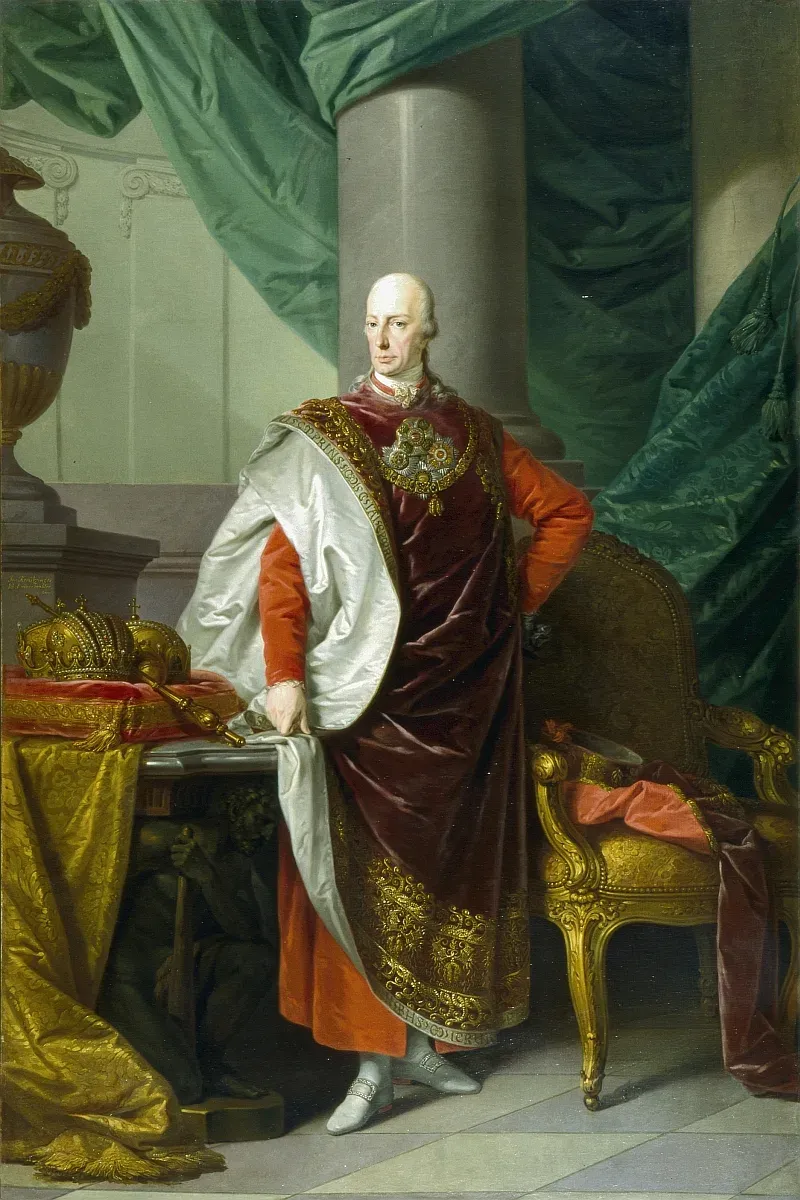
On the morning of 6 August 1806, an imperial herald rode from the Hofburg in Vienna to a nearby church, climbed onto a balcony overlooking the square, and read out a short proclamation. That was the whole ceremony. No siege, no coronation, no assembly of princes swearing anything to anyone. One official reading one document, and an institution that had run continuously since Charlemagne’s coronation in the year 800 was, on paper, finished. Voltaire’s old line - that the Holy Roman Empire was neither Holy, nor Roman, nor an Empire - had been getting laughs in European salons for decades. On this particular Wednesday it also became the thing’s epitaph.
I keep coming back to the mismatch between how that crown was won and how it was lost. In 1519, when Charles V wanted it, he had to outbid the King of France for the votes of seven electors who treated the whole contest as an auction. He borrowed 850,000 florins from the Augsburg banker Jakob Fugger - two thirds of the total bribe - plus another 143,000 from the Welser family, just to make sure the electors chose him over Francis I. Fugger later wrote to Charles reminding him, not at all subtly, that “your majesty could not have gained the Roman crown save with mine aid.” That is roughly the going rate for the title that Francis II gave up in a single morning, for free, essentially to spite a man he’d already lost a war to.
The title was worth the trouble, at least on paper. A Holy Roman Emperor was not simply the ruler of Germany and Austria - he claimed, by descent from Rome and by the Pope’s old blessing, to outrank every other Christian monarch in Europe. Austrian diplomats spent years refusing to call George III of Great Britain “His Majesty” in correspondence, on the technical grounds that a mere king had no business claiming equality with an emperor. Even Russia and the Ottoman sultans had at various points formally conceded precedence to the Holy Roman title, at least on the diplomatic paperwork. It was a claim to universal Christian authority stretching back to Augustus, and European chancelleries took it seriously enough to fight wars, and pay Fuggers, over who got to wear it.
By the eighteenth century, the whole arrangement had become an open embarrassment to the people running it. The empire had no standing army and no central treasury, its monarch was elected rather than hereditary, and its constituent princes did more or less as they pleased. The seventeenth-century jurist Samuel von Pufendorf called it a “monstrosity” of a state, and the description stuck. Contemporaries described it as “sick.” Even so, nobody with real power thought it was actually dying - the Imperial Diet was still passing major reorganising legislation as late as 1803, and most observers assumed the patient, however irregular, would recover as it always had.
Napoleon killed that assumption in about eighteen months. When he crowned himself Emperor of the French in 1804, Francis II responded in kind rather than in protest, declaring himself hereditary Emperor of Austria while insisting his old Holy Roman title still outranked both new arrangements - a nicety nobody in Paris much cared about. The real damage came at Austerlitz in December 1805, where Napoleon dismantled the Austrian and Russian armies in a single afternoon, and again the following July, when Bavaria, Württemberg, and fourteen other German states broke away entirely to form the Confederation of the Rhine under Napoleon’s protection. On 1 August 1806, a French envoy informed the Imperial Diet that Napoleon no longer recognised the empire’s existence at all. Three weeks earlier, Napoleon had already sent Francis an ultimatum: abdicate the Holy Roman title by 10 August, or else.
Francis moved five days early and did something no previous emperor had done. Earlier abdications, including Charles V’s own retirement in 1556, had simply returned the crown to the electors so they could choose a successor. Francis instead dissolved the empire itself, releasing every prince, city, and knight from their oaths in the same breath that he gave up his own. There would be no electors left to elect anyone, which was rather the point: Vienna genuinely feared Napoleon might claim the vacant Holy Roman title himself, or engineer a puppet emperor through the pro-French electors of Saxony and Bavaria, either of which would have technically made Francis - now merely Emperor of Austria - a vassal of his own former inferior. Better to smash the chessboard than lose the game on it.
What is striking is how little of that calculation reached the street. In Vienna, contemporary reports describe the public reaction as one of plain horror, “incomprehensible” to people who had never known a world without the empire. Farmers in Thuringia were still refusing to believe the news as late as October, convinced their local officials had invented the whole story. Even the German princes who had just signed away their own loyalty to Napoleon a month earlier turned out to be shocked at the consequences: the Bavarian envoy to the Imperial Diet, Rechberg, wrote that he was “furious” at having put his own signature to “the destruction of the German name,” apparently without noticing that his signature was exactly what had destroyed it. Educated Germans reached for the fall of Troy as their comparison of choice, and more than a few reached further, treating the end of the empire as a genuine sign of the apocalypse.
None of that grief changed anything, because grief was never going to be the mechanism that mattered here. The empire that had consumed a fortune and a war every time someone wanted to sit at its head went out on a single sheet of paper, read once from a balcony, mostly as an act of denial rather than a funeral anyone had planned. When the powers of Europe gathered at the Congress of Vienna in 1814 with the empire’s fate genuinely back on the table, and Francis himself in the room, he chose not to revive it. The imperial regalia stayed in a glass case in the Hofburg, where tourists can still see them today. Voltaire’s joke, meanwhile, outlived every emperor it was written about, which is a fairly efficient use of one sentence, and rather more than the thousand years of bribery and bloodshed that came before it ever managed.