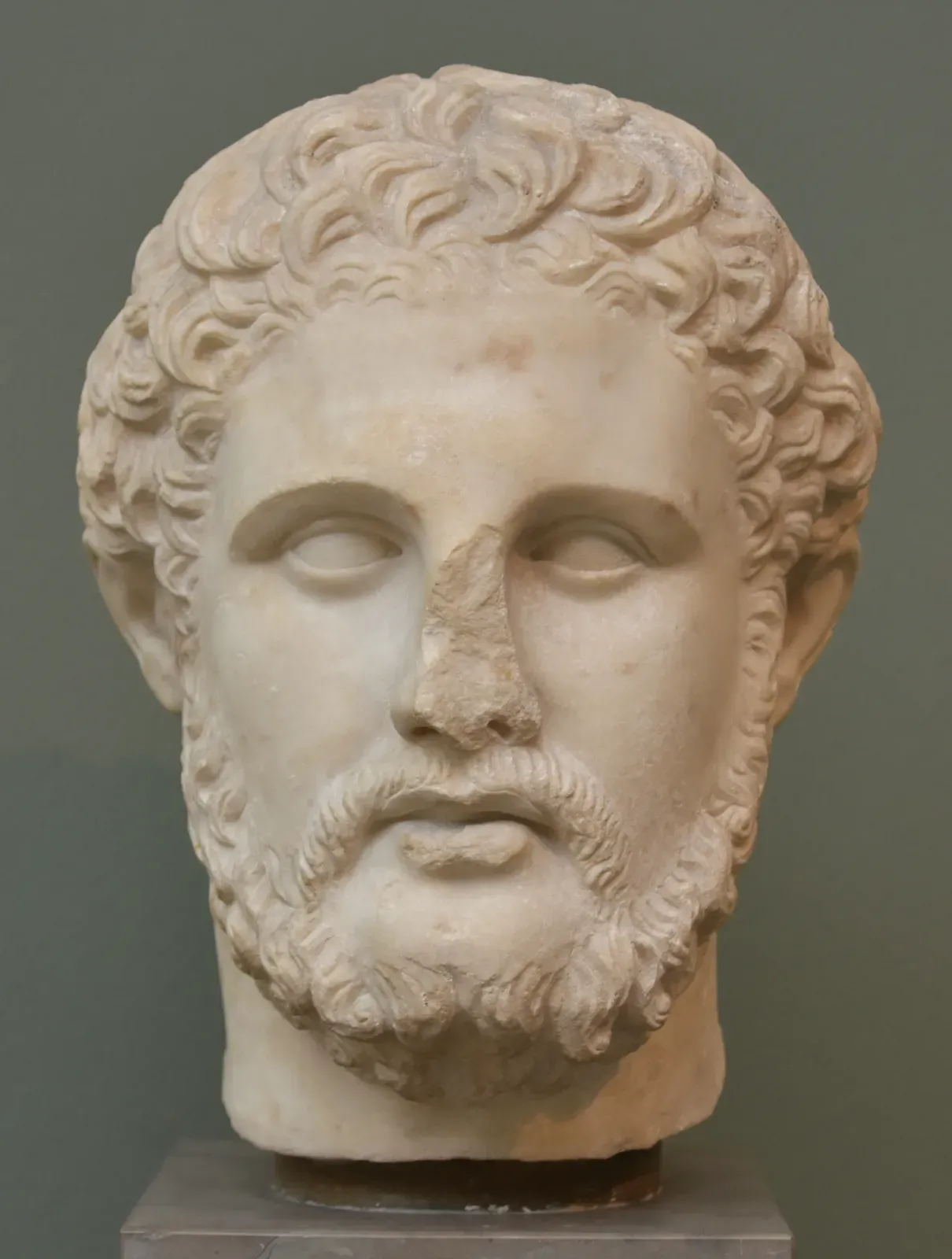
On 2 August 338 BC, on a plain outside a small Boeotian town called Chaeronea, the combined armies of Athens and Thebes broke and ran. An eighteen-year-old prince named Alexander led the charge that shattered the Theban right, cutting down the Sacred Band, three hundred of the finest infantry in Greece, to a man. Archaeologists digging under the Lion of Chaeronea in the twentieth century found 254 skeletons stacked beneath it, arranged in seven neat rows. That is the detail everyone remembers about this battle, if they remember it at all: the boy who would become Alexander the Great, already terrifying, already brilliant, on the day Greek freedom died. What almost nobody remembers is the man standing on the other wing, directing the whole engagement, who had spent the previous twenty years making that afternoon possible. His name was Philip II, and history has spent more than two thousand years treating him as a warm-up act for his own son.
That is an injustice worth correcting, and Chaeronea is the place to start, because the battle itself was Philip’s design from the first move to the last. Diodorus and Polyaenus, our two main sources, describe a Macedonian line that pulled back on Philip’s own flank, drawing the inexperienced Athenian hoplites forward in a ragged pursuit across open ground. When the gap was wide enough, Philip stopped retreating and turned on them. At the same moment, on the other wing, the Macedonian phalanx and companion infantry under Alexander’s command punched through the Theban line and rolled up the Sacred Band from the flank. It was not a shoving match settled by numbers - both armies were roughly the same size, around 30,000 men each - it was won by an army executing a manoeuvre that required discipline the Greek city-state levies simply did not have. Philip built that discipline. He didn’t inherit it.
Go back to 359 BC, when Philip took the Macedonian throne, and the contrast is stark. Macedon had just lost a battle to the Illyrians that killed the previous king, Philip’s own brother, along with 4,000 soldiers. Paeonian and Thracian raiders were burning the eastern frontier. Athens had landed troops on the coast backing a rival claimant to the throne. Macedon was not a great power. It was a target. Within a year Philip had bought off the Paeonians, bribed the Thracians, and beaten the Athenian force in the field. Within five, he had rebuilt the army from the ground up: cavalry expanded from 600 riders to a force that would eventually reach 4,000, infantry reorganised into the phalanx formation armed with the sarissa, an eighteen-foot pike that outreached anything the Greek hoplites carried, and a merit-based system of promotion and bonus pay that turned peasant levies into professional soldiers. This is the army Alexander later marched to the Indus. Philip designed every part of it, and by the time his son took command of a wing at Chaeronea, it had already been battle-tested for two decades.
Those two decades matter more than the single afternoon at Chaeronea, because they show a man who understood siege warfare, diplomacy, and patience as well as he understood the sarissa. Philip fought the Third Sacred War by degrees, picking up the leadership of the Thessalian League along the way. He took Amphipolis and its gold mines, then Crenides, which he renamed Philippi and turned into a mint that funded everything that followed. He razed Olynthus when it was useful and spared Athens’s fleet when that was useful instead. While Athenian orators like Demosthenes and Aeschines spent a decade arguing in the assembly about whether Philip was a threat worth confronting, Philip was busy answering the question with troops, garrisons, and treaties, one region at a time. By the time he marched into Boeotia in 338 BC, the war was close to already won. Chaeronea was the closing argument, not the opening one.
What Philip did after the battle tells you as much as the battle itself. He could have destroyed Athens outright. Instead, he dissolved the Athenian confederacy but freed Athenian prisoners without ransom and left the city its fleet, because he needed that fleet for the invasion of Persia he had been planning for years. He treated Thebes far more harshly, garrisoning it and installing a friendly government, because Thebes had betrayed an alliance and Athens had not. Within a year he had organised the League of Corinth, bound every major Greek state except Sparta into a common peace under his own leadership, and been voted strategos autokrator, supreme commander, for a pan-Hellenic war against the Achaemenid Empire. By early 336 BC, before Alexander had inherited anything, Philip had already sent Parmenion across the Hellespont with 10,000 men to secure a bridgehead in Asia Minor. The invasion of Persia was not Alexander’s idea. It was Philip’s unfinished business.
Then, in October 336 BC, at his own daughter’s wedding, a bodyguard named Pausanias stabbed Philip to death in front of the assembled Macedonian court. Alexander was twenty years old. What he inherited was not a promising kingdom with potential. It was a finished weapon: a professional army built and blooded over two decades, a network of loyal generals Philip had trained personally, a treasury filled by Philip’s mines, a Greece pacified and bound into a coalition by Philip’s diplomacy, and a war against Persia already declared, funded, and under way. Alexander’s genius was real - no one marches an army from Macedon to the Indus on inertia alone - but he spent it executing a campaign his father had designed the machinery for and had already put into motion. Strip away the thirteen years of conquest that followed, and ask what Alexander actually invented that Philip hadn’t already built: the phalanx, no; the sarissa, no; the companion cavalry, no; the title and the war, no. What Alexander added was the scale, and the nerve to keep going past where Philip would likely have stopped.
The Athenian orator Lycurgus said that the freedom of the Greeks was buried with the corpses at Chaeronea. He was right, but something else got buried there too, quietly, without anyone noticing at the time: the last moment at which Philip’s name was bigger than his son’s. Everything after that battle was execution of a plan already drawn. History remembers the son who carried it out and forgets the father who drew it up, armed it, funded it, and pointed it east. That is not how credit is supposed to work, but it is how legends are made - the finisher gets the statue, and the builder gets a footnote in his own son’s story.