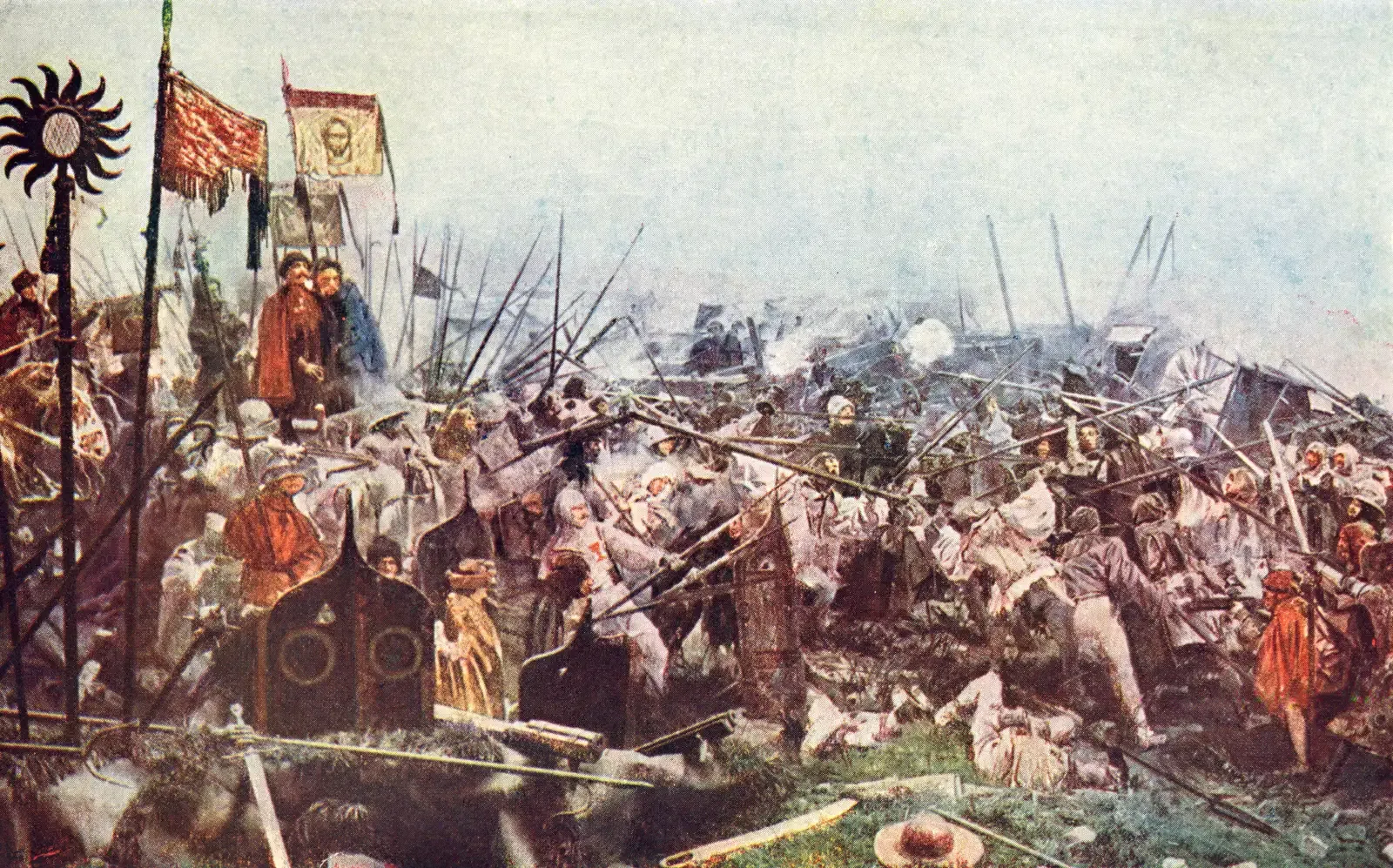
On 30 May 1434, on a rolling field near the village of Lipany, the most formidable military machine in Central Europe was turned against itself. For fifteen years, the Hussite armies of Bohemia had been invincible. They had defeated five consecutive crusades launched by the Pope and the Holy Roman Emperor, using a revolutionary tactical system - the wagon fort - that turned peasants with flails and primitive handguns into knight-killing specialists. But at Lipany, there were wagon forts on both sides. When the dust cleared, the radical wing of the Hussite movement, the Taborites, was annihilated, their charismatic leader Prokop the Great lay dead, and the radical dream of a classless, stateless Christian utopia was buried in a mass grave. It was a victory for moderation, bought at the price of fratricide.
To understand how Bohemia became the armed, heretical heart of Europe, one must go back to Jan Hus. A century before Martin Luther nailed his theses to the Wittenberg door, Hus, a popular preacher in Prague, was calling for the reform of a corrupt Catholic Church. He argued that the Bible, not the Pope, was the ultimate authority, and that laypeople should receive communion in both kinds - both the bread and the wine, represented by the chalice, which became the movement’s symbol. In 1415, the Council of Constance promised Hus safe conduct, then promptly burned him at the stake. It was a catastrophic miscalculation. Instead of crushing the heresy, the flames ignited a national rebellion that threw off the rule of the Catholic Church and the Holy Roman Empire.
The Hussites, however, were never a monolith. They were united only by their defence of the chalice and their hatred of the crusaders sent to destroy them. Once the immediate threat of Catholic invasion receded, the movement fractured along class and ideological lines. The Utraquists - from the Latin sub utraque specie, meaning “under both kinds” - were the moderates. Composed of wealthy Prague burghers, university professors, and the higher nobility, they wanted religious reform but had no interest in overturning the social order. They wanted to negotiate a compromise that would allow them to remain within the Catholic fold while keeping their chalice. The Taborites, named after their fortified base on Mount Tabor, were the radicals. These were the peasants, artisans, and lower gentry who wanted to abolish the feudal system, private property, and the monarchy. They believed they were fighting a holy war to usher in the Millennium, and they had no interest in compromising with a corrupt world.
By 1434, Bohemia was exhausted. Fifteen years of constant warfare, economic blockades, and internal pillaging had devastated the country. The moderate Utraquists realised that the radicals, led by the priest-general Prokop the Great, would never lay down their arms. The moderates formed an alliance with the Bohemian Catholic nobility - an alliance of convenience between former mortal enemies - to restore order and end the blockades. At Lipany, the two sides faced each other in identical wagon forts. The Utraquists, commanded by Diviš Bořek of Miletínek, a seasoned veteran who had once fought alongside the legendary Hussite general Jan Žižka, knew exactly how to crack the radical defence. He ordered a feigned retreat. The Taborites, believing their enemies were fleeing, broke their wagon line to pursue them. It was a fatal mistake. The Utraquist cavalry turned and struck the exposed radicals, while a hidden reserve breached the Taborite wagons. The slaughter was systematic.
I find the political outcome of this fratricide far more instructive than the military tactics. Lipany did not restore Catholic supremacy in Bohemia. Instead, it empowered the moderate Utraquists to negotiate the Compacts of Basel in 1436. The Catholic Church, desperate to bring Bohemia back into the fold, conceded the right of Czechs to receive communion in both kinds. For the first time in medieval Europe, a Christian state was officially permitted to have two legal religions. Bohemia became a unique island of relative religious tolerance, a century before the rest of Europe would tear itself apart in the Wars of Religion.
The tragedy of Lipany is the classic tragedy of the successful revolution. The radicals had created the military system that saved Bohemia, but their very success made them an obstacle to the peace the country desperately needed. They were soldiers of the millennium, incapable of living in a world of compromises, treaties, and tax assessments. The moderates had to destroy them to save the reforms they had fought for. We often romanticise the uncompromising radical, but it is the pragmatist who usually builds the world that survives. At Lipany, the Hussites saved their chalice, but only by spilling the blood of the men who had defended it best.