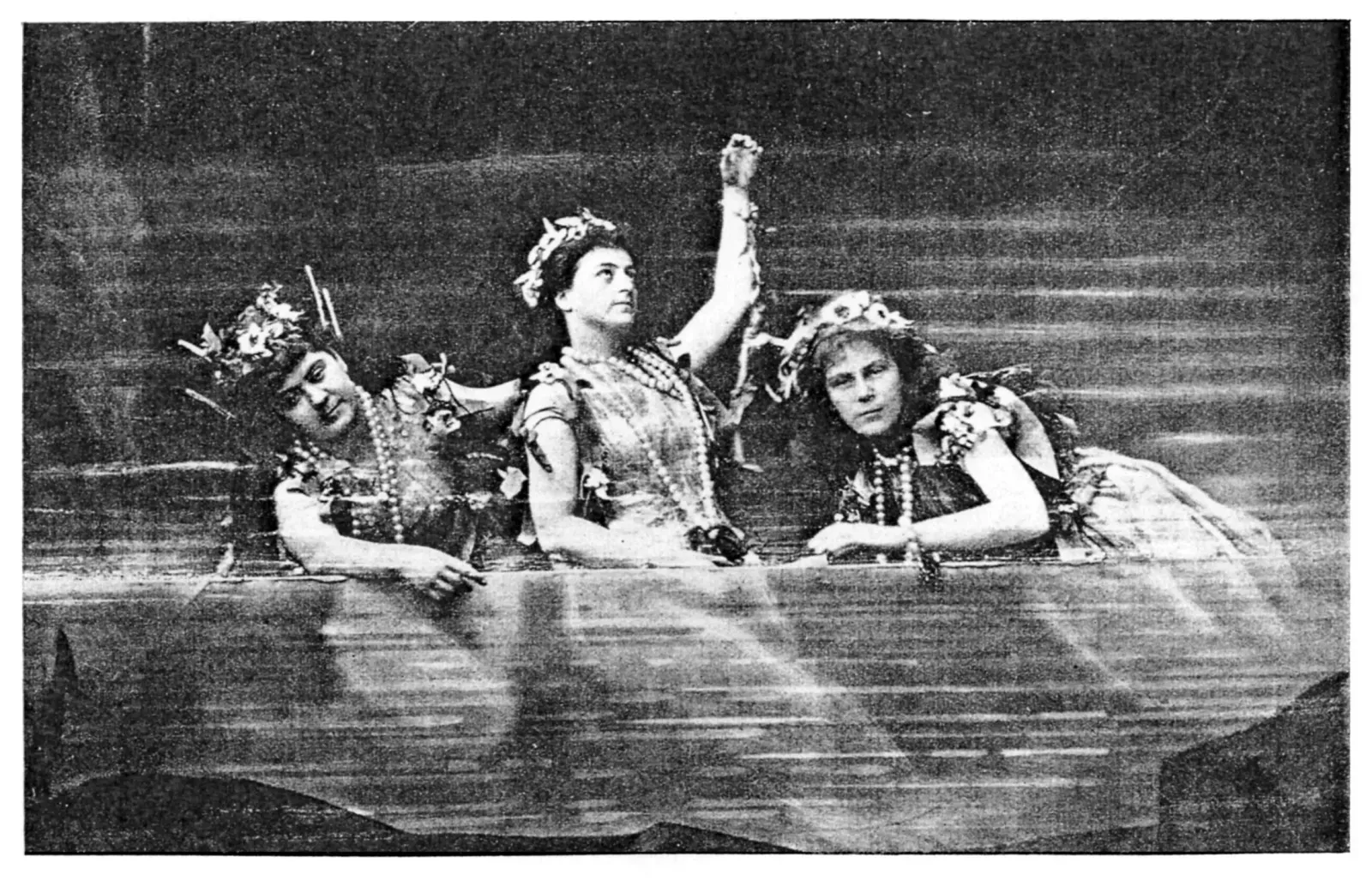
On 13 August 1876, in a purpose-built theatre on a hill above a small Bavarian town, Richard Wagner finally got what he had been demanding in print since 1851: a specially-appointed festival, an audience that had come for no other purpose, and four nights in which to unfold a myth of his own assembly. The first of those nights was Das Rheingold, the “preliminary evening” to Der Ring des Nibelungen. Kaiser Wilhelm I was in the house. So was Emperor Pedro II of Brazil, Franz Liszt, Anton Bruckner, Edvard Grieg, Camille Saint-Saëns, Charles Gounod, and Pyotr Tchaikovsky, who later described his stay in overcrowded Bayreuth as a “struggle for existence.” King Ludwig II of Bavaria, who had paid for the building when every other patron failed, attended the dress rehearsals in disguise and left before opening night rather than share a town with the Kaiser. Wagner himself had spent the preceding months as director, coach, stage manager, and prompter. Hans Richter conducted. Of the Munich cast that had sung Rheingold seven years earlier, against Wagner’s wishes, only Heinrich Vogl returned, as Loge.
The evening did not go as the Gesamtkunstwerk - the “total work of art” - was supposed to go. A backdrop rose too soon and showed the stagehands. Franz Betz, singing Wotan, mislaid the ring and had to hunt for it offstage. The gas lighting failed more than once. Critics wrote about the machinery. They wrote less about the fact that the Rhinemaidens’ swimming apparatus actually worked, and that the singing pleased even Wagner, who was otherwise in despair and refused to come out for a bow. The remaining three evenings - Die Walküre, Siegfried, Götterdämmerung - ran through 17 August. Artistically, Tchaikovsky thought something had happened that grandchildren would still remember. Financially, the festival was a wreck. Wagner cancelled the next year, went to London to conduct his way out of the deficit, and did not live to see Bayreuth become a paying concern. He died in Venice in 1883. His widow Cosima kept the productions frozen as Papa had done them, and the green hill became a shrine.
It had taken him twenty-six years to get there. In 1848, after finishing Lohengrin, he sketched a drama about Siegfried’s death, drawing on the Poetic and Prose Eddas, the Völsunga saga, and the Nibelungenlied, that twelfth-century German poem the Romantics had decided was a national epic. Then he wrote backwards. Siegfried’s Death needed a youth; the youth needed parents; the parents needed a world already poisoned by a stolen hoard. The libretti were finished by 1852, in reverse narrative order. The music was composed in the order of the story, starting with Rheingold in November 1853 - Wagner later claimed the E-flat prelude came to him as a half-dream of sinking water in Spezia - and pausing for twelve years after Act II of Siegfried while he wrote Tristan und Isolde and Die Meistersinger. Ludwig II, who owned the copyright, forced Munich premieres of Rheingold in 1869 and Die Walküre in 1870. Wagner wanted the cycle whole, in a house designed around a hidden orchestra pit and a darkened auditorium, so that a singer could be heard at natural volume against an orchestra that included Wagner tubas, a bass trumpet, and, in Rheingold, eighteen offstage anvils. Bayreuth was the instrument. The Ring was the piece it existed to play.
The plot, stripped of leitmotifs, is a story about power and the people who think they can hold it. Alberich the Nibelung, mocked by the Rhinemaidens, renounces love, steals their gold, and forges a ring that rules the world. Wotan, whose authority is the treaties carved on his spear, cheats Alberich out of the ring to pay the giants who built Valhalla, then spends the next three evenings trying to undo the theft without breaking the contracts that make him a god. He fails. Siegfried wins the ring and does not understand it. Hagen, Alberich’s son, murders him for it. Brünnhilde returns it to the Rhine and rides into the fire. The gods burn. George Bernard Shaw, in The Perfect Wagnerite, read all this as a socialist assault on industrial capitalism. Jungians later read it as a map of the psyche. Directors have set it in a hydroelectric dam, a Mafia boardroom, and the American West. Patrice Chéreau’s 1976 Bayreuth centenary production was booed like a riot; by 1980 it received an ovation that lasted the better part of an hour. The work absorbs the interpretations because it was built to. Wagner called the recurring musical ideas “guides-to-feeling,” not labels. They tell you what the characters will not say. That is why a fifteen-hour tetralogy, with almost no choruses and no arias in the Italian sense, still functions as drama rather than as a lecture with brass.
Wagner’s politics are another matter, and they were never a secret. He had been a revolutionary in Dresden in 1849, then a German nationalist, then the author of Das Judenthum in der Musik, an antisemitic essay first published under a pseudonym in 1850 and reissued under his own name in 1869, the year Ludwig forced Rheingold onto the Munich stage. The Bayreuth circle after his death made the shrine narrower. Cosima’s festival years folded the work into a cult of German purity. Winifred Wagner, who ran the house from 1930, was a friend of Adolf Hitler; under the Third Reich the festival became a state ritual, complete with wounded soldiers marched in as “guests of the Führer” and lectured on the Master before the curtain rose. Hitler’s taste does not make the Ring a Nazi opera any more than Napoleon’s taste makes Ossian a marching song, but it made the association stick, and the association is deserved in one direction: Wagner’s prose supplied later monsters with a vocabulary they were only too happy to use. After the war, his grandson Wieland stripped the stagings to light and a disc, trying to salvage the dramas from the Teutonic furniture. The arguments have not stopped. They will not stop.
They have also not emptied the theatres. A complete Ring is still the most expensive, most exhausting thing an opera house can attempt - Anthony Freud called it the high-water mark of the form - and houses keep attempting it. Bayreuth sells on the order of 58,000 tickets against a demand an order of magnitude larger; people wait years. New cycles appear in Chicago, Seattle, Melbourne, St Petersburg, Copenhagen. Recordings multiply. The controversies around the maker are taught in the programme notes now, which is as it should be. They have not made the E-flat of the Rhine, or the Ride, or the Immolation Scene, any less magnetic. Art this large is not a character reference. It is a machine for putting gods, dwarves, and human beings on the same stage and letting a curse work itself out over four nights. Wagner wanted spectators who had gathered expressly to learn his purpose. They are still gathering. They are not, on the whole, gathering for his pamphlets. On 13 August 1876, a man who could not stop himself came out of the water with a ring. The man has been out of fashion for a long time. The ring has not.