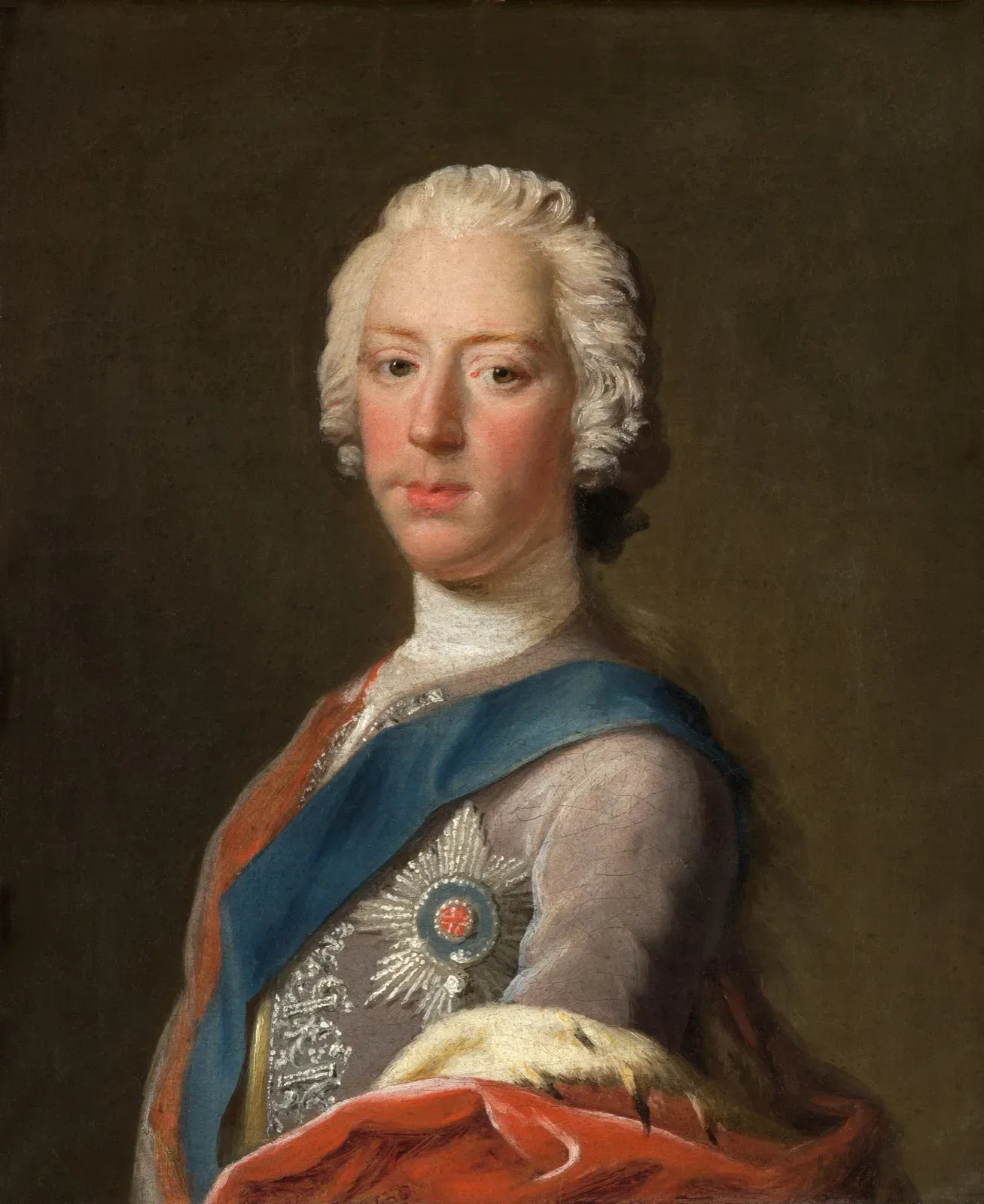
On the morning of 19 August 1745, at the damp northern head of Loch Shiel, a twenty-four-year-old Italian prince waited inside a lonely stone bothy to see whether anyone was going to show up for his revolution. He had arrived in Scotland three weeks earlier aboard a French privateer with seven companions, zero French troops, an empty war chest, and a supply of muskets so pathetic that the first Scottish clan chiefs he met told him to turn around and sail back to the Continent. For hours that morning, the heather at Glenfinnan was dead silent. The Prince paced the dirt floor, staring out across the grey water, terrified that his great imperial gamble was about to collapse into farcical humiliation.
Then, around two in the afternoon, the drone of bagpipes echoed down the mountain pass. Donald Cameron of Lochiel marched into the glen at the head of seven or eight hundred clan infantry, followed shortly by three hundred MacDonalds of Keppoch. William Murray, the Marquess of Tullibardine - an exiled nobleman so crippled by gout that two retainers had to hold him upright - unfurled a banner of red, white, and blue silk into the Highland drizzle. A proclamation was read declaring Charles’s father King James VIII and III, Charles himself Prince Regent, and all British soldiers under the Hanoverian crown traitors to their rightful sovereign. The Second Jacobite Rebellion, known to history as “the ’45,” had officially begun.
Generations of Victorian kitsch, Walter Scott novels, and misty sentimental ballads have turned Glenfinnan into the opening scene of a doomed Celtic romance. We are told to picture Bonnie Prince Charlie as a radiant young liberator, rallying fiercely loyal clansmen to an ancient, noble cause against the cold machinery of the Hanoverian state. But strip away the souvenir tea towels and the melancholy refrains of The Skye Boat Song, and what actually happened at Glenfinnan was something far uglier. It was the moment an arrogant European dynastic pretender emotionally blackmailed a fragile, impoverished society into committing collective suicide for the sake of a crown that had never cared about them in the first place.
Charles Edward Stuart was not a Highlander. He was born in Rome, raised in the Palazzo Muti on a papal pension, and spoke Italian and French far better than he spoke English. He had never set foot on British soil in his life until July 1745. To Charles, Scotland was not a homeland to be defended or a culture to be preserved; it was a convenient, defenceless back door through which he could reclaim the three kingdoms his grandfather, James II, had thrown away in 1688. The French court of Louis XV had toyed with launching a full invasion the year before, but an Atlantic storm wrecked their transport fleet at Dunkirk, and French ministers lost interest. Refusing to wait for diplomatic reality to catch up with his ambition, Charles borrowed two hundred thousand livres, pawned his mother’s jewels, and sailed for Scotland on his own, convinced that his personal charisma would compel an entire kingdom to rise.
When he landed on the Hebridean island of Eriskay, the men who actually lived in the Highlands saw the madness instantly. Alexander MacDonald of Boisdale met the prince on the beach and told him flatly to go home. Charles replied with theatrical bravado: “I am come home, sir.” It was a great line for a stage play, but a catastrophic lie in the real world. When Charles reached the mainland at Moidart and summoned Donald Cameron of Lochiel, the Cameron chief arrived intending to urge the prince to abandon the venture before anyone got killed. Lochiel knew the cold arithmetic of eighteenth-century warfare: without regular French infantry, siege artillery, and reliable financial backing, challenging the British military state was an act of lunacy.
What followed in their private meeting was an exercise in pure moral coercion. When rational arguments failed to sway the chief, Charles went for the emotional jugular. He told Lochiel that he was determined to raise the royal standard anyway, and that if the Camerons chose to stay in their glens, their prince would march on with whatever rabble he could find and let the world judge Lochiel’s loyalty to the Stuart name. It was an intolerable insult to a Highland chieftain whose entire social code was built on honour and personal fealty. Lochiel broke. “No,” he famously replied, “I will share the fate of my Prince.” With that single surrender of common sense to dynastic guilt, the rest of the western clans were dragged into the fire.
For a few intoxicating months, the gamble looked like a miracle. The British government, caught flat-footed with its best regiments fighting the French in Flanders, had left Scotland defended by raw recruits under Sir John Cope. Charles swept down from the Highlands, took Edinburgh without firing a shot, and held court in Holyrood Palace. The memory of the Acts of Union was still a raw wound across Scotland, and the Stuart cause offered an easy vessel for every lingering economic grievance and national resentment. When Cope finally caught up with the Jacobites at Prestonpans on 21 September, the Highland charge - a terrifying downhill sprint through the morning mist with broadswords drawn - shattered the government lines in less than ten minutes.
By November, Charles had led his army south across the border, taking Carlisle and Manchester before pushing all the way to Derby, just 125 miles from London. In Westminster, panic took hold. King George II packed his royal yachts on the Thames, and the Bank of England faced a run on gold. To this day, romantic Jacobite partisans argue that if Charles had only pressed on from Derby, he would have taken London and put a Stuart back on the throne.
It is an absurd fantasy. The Jacobite army at Derby was a force of barely five thousand exhausted men, operating deep in hostile English territory, with zero siege guns, no supply line, and no reinforcement. The mass English Jacobite uprising that Charles had promised his commanders had failed to materialise; fewer than three hundred Englishmen joined the ranks in Manchester. The French invasion fleet sat idle across the Channel. Lord George Murray, the only competent military strategist in the Jacobite command, pointed out the obvious: three government armies, totalling over thirty thousand veteran troops, were closing in from every side. To advance was to march into an open trap.
When the clan council voted unanimously to retreat to Scotland, Charles revealed what lay behind his charming royal exterior: the petty vindictiveness of a spoiled child. He threw tantrums, accused his most devoted commanders of treason, and refused to participate in tactical meetings. On the long, miserable retreat through the winter mud, while Murray skilfully kept the army intact and beat off government cavalry, Charles sulked on horseback, taking no responsibility for the crisis he had created.
The inevitable reckoning arrived on 16 April 1746 on the bleak, waterlogged moor of Culloden. Ignoring Murray’s desperate advice to fight in broken terrain where the Highland broadsword had an advantage, Charles insisted on deploying his starving, exhausted clansmen on flat, open turf. It was the ideal shooting gallery for government artillery. The Duke of Cumberland, commanding nine thousand disciplined regulars, simply parked his cannon on the ridge and tore the Jacobite ranks apart with grapeshot and canister. When the desperate Highland charge finally came, it was decimated by disciplined rolling volleys and bayonet drills designed specifically to counter the broadsword. In less than an hour, the Jacobite army ceased to exist. Over fifteen hundred Scots lay dead or dying in the mud.
Charles Edward Stuart did not stay to share their fate. As the lines broke, the prince was bundled onto a horse and fled the field, leaving his wounded soldiers to be bayoneted where they lay by Cumberland’s troops. While the prince spent the next five months playing the romantic fugitive among the western isles - protected by impoverished crofters who refused to betray him even for the staggering £30,000 bounty on his head - the British state began the systematic dismantling of Gaelic civilisation.
The punishment was total and industrial. Cumberland earned his title of “the Butcher” by turning the Highlands into an occupied zone, burning homes, slaughtering livestock, and hanging suspected rebels from church rafters. Westminster passed the Act of Proscription in 1746, banning the bearing of arms, the playing of the bagpipes, and the wearing of tartan. The Heritable Jurisdictions Act stripped the clan chiefs of their ancient legal authority, reducing them from feudal protectors to commercial landlords. Within a generation, the chiefs discovered that sheep were more profitable than people, paving the way for the brutal clearances that emptied the glens forever.
And what became of the prince who had demanded so much devotion at Glenfinnan? Charles escaped back to France aboard a privateer, was eventually kicked out of Paris under the terms of the Treaty of Aix-la-Chapelle, and drifted across Europe. He spent the last decades of his life in Rome and Florence, a bloated, abusive alcoholic, beating his wife, complaining about his pensions, and boring dinner guests with drunken tales of the crown he had briefly touched.
When that red and white standard caught the wind above Loch Shiel on 19 August 1745, it was not the dawn of Scottish liberation; it was the prologue to an eviction notice for an entire society. Charles Edward Stuart got his romantic ballads, his face on tins of shortbread, and two centuries of tourist nostalgia. The men who answered his bagpipes in the rain got the bayonet, the gibbet, and the bitter taste of excile.