Imagine the bespectacled figure, wrapped in a white turban, his long pointed and wide black beard speckled with white, the mighty Ayatollah Ali Khamenei, sitting in front of a camera and delivering a polished eulogy to Lockheed Martin. He praises the precision of their missile systems, the reliability of their delivery platforms, the way their products keep the world “secure.” The entire performance is staged for global consumption, complete with soft lighting and carefully chosen backdrops. Such a spectacle is completely unimaginable. No matter the pressure, the inducements, or the passage of time, it will never happen - unless, of course, artificial intelligence fabricates the scene for some dystopian collage. The real Ayatollah is now buried and will never know the particular shame of serving as a public-relations prop for the arsenal of his declared enemies.
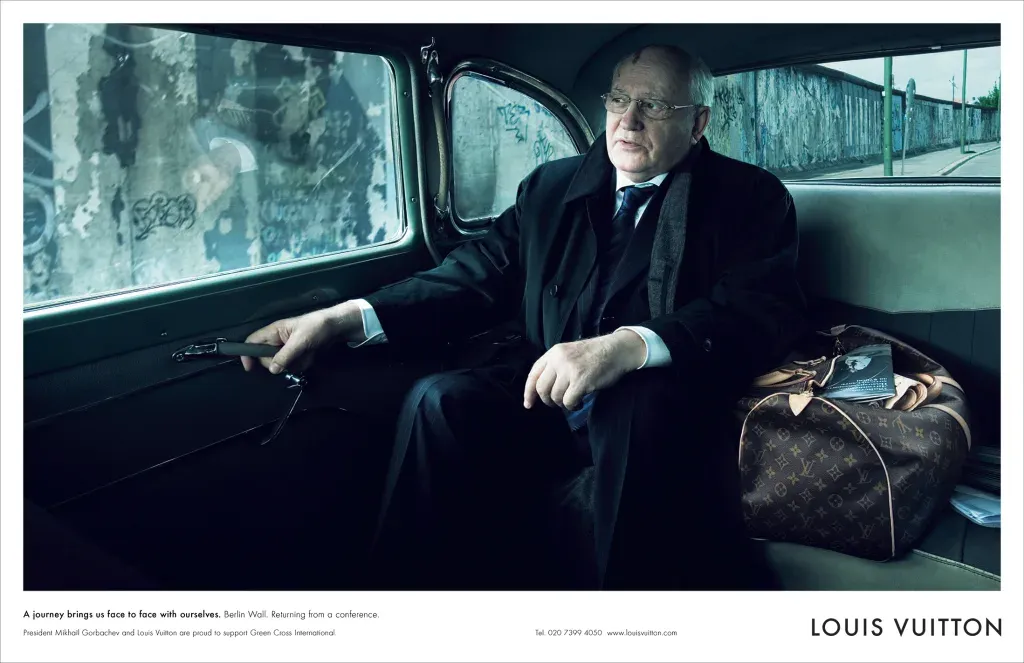
Anyone who hears this invented scene will dismiss it as overheated American capitalist imagination, the product of someone who has spent too much time reading geopolitical commentary and watching too many late-night comedies. Yet there is a real parallel, something very similar that actually happened. The ex-president, the first and the last of the USSR, Mikhail Gorbachev, took part in a promotional campaign for Louis Vuitton. There is a photograph of him sitting on the back seat of a car. Gorbachev is the very embodiment of a Sovied bureaucrat - elderly, bald, overweight, well dressed. A soft Louis Vuitton valise placed beside him, the remnant of the Berlin Wall sliding past the window. When I first saw that picture I thought it was one of the most ridiculous things I had ever encountered. Here was a man who had once commanded one of the two most powerful military and ideological machines on the planet, now reduced to the visual grammar of product placement.
This is the sort of work that defeats athletes, so-called influencers, musicians, and actors. It is expected of them; their currency is visibility and their dignity is already mortgaged to the market. Their very profession is selling out. It is not expected of a politician who once carried the gravitas of a superpower. The demeaning quality is not merely aesthetic. It is existential. A man who sat across the table from Reagan and Thatcher, who held the nuclear codes of the Soviet Union, who could order tanks into the streets of Eastern Europe or, later, choose not to, is now lending his face and his history to a luxury luggage brand. The bag is soft leather. The history is not.
To be fair, by the time the photograph was taken in 2007, Gorbachev had long been nobody in the practical sense. After he let power slip from his hands and from the hands of the Communist Party of the Soviet Union, the world moved on with remarkable speed. Since the fateful year of 1991 he and his role have been discussed almost exclusively in the past tense. The empire he once ruled dissolved into a collection of successor states, many of them chaotic, some of them resentful, few of them inclined to treat him as a living monument. He became a professional elder statesman, a foundation head, an occasional speaker, a man whose name still carried recognition but whose authority had evaporated.
Nonetheless, he had been one of the most powerful men in the world for a decisive few years. Simply out of self-respect, and out of respect for the country that no longer existed in the form he once led, he should not have debased himself so thoroughly. That is why the invented image of Khamenei is useful. The Iranians were never as powerful as the Soviet Union at its peak. Their resources were smaller, their reach more limited, their isolation more complete. And yet it remains almost impossible to imagine one of their stubborn ayatollahs consenting to anything even remotely comparable. Ideological rigidity has its costs, but it also preserves a certain stubborn dignity. The men in black turbans have not, so far, agreed to smile next to handbags while the symbols of their own historical defeats serve as scenic backdrop.
The contrast is instructive. The Soviet Union, once it collapsed - by a combination of internal exhaustion, elite betrayal, and its own reformist desires - lost its ideological backbone with astonishing speed. Many of those who had spent decades denouncing the West as the source of imperialist decay began to treat the same West as the sole repository of truth, modernity, and legitimacy. That intellectual surrender almost certainly played a role in the choices Gorbachev later made. Or perhaps the explanation is more prosaic: he needed money. His foundations required funding. Louis Vuitton, according to contemporary reports, made a donation to his environmental charity, Green Cross International. The transaction was therefore dressed in the respectable clothing of philanthropy. The photograph remained a photograph of a former superpower leader sitting next to a luxury bag against the ruins of the wall that had once defined his era.
The image will stay forever as a sign of shame and disgrace - not only for the individual but for the vanished country he once embodied. Countries do not feel shame; people do. But symbols matter. When the last general secretary of the Communist Party of the Soviet Union becomes a prop in a campaign meant to sell the “art of travel” to newly rich Russians and Chinese consumers, something deeper than personal vanity has been surrendered. The campaign itself was photographed by Annie Leibovitz and included other celebrities - Catherine Deneuve, Steffi Graf and Andre Agassi - each of them staged in carefully chosen locations that spoke of journeys and heritage. Gorbachev’s contribution was the political irony: the man who had overseen the end of the Cold War now traveling, at least photographically, past the physical remnant of that same conflict while advertising the soft goods of the victorious side’s luxury economy.
One can argue that the choice was pragmatic. Gorbachev had already appeared in a Pizza Hut commercial years earlier, an earlier and more comic exercise in post-Soviet adaptation. He was not the first fallen leader to monetize residual fame. Yet the Louis Vuitton image carries a heavier symbolic load. Pizza Hut was American fast food; the joke was obvious and almost self-aware. A Louis Vuitton bag next to the Berlin Wall is quieter and more devastating. It suggests that the entire drama of twentieth-century ideology - class struggle, historical materialism, the vanguard party, the confrontation of systems - could be folded neatly into a soft leather valise and sold as lifestyle.
The Iranian counterfactual remains useful because the Islamic Republic has not yet undergone an equivalent ideological collapse. Its ruling elite still speaks the language of resistance, still frames the United States and its allies as existential adversaries, still maintains the forms of revolutionary purity even when the substance has eroded. That purity is often ugly, frequently repressive, and strategically costly. It also makes certain forms of self-abasement unthinkable. An ayatollah promoting Western weapons systems or Western luxury goods would not merely look ridiculous; it would constitute a categorical betrayal of the regime’s foundational narrative. The Soviet case shows what becomes possible once that narrative is abandoned and the former center of power is left without a coherent story about itself.
There is a broader pattern here. Soft power does not always announce itself with tanks or sanctions. Sometimes it arrives as a donation to a charity and a request for a photograph. The former adversary is invited to participate in the aesthetics of the victor’s consumer culture. The invitation is framed as opportunity, as recognition, as a chance to support good causes. Refusal would look churlish. Acceptance looks, in retrospect, like the final quiet defeat. Gorbachev’s participation does not erase the historical significance of perestroika or the bloodless end of the Cold War in Europe. It does, however, illustrate how thoroughly the terms of dignity can change once the supporting ideology has dissolved.
Critics of this reading will say it is unfair. Gorbachev was an old man by 2007. His country no longer existed. He had every right to raise money for causes he believed in. The photograph is just a photograph. Yet symbols outlive the practical justifications offered for them. The picture of the last Soviet leader with a Louis Vuitton bag against the Berlin Wall will continue to circulate long after the charity donation has been spent and the marketing campaign forgotten. It will continue to function as a visual shorthand for the peculiar vulnerability of power that has lost its faith in itself.
The invented scene of Khamenei praising Lockheed Martin will never occur. The real scene of Gorbachev lending his presence to Louis Vuitton already has. Between the two lies the difference between a political culture that still believes its own story, however flawed, and one that no longer does. The latter is freer in many ways. It is also more available for hire. That availability is not without cost. Some prices are paid in currency. Others are paid in the residual dignity of a vanished order. The soft valise on the car seat was, in the end, never soft enough to cushion that particular fall.