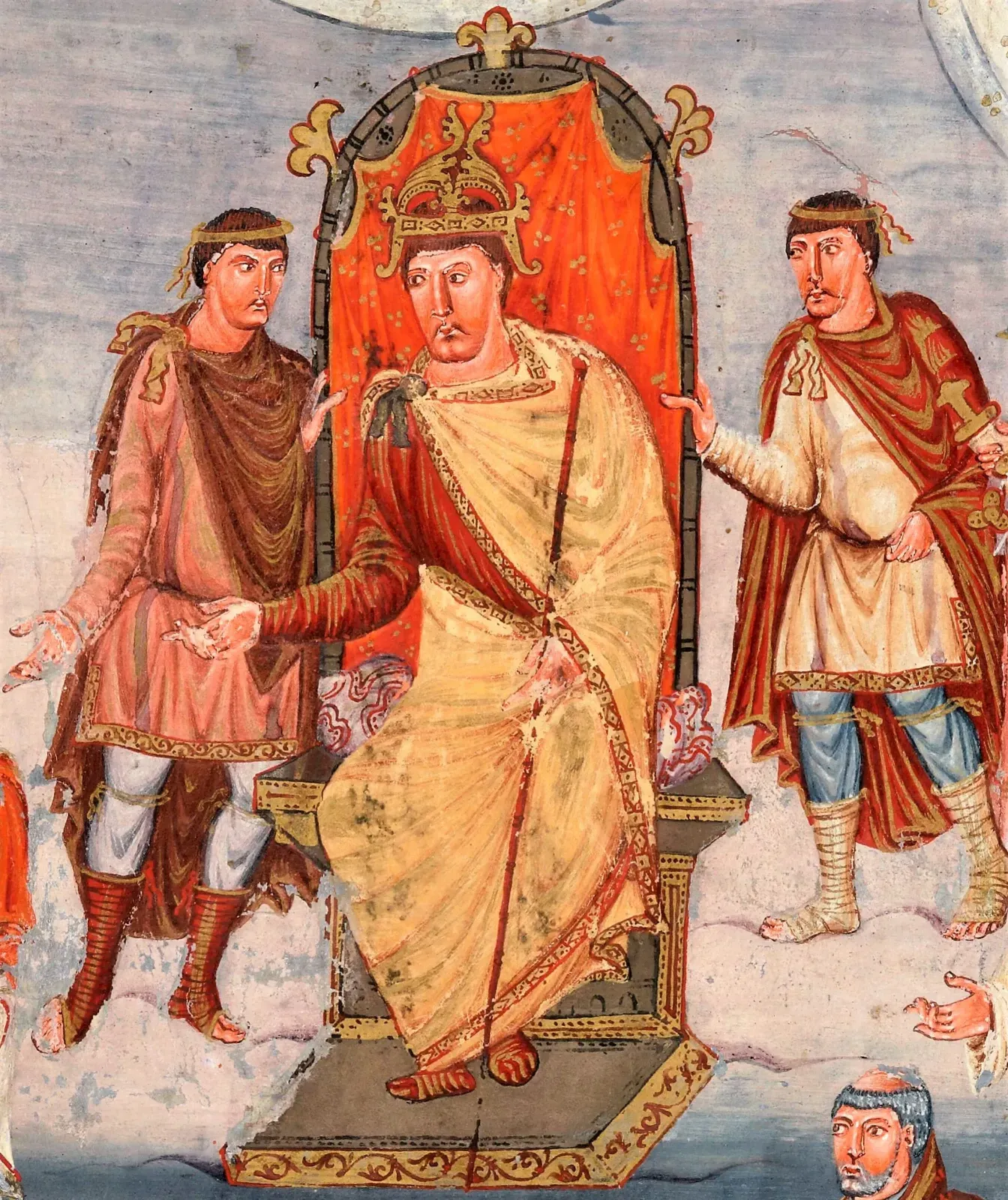
On 8 August 870, at a royal estate near Maastricht called Meerssen, two middle-aged kings finished dividing a dead man’s kingdom exactly one year after he died. The dead man was their nephew, Lothair II. The kingdom was Lotharingia, the middle strip of what had once been Charlemagne’s empire. His uncles, Louis the German and Charles the Bald, had not spent that year in respectful mourning. They had, in fact, already agreed on how to split the inheritance a full year before their nephew was even dead: the pact was struck at Metz in 868, while Lothair was still alive, still king, and presumably unaware that his uncles had already priced him out of his own kingdom.
That pact was not an isolated bit of cynicism. It was a habit. When Charles of Provence, the third of the three brothers who had inherited Middle Francia in 855, died young and epileptic in 863 without an heir, his kingdom did not pass to a son. It was split between his two surviving brothers, Louis II of Italy and Lothair II, the same way every dead Carolingian’s territory got split in this family: among whoever was left standing and close enough to claim it. Lothair picked up Lyon, Vienne, Vivarais and Uzès. Six years later it would be his turn to die, and his own uncles would apply the identical principle to him.
Lothair II died in 869 without a legitimate son. Under the ordinary logic of Carolingian succession, his kingdom should have gone to his surviving brother, Louis II of Italy, the reigning emperor. Louis had the better claim by a wide margin. He also had a war on his hands: he was in the middle of a long campaign against the Emirate of Bari, an Arab stronghold that had controlled the Adriatic port since 847 and was not going to be dislodged by a distracted emperor riding off to settle a family inheritance. Louis could not leave. His uncles could, and they did not need to be asked twice.
Charles the Bald moved first, and moved fast. Within weeks of his nephew’s death he had occupied territory and ridden to Metz, where in September 869 he had himself anointed King of Lotharingia, dressing up a land grab as a restoration of order. His half-brother Louis the German was not fooled and was not willing to be cut out. He mobilised, threatened war, and reminded Charles that they had already shaken hands on splitting the loot the previous year. Charles backed down rather than fight a war he could not be certain of winning, and the two of them sat down to work out the details.
Working out the details took eleven days. Negotiators met at Meerssen from 28 July to 8 August 870, and both sides had clearly learned something from a lifetime inside this family: they agreed in advance that each king would bring no more than four bishops, ten counsellors and thirty other retainers, so that neither side could simply overwhelm the other with numbers and call it diplomacy. By most accounts Louis, whatever his health, drove the harder bargain, and Charles ended up handing back a fair amount of the ground he had already grabbed at Metz. The deal that emerged replaced the old three-way split from the 843 Treaty of Verdun with a cleaner two-way one: Louis took the eastern portion, including Aachen, the very city where Charlemagne himself had once held court, along with Metz, Cologne, Trier and most of Frisia. Charles took the west, stretching from the mouth of the Rhine down to Toul, plus the Provençal leftovers he had already picked up from his other dead brother in 863 - a corridor that, conveniently, opened him a route towards Italy. The border between them ran roughly along the Meuse, the Ourthe, the Moselle, the Saône and the Rhône.
It is a tidy-sounding line on a map, and that is exactly the problem with it. Large stretches of the Frisian coast that the treaty so carefully assigned to Louis were, at the time, under the control of Viking forces who had been operating out of the region for two decades and answered to nobody in Aachen or Metz. The two kings spent eleven days negotiating the precise ownership of a coastline neither of them actually held. It was a partition on parchment, drawn through territory that had already partitioned itself.
None of it lasted. The arrangement held for barely six years. When Louis the German died in 876, Charles the Bald - by then also King of Italy and, since 875, Holy Roman Emperor, having raced south to claim the vacant imperial title the moment his other nephew, Louis II, finally died - decided the moment was right to grab the eastern half of Lotharingia too. He invaded and lost badly at the Battle of Andernach later that same year, beaten by Louis the Younger, his own dead brother’s son. Charles himself died the following year, and with his successors too weak to hold even West Francia together, Louis the Younger finished the job in 879 and 880. The Treaty of Ribemont handed the whole of Lotharingia to East Francia, and the careful two-way split that had taken eleven days of hard bargaining to draw up lasted exactly ten years before being erased.
Look at the pattern across those three deaths - Charles of Provence in 863, Lothair II in 869, Louis II in 875 - and one figure is present at every single one of them with a claim already drafted: Charles the Bald. He was not the most militarily capable of Charlemagne’s grandsons, and he lost the one big battle that mattered when he finally overreached. What he had instead was timing, and an apparently bottomless willingness to treat his own relatives’ deaths as opportunities rather than occasions. The Treaty of Meerssen is remembered, when it is remembered at all, as a tidy administrative footnote between Verdun and Ribemont, one more line redrawn on a map that kept getting redrawn for a thousand years afterward. It is better remembered as a family portrait. Somewhere in southern Italy, an emperor who had actually deserved that inheritance was still busy fighting the wrong war, and back home, his uncles had already spent it.