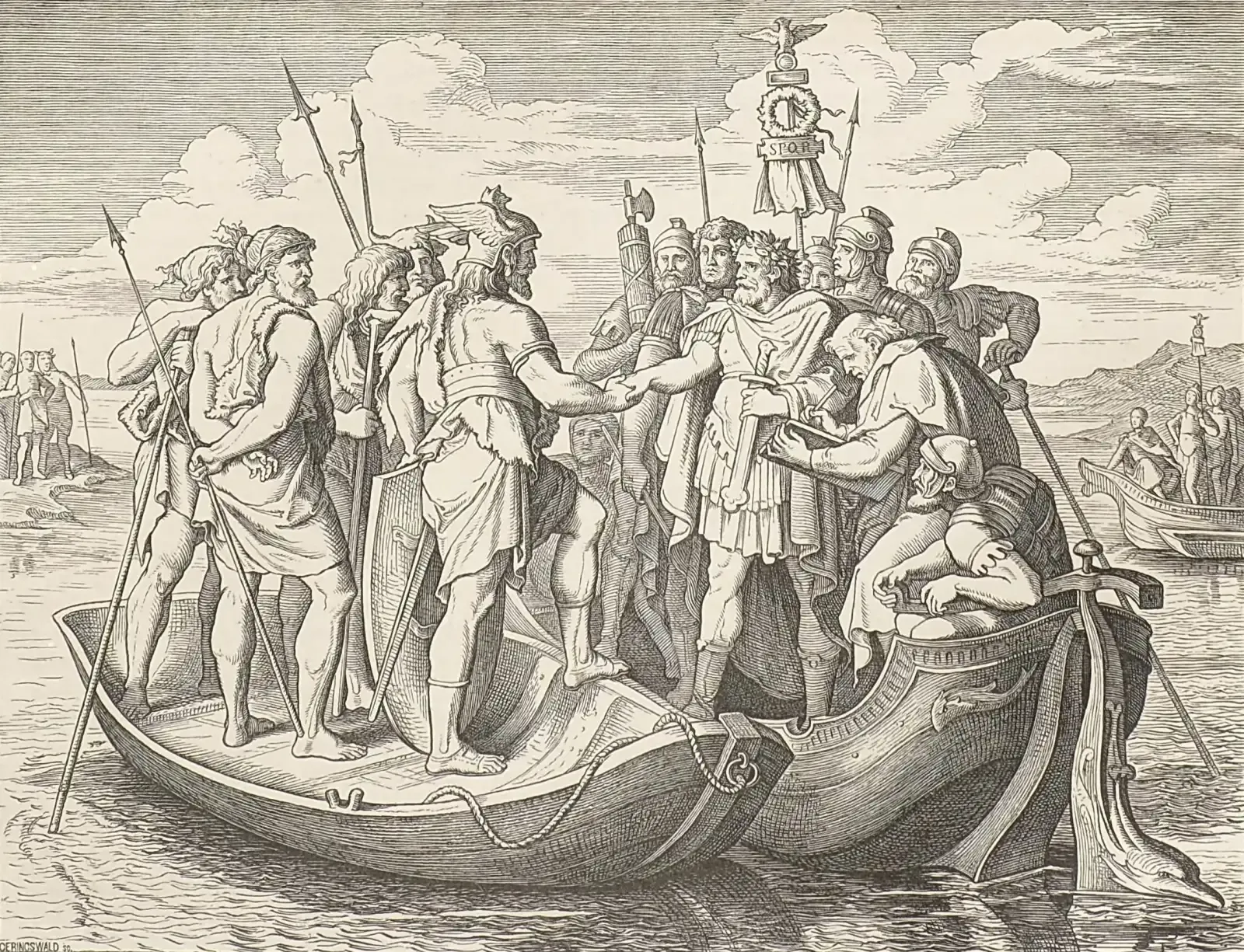
Valens’s body was never found. Wounded by an arrow at Adrianople on 9 August 378, the Eastern Roman emperor was carried into a farmhouse near the battlefield. The Goths who found it, unaware or uncaring that the ruler of half the Roman world was barricaded inside, burned it to the ground rather than force the door. No corpse was ever pulled from the ashes and identified. A man who had commanded tens of thousands of soldiers ended up with no funeral, no tomb, and no confirmed cause of death beyond “somewhere in that fire.” It is the right image for a disaster whose real causes have almost nothing to do with the swords swung on the day itself.
Three years earlier, that outcome would have looked absurd to anyone paying attention. Rome’s problem in 375 wasn’t an invasion. It was a refugee crisis. Hunnic horsemen, riding out of the steppe for reasons historians still argue about, had smashed the Greuthungi Goths east of the Dniester and were pressing hard on the Tervingi Goths further west. Tens of thousands of Tervingi, led by a chieftain named Fritigern, arrived at the Danube in 376 and asked Valens for asylum inside the empire. He said yes, not out of generosity but arithmetic: Valens was fighting Persia on his eastern frontier and wanted the manpower and tax revenue a large new population promised more than he feared it as a threat. He let the Tervingi cross under supervision. He refused the Greuthungi, who crossed anyway, a few miles upstream, unsupervised and unrecorded.
Here is where Rome’s actual failure begins, and it isn’t a failure of arms. The Roman commanders responsible for processing the refugees, Lupicinus and Maximus, treated a humanitarian emergency as a captive market to be squeezed. They charged extortionate prices for food, according to the historian Ammianus Marcellinus, our only detailed contemporary source - dog meat sold at the price of a slave, in the most repeated version of the story. Starving Gothic families sold their own children to eat. When Fritigern led his people toward the frontier town of Marcianopolis looking for supplies on fairer terms, Lupicinus panicked and tried to have him murdered at a banquet meant to smooth things over. The plot failed. Fritigern escaped with a war to lead instead of a grievance to nurse, and within months the people who had crossed the Danube as refugees were an armed rebellion burning their way through the Balkans.
That war ran for two years before Valens ever reached Adrianople, and Rome spent both of them fighting a fire its own corruption had lit rather than the crisis it had actually been handed. Reinforcements from the west under Emperor Gratian were marching to join him in the summer of 378, and Valens, fresh off the Persian front and apparently unwilling to share credit for ending a war his own administrators had started, chose not to wait. His scouts underestimated the size of the Gothic force gathering near Adrianople and missed entirely that a large body of Greuthungi cavalry under the chieftains Alatheus and Saphrax was away foraging and would be back within hours. Valens marched his infantry eight miles in the August heat to meet an enemy he thought he understood, arriving hungry, thirsty, and wrong about the numbers waiting for him.
The Goths had drawn their wagons into a defensive circle on high ground and, by several accounts, were stalling for time through negotiation rather than looking for a fight, aware their cavalry hadn’t returned yet. The talks broke down - sources disagree on which side struck the first blow - and skirmishing escalated into a general engagement before either army had properly formed up. The Roman left wing pushed forward too fast, lost contact with the rest of the line, and was still trying to recover when the returning Gothic horsemen hit it from the flank. Ammianus says the cavalry came down “like a thunderbolt.” Packed shoulder to shoulder with no room to swing a sword, the Roman infantry was cut apart by riders and archers it couldn’t reach. Ammianus reached for Cannae as his point of comparison, and for a Roman historian, there was no worse defeat on record to invoke.
The Eastern field army, something like twenty-five thousand strong when it marched out that morning, lost close to two-thirds of its strength by evening, along with most of its senior commanders. Valens went down somewhere in the collapse, and the empire he ruled couldn’t produce a body to bury.
What came after mattered more than the battle itself. Rome had nothing left in the east capable of destroying the Goths outright, so Theodosius, the general Gratian promoted to clean up the wreckage, settled them inside imperial territory in 382 as foederati: allied troops under their own commanders, armed, permanently inside the border they had once tried to cross as refugees. I’ve written elsewhere about what that arrangement cost the empire once Theodosius himself was gone, but the short version is that it solved the crisis of 378 by planting the one that hit in 410, when Alaric’s Visigoths - descendants of the same people Valens had once hoped to turn into taxpayers - sacked Rome itself.
The easy shelf to file Adrianople on is “barbarians overwhelm a declining empire,” and that framing has had a fifteen-century head start on any correction. It’s also mostly wrong. The Goths who won at Adrianople weren’t an invading horde; they were a displaced population Rome had agreed to absorb, then robbed, starved, and radicalised through the greed of two officials whose names barely survive as footnotes beside Fritigern’s. The army that lost that afternoon wasn’t beaten by superior numbers or superior tactics - Ammianus’s own account makes plain that Roman scouting failed, Roman logistics failed, and a Roman emperor in a hurry to out-glory his co-ruler marched an exhausted army into a fight it didn’t need to have that day. The machine hadn’t gone soft. The men running it had. Valens paid for that with an unmarked grave inside a burned-out farmhouse, and the empire spent the better part of a century paying interest on the same mistake.