On 10 August 1519, five ships eased off their moorings at Seville and drifted down the Guadalquivir toward the Atlantic, carrying Ferdinand Magellan and roughly 270 men on what would become the first circumnavigation of the earth. Every textbook cites that date as the start of the voyage. It is a small lie. The fleet did not reach open ocean for another five weeks. It sat at Sanlúcar de Barrameda while Magellan finished loading provisions and watched for the Portuguese squadron sent to intercept him before he cleared Spanish waters. The real departure, into the Atlantic proper, came on 20 September. Nobody remembers that date, because 10 August is the one that gives the story a clean beginning. As we’ll see, cleanliness is not this story’s strong suit.
Magellan was Portuguese, which made the whole enterprise personal before it started. King Manuel I had twice refused to fund his proposed western route to the Spice Islands, so Magellan took his charts, his cosmographer Rui Faleiro, and his argument that the Moluccas fell within Spain’s half of the world under the Treaty of Tordesillas, and sold the plan to the eighteen-year-old Charles I instead. Manuel took the defection as a betrayal bordering on treason. He allegedly had Magellan’s family home in Sabrosa vandalised and sent a fleet after him once he sailed. Charles gave Magellan five ships, the title of admiral, and a crew of roughly 270 drawn from a dozen nations - Spaniards in the majority, Portuguese and Italian sailors close behind, Frenchmen, Greeks, Flemings, a German, two Irishmen, one Englishman, and Enrique, a Malay slave Magellan had brought back from an earlier posting in Asia and now needed as an interpreter.
The Atlantic crossing was the easy part, and even that produced a garroted rapist, three months anchored at Port Saint Julian waiting out the winter, and a mutiny by three of his own Spanish captains, who briefly took control of three of the five ships before Magellan clawed his command back. He had one man beheaded, another marooned on the Patagonian coast, and the rest sentenced to hard labour in chains. One ship deserted for home through the strait he was about to discover; another wrecked in a storm surveying it. Two remained by the time he reached the ocean on the far side, which he named the Pacific for its stillness compared to the Atlantic he had just fought his way across. Based on maps that understated the size of the earth by a considerable margin, Magellan expected the crossing to Asia to take three or four days. It took three months and twenty days. Around thirty men died, mostly of scurvy. Magellan himself stayed healthy throughout, reportedly living off a personal store of preserved quince he had thought to bring along - a detail that tells you rather a lot about the gap between a commander’s planning and everyone else’s suffering.
They reached the Philippines in March 1521 and, at Cebu, found a willing convert in Rajah Humabon, who accepted baptism along with roughly 2,200 of his subjects and sealed the arrangement with a blood compact. Humabon then asked Magellan to do him a favour: subdue Lapu-Lapu, the chieftain of the neighbouring island of Mactan, who had refused to pay tribute either to Humabon or, by extension, to Spain. Magellan agreed, and in doing so made the mistake that killed him. He assumed Visayan society worked the way European society worked, with a king who commanded lesser lords. It didn’t. The islands ran on a loose federation of roughly equal chiefdoms, and Lapu-Lapu answered to nobody, least of all a rival datu who happened to have been recently baptised as “Carlos” by some foreigners with muskets.
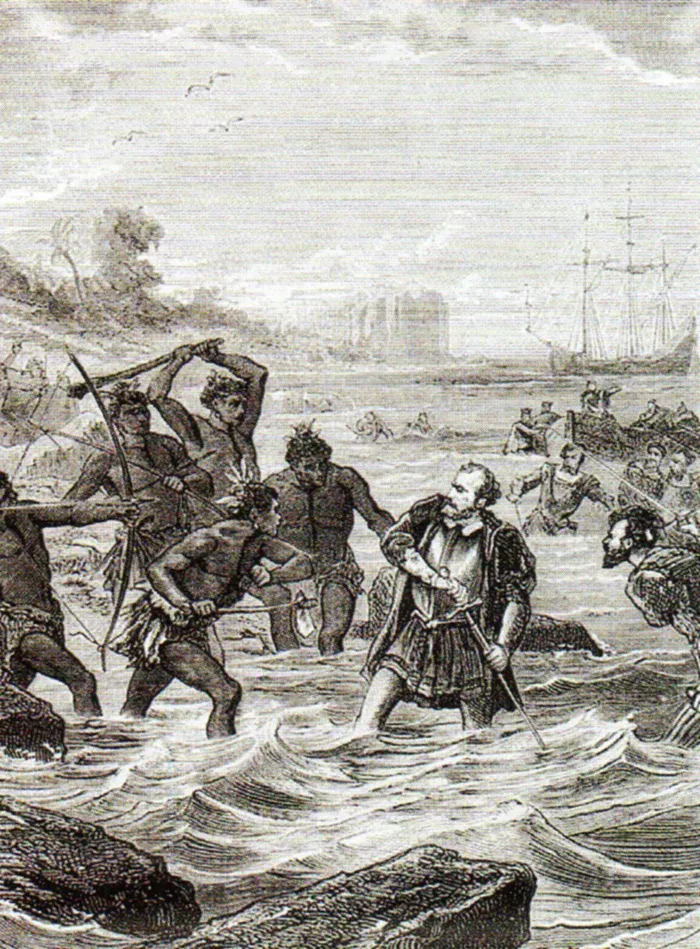
On 27 April 1521, Magellan led forty-nine armoured men ashore at Mactan, wading through the shallows because coral reefs kept his ships two crossbow-shots from the beach, while he told Humabon’s own warriors to stay in their boats and watch - he wanted them to see European steel do its work. Lapu-Lapu met him with somewhere around 1,500 men armed with kampilans, bamboo spears, and bows. The armour that was supposed to impress the Cebuanos instead slowed the Spaniards down in the surf. Magellan was hit in the leg with a poisoned arrow, recognised as the commander, and swarmed. He died on the beach he’d come to conquer on Humabon’s behalf. Lapu-Lapu refused a ransom for the body and kept it as a trophy. Of the 270 men who had left Seville, eighteen or nineteen made it home three years later, on a single ship, the Victoria, commanded not by Magellan but by Juan Sebastián Elcano - one of the very captains who had mutinied against him at Saint Julian.
Here is where the story stops being about navigation and starts being about who gets remembered for what. Magellan has a strait, an ocean, two dwarf galaxies, a Cold War submarine mission, and a NASA spacecraft named after him, despite dying two-thirds of the way through a voyage he never completed. Elcano, who actually sailed the thing home, spends the 500th anniversary sharing a joint UNESCO commemoration with Magellan because Spain wanted its own captain acknowledged and Portugal wanted its native son kept in the frame - a compromise about billing, five centuries after the fact, for a job one of them didn’t finish and the other one did. And then there is Lapu-Lapu, about whom almost nothing is reliably known. The only primary source that names him at all is Antonio Pigafetta’s account, and the historian Resil Mojares points out that no European who wrote about the battle actually saw the man, heard him speak, or could confirm he was even present - his famous defiance survives only as reported speech. That has not stopped the Philippines from building him into a fully furnished national icon: a city renamed in his honour, a statue in Manila’s Rizal Park, a face on the old one-centavo coin and a modern 5,000-peso commemorative note, a police-force seal, and since 2017 an official Lapu-Lapu Day with its own executive order specifying the correct spelling of a name nobody at the time wrote down consistently.
None of this is really an argument about who behaved better on a beach in April 1521. It’s a demonstration of how thin the connection can be between what a person did and what a country later needs a hero to look like. Magellan gets credit for a circumnavigation he was dead for a third of. Lapu-Lapu gets a biography built mostly out of absence. Even the date this whole essay opened with, 10 August, was chosen for how it reads rather than for where the ships actually were. The circumnavigation started with a minor fiction about when it began and ended with a much larger one about who deserves the statue.