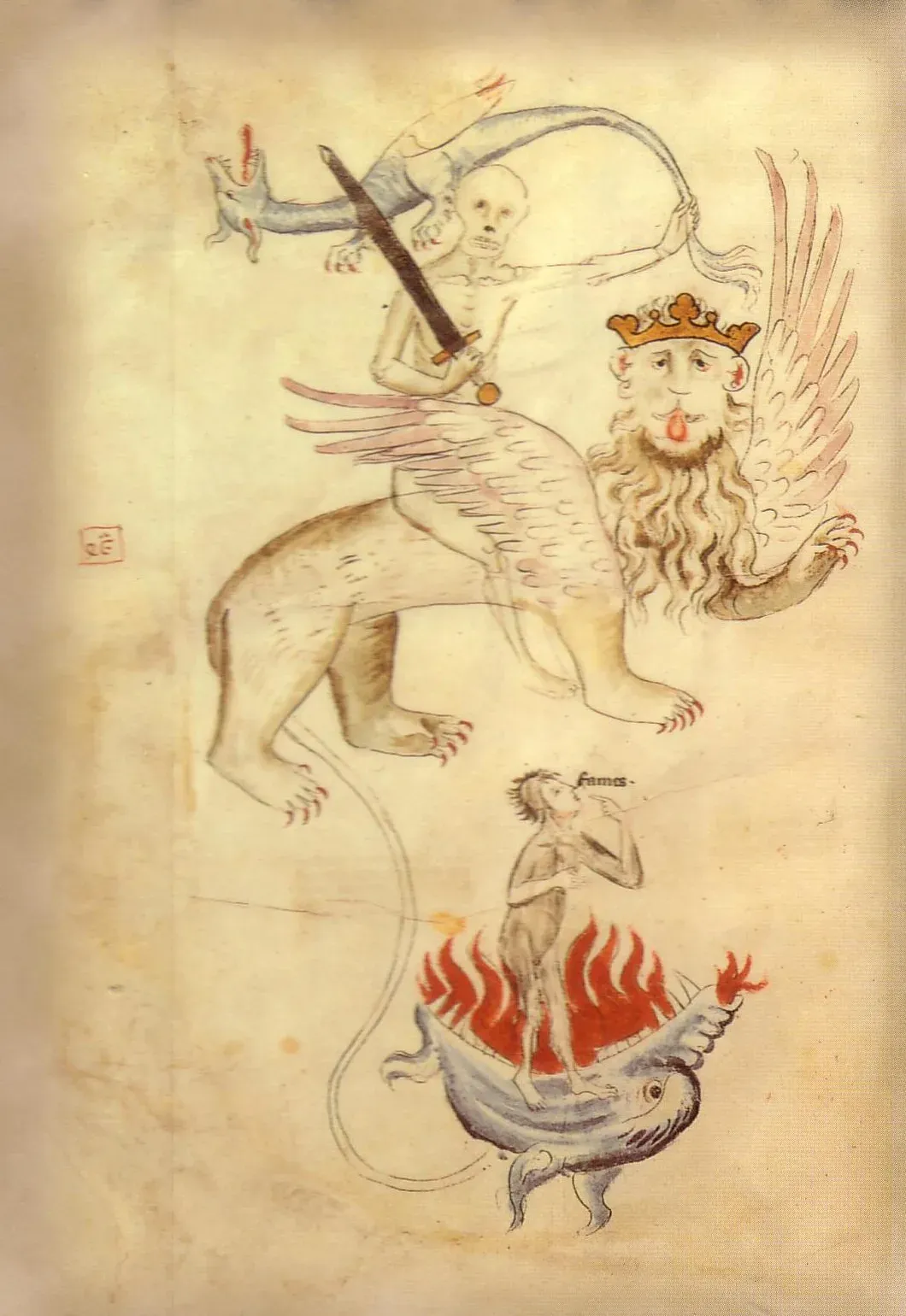
On 11 August 1315, Edward II of England stopped at St Albans on the road with his household and could not find bread. Not scarce bread, not expensive bread - no bread at all, for the king of the wealthiest kingdom in Europe and the men who rode with him. A chronicler thought it worth recording precisely because it was so unusual: an English king going hungry was not a thing that happened. It had just happened.
It happened because the rain would not stop. Beginning in the spring of 1315, an unrelenting wet settled over Northern Europe - England, northern France, the Low Countries, Germany, Scandinavia, western Poland - and it did not lift for two years. Grain could not ripen in the fields. Hay and straw could not be cured, so livestock went without fodder over the winter. Soil turned too sodden to plough. In Yorkshire, lowland fields flooded outright and fishponds on the River Foss washed away entirely. None of this was famine caused by war, or blight, or a failed empire mismanaging its granaries. It was three consecutive wet years, arriving on a continent that had no reserve capacity left to absorb them.
That lack of reserve was the trap. Europe’s population had grown for two and a half centuries, riding the Medieval Warm Period to numbers the continent would not see again in some regions until the 1800s. Wheat yields, meanwhile, had been sliding since 1280: a good harvest returned seven grains for every one planted, a bad one barely two, and one of those two had to be kept back as next year’s seed. A modern farm returns thirty or more. There was, in other words, almost no margin between “enough” and “not enough” even before the weather turned against everyone at once. When it did, the system had nothing left to give.
Prices did what prices do under absolute scarcity: they stopped behaving like prices and started behaving like extortion. English food costs doubled between spring and midsummer of 1315. Salt, without which nobody could preserve meat through the winter, could not be evaporated properly in the wet and rose by a third. In Lorraine, wheat went up 320 per cent. Grain reserves existed, but only for royalty, the Church, and the wealthy - the 95 per cent of the population who worked the land had none. People stripped forests for roots, bark, and wild grasses. Louis X marched an army into Flanders that year and had to abandon the campaign entirely, his men bogged in flooded ground, forced to burn the very provisions they could no longer carry.
What came next is the part chroniclers kept writing down long after they stopped writing down the weather. In Bristol, the city’s own annals recorded that “horse flesh and dogs flesh was accounted good meat, and some eat their own children,” and that prisoners newly thrown into jail were torn apart and eaten by inmates already there. Elsewhere, the old starved themselves deliberately so the young could keep working the fields. Families abandoned children they could no longer feed - the folk memory of that choice is still with us, wearing the names Hansel and Gretel. Graves were opened for whatever the ground had not yet claimed back. By the time the weather finally broke in the summer of 1317, something like ten to twenty-five per cent of the population in many towns was dead, and it took until 1325 for food supplies to return to something recognisable as normal. A famine among cattle followed close behind, cutting herds by as much as 80 per cent and removing draught animals, milk, and manure from a farming system that depended on all three to recover at all.
The famine did more than kill people. It broke something in how medieval society understood its own institutions. Prayer had always been the first and most trusted remedy for calamity, and prayer did nothing whatsoever against three years of continuous rain. That failure did lasting damage to the Church’s authority and gave oxygen to movements the papacy would later brand heretical. In England, the same failure attached itself to the crown. Edward II was already an unpopular king, and his subjects decided - not unreasonably - that a monarch who could not organise relief for his own starving kingdom had forfeited some of his claim to rule it. The resentment that built during those three wet years followed him for the rest of his reign and fed directly into his deposition in 1327. A famine you cannot pray away, it turns out, you can still blame on the man wearing the crown.
I keep circling back to the geography of all this, because it is the detail that should embarrass anyone tempted to treat European prosperity as a permanent fact of nature. Today, people drown in the Mediterranean and suffocate in shipping containers trying to reach Europe, because Europe is where the food is, where the wages are, where a bad harvest doesn’t end in your children going into the ground. Seven hundred years is not a long time as history measures these things - roughly twenty-five generations, nothing at all against the age of the institutions that still run the countries in question. And that recently, Europe was not the destination. It was the place people were trying to survive, where the king himself couldn’t buy a loaf of bread and thieves ate the newly imprisoned rather than starve in their cells.
None of this is an argument that misery is interchangeable across the centuries, or that today’s migrants and 1315’s peasants are living the same story. They are not. It’s a much narrower point: the wealth that makes Europe a magnet now is not an inheritance written into its soil or its people. It is a few centuries of agricultural technology, stable institutions, and - not least - weather that has mostly cooperated. Take away any one of those for three consecutive years, the way the rain took away the harvest in 1315, and the direction of the desperate crossing has no reason to stay fixed. Edward II found that out at St Albans, over a table with nothing on it. He was the King of England, and for one afternoon in August, that title bought him nothing to eat.